
Icynene Attic Insulation in North Tustin: A Homeowner’s Guide
Icynene open-cell spray foam costs roughly three to four times more per square foot than blown fiberglass, and in a standard vented North Tustin attic, it may not outperform a properly installed cellulose job. But in an unvented conditioned attic with ducts and an air handler up there, it’s often the only product that makes the physics work. This guide draws that line clearly so you can decide whether Icynene is right for your attic, or whether you’d be paying a premium for a product your roof assembly doesn’t need.
If you’d rather skip the technical deep-dive and get a straight answer for your specific house, call (877) 265-5712 and we’ll walk you through it. Estimates are free.
Key Takeaways
- Icynene open-cell spray foam makes the most sense in unvented, conditioned attics, not standard vented ones.
- Its R-3.7 per inch is lower than closed-cell foam, but that’s acceptable when the attic is brought inside the home’s thermal envelope.
- Homes with HVAC equipment in the attic – common across North Tustin – see the biggest performance gains from Icynene.
- Realistic installed cost in North Tustin runs $2.50 to $4.50 per board foot, depending on roof pitch, depth, and prep work.
- The vented vs. unvented decision has to happen before you choose a product, not after.
What Icynene Actually Is (and What It Isn’t)
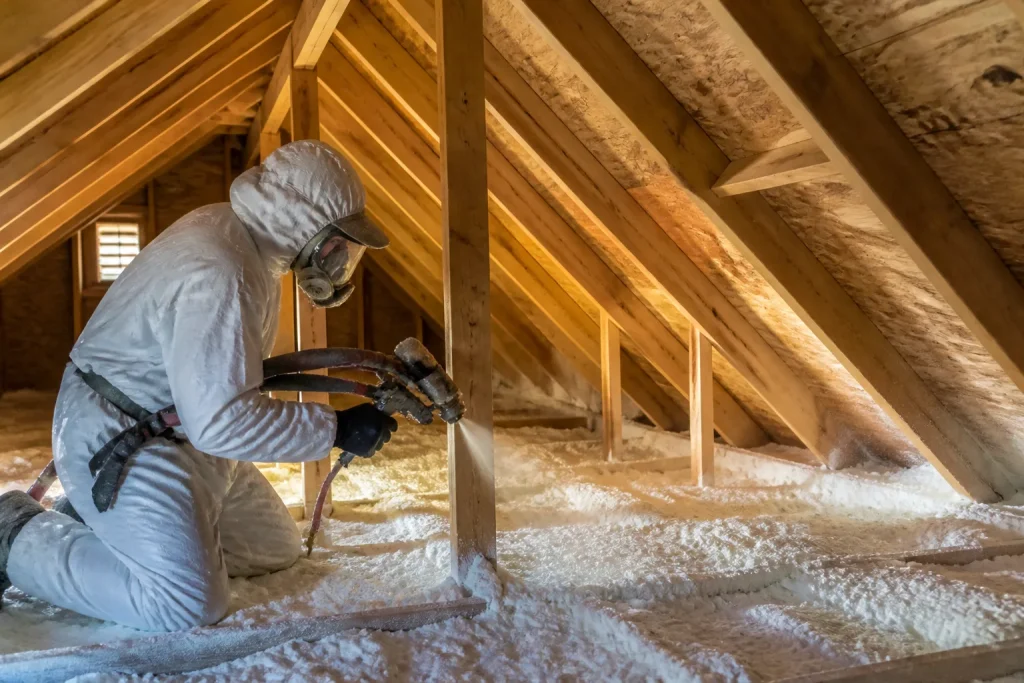
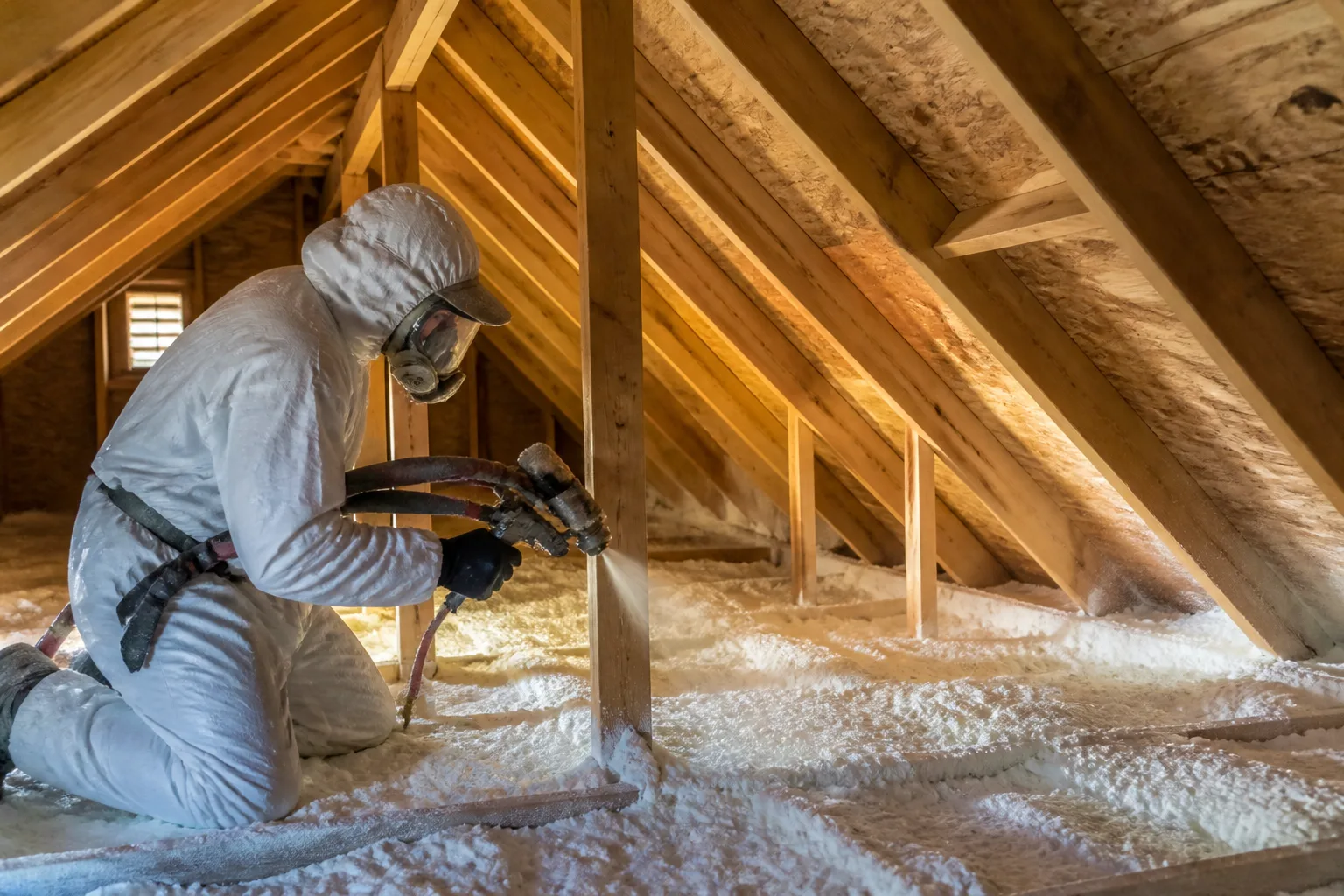
Icynene is a brand of open-cell spray foam insulation. When it’s applied, the two components hit the substrate as a liquid and expand to about 100 times their original volume within seconds, filling irregular cavities, sealing small gaps, and adhering to the underside of the roof deck. The cured foam is soft to the touch, semi-rigid, and – critically for attic applications – vapor permeable. That last part matters more than most homeowners realize.
Open-cell foam allows moisture vapor to pass through it. That sounds like a drawback until you think about how a roof assembly behaves. If a small leak develops in the roof deck or condensation forms on the underside of the sheathing, open-cell foam will let that moisture migrate and dry rather than trapping it against the wood. Trapped moisture against roof sheathing is how you get rot. Closed-cell foam, by contrast, is a vapor barrier, which means any water that gets behind it stays behind it, and you won’t know there’s a problem until the sheathing is already compromised.
We match the material to the home, not the other way around. Icynene carries an R-value of about R-3.7 per inch. That’s lower than closed-cell foam (R-6 to R-7 per inch) and lower than what some homeowners expect when they hear “spray foam.” But in the right assembly, the R-value per inch isn’t the number that drives performance. What matters is air sealing, and open-cell foam is excellent at that. A 3.5-inch Icynene layer on a roof deck stops the air movement that makes fiberglass underperform, and once the attic is inside the thermal envelope, the foam doesn’t need to carry the whole insulation load on its own.
We also carry Demilec, another leading spray foam system, for jobs where a different cell structure or application profile makes more sense. And for homeowners who want to explore mineral wool or cellulose alternatives, Rockwool and GreenFiber are in our standard lineup. North Tustin Insulation home is where you’ll find the full scope of what we install.
Vented vs. Unvented: The Decision That Comes First
The biggest mistake we see in North Tustin attics is a homeowner deciding on a material before deciding on an attic assembly. Icynene spray foam applied to the attic floor of a vented attic is usually money spent on the wrong layer. The vented attic is designed to breathe: soffit vents pull air in, ridge or gable vents let it out, and the insulation’s job is to keep the conditioned space below separate from that hot, ventilated space above. In that configuration, air sealing at the attic floor matters more than what you put on the roof deck, and a dense-packed cellulose or blown fiberglass job does the job well for a fraction of the cost.
But an unvented attic – sometimes called a conditioned attic or hot roof – changes everything. There’s no venting at the soffit or ridge. The insulation is applied directly to the underside of the roof deck, the attic becomes part of the conditioned space, and the thermal boundary of the house moves up to the roofline. That’s where Icynene open-cell foam earns its price tag. It expands into the irregular spaces between rafters and against the sheathing, creates a continuous air barrier, and its vapor permeability lets the roof assembly dry inward if it ever needs to.
North Tustin homes built in the 1960s through the early 2000s typically have vented attics. Converting one to an unvented assembly isn’t a simple material swap – it changes how the roof deck handles moisture, how the HVAC system interacts with the space, and what building code requires. We’d want to look at the existing ventilation, the roof condition, and whether any mechanical equipment lives up there before recommending Icynene as anything more than a pricey option on a vented floor.
HVAC in the Attic: The Scenario Where Icynene Shines
Walk down almost any street in North Tustin and look at the rooflines. A significant share of the homes have the air handler and a run of flex ducts sitting in the attic, above the insulation, baking in the summer heat. On a 95-degree August afternoon, that attic can hit 130 degrees or higher. The ducts are carrying 55-degree supply air through a 130-degree space, which means the system is losing cooling capacity before the air ever reaches the registers.
When you insulate the roofline with Icynene open-cell foam and seal the attic, that entire mechanical space moves inside the thermal envelope. The air handler no longer sits in a superheated box. The ducts are now running through 75 to 80-degree air instead of 130-degree air. The result isn’t just a lower electric bill – it’s a system that doesn’t have to work as hard to maintain setpoint, which extends equipment life and evens out temperatures between the upstairs and downstairs of a two-story home.
This is the application where Icynene’s lower R-value per inch stops being a liability. The attic doesn’t need R-38 at the roofline unless local code requires it; the foam’s air-sealing job is doing the real work. We’ve inspected homes in North Tustin where the ducts were sweating in the attic because the existing insulation was doing nothing to stop air movement, not just heat transfer. Insulation-only focus means we’re not also trying to sell you a new HVAC system – we’re just fixing the envelope it lives in.
If you’re comparing spray-foam options for this scenario, see Spray Foam Insulation in East La Mirada for how the same logic applies across nearby communities. The physics doesn’t care about city limits.
What a Realistic Icynene Attic Job Costs in North Tustin
Spray foam pricing is quoted per board foot, which is a square foot of coverage at one inch of thickness. The math confuses people, so here’s a straight breakdown. In the North Tustin market in 2025, Icynene open-cell runs roughly $2.50 to $4.50 per board foot installed, depending on roof pitch, access, prep work, and depth.
For a typical 1,500-square-foot attic with a straightforward roofline, a 5.5-inch open-cell application to the roof deck might run between $10,000 and $14,000. That includes:
- Prep: covering or moving any stored items, protecting access points, masking off areas that won’t be foamed
- Application: spraying the foam to the specified depth across the roof deck and gable ends
- Air sealing: foam around penetrations, top plates, and any gaps in the attic floor if needed
- Ventilation reconfiguration: sealing soffit vents and ridge vents if converting to an unvented assembly
- Cleanup and post-installation inspection
What’s negotiable: the depth of the foam in less critical areas, whether you do the prep work yourself (clearing stored items, pulling back old insulation in specific spots), and whether the job includes re-insulating the attic floor as well. What’s not negotiable: sealing the vents on a conversion job. Skip that and you’ve created a moisture trap.
For comparison, blowing R-38 cellulose on the attic floor of that same 1,500-square-foot home with proper air sealing runs $2,800 to $4,500 in North Tustin. If your attic is vented and your HVAC isn’t up there, that’s often the smarter spend. We carry GreenFiber recycled cellulose and certain fiberglass options from CertainTeed and Knauf for exactly that application. See Blown In Insulation in East La Mirada for how that method works.
Icynene vs. Closed-Cell Foam: Moisture, Structure, and Long-Term Behavior
Closed-cell spray foam like BASF Enertite (or Demilec’s closed-cell line, which we also carry) is a different animal. It’s denser, acts as a vapor barrier, and adds structural shear strength to the roof deck when applied to the underside of the sheathing. For an attic in a coastal climate, a home with a low-slope roof prone to ice damming, or a retrofit where the roof deck needs stiffening, closed-cell has a legitimate case.
But in North Tustin’s climate – dry summers, mild winters, limited freeze-thaw cycling – the vapor permeability of open-cell Icynene is arguably a feature, not a flaw. It lets the roof assembly dry. It doesn’t trap moisture. And it’s typically 40 to 50 percent cheaper per board foot than closed-cell for an equivalent R-value target. The structural contribution of closed-cell is real, but most North Tustin homes with standard plywood or OSB decking in good condition don’t need it.
Where closed-cell does win: jobs with very limited depth. If you only have 3 inches of rafter bay to work with and need the highest R-value possible in that space, closed-cell delivers roughly double the R-value per inch. But that’s a narrow scenario, and the cost differential usually tips the decision toward open-cell for roof-deck applications in our climate. A trained installer who carries both systems can give you an honest recommendation, which is why we keep Icynene and Demilec in the van rather than pushing whichever one we’re more familiar with.
For the broader attic insulation picture, Attic Insulation in East La Mirada covers the full range of methods we install.
The Bottom Line
Icynene is a great product in the right attic and a waste of money in the wrong one. The deciding question isn’t “Which insulation should I buy?” It’s “What attic assembly does my home need?” If your attic is vented, your HVAC isn’t up there, and your comfort issues are coming from a thin layer of old fiberglass on the attic floor, a dense-packed cellulose or fiberglass job will fix the problem at a third of the cost. If your attic is unvented, or you’re converting it, or you’ve got ducts and an air handler cooking in 130-degree heat, Icynene open-cell foam starts to look like the only product that actually solves the physics.
Eight brands. One contractor. The right fit for your home. If you’re in North Tustin and want a straight recommendation, North Tustin Insulation offers free estimates – call (877) 265-5712 and we’ll tell you what your attic actually needs, even if it means talking you out of the more expensive product.
Frequently Asked Questions
Icynene spray foam is worth the cost if your attic is unvented or contains HVAC equipment like an air handler and ducts. In a standard vented attic without mechanicals, a properly installed blown cellulose or fiberglass job delivers comparable comfort at roughly a third of the price. Call (877) 265-5712 for an honest assessment of which camp your home falls into.
Expect $2.50 to $4.50 per board foot installed, which puts a typical 1,500-square-foot roofline application between $10,000 and $14,000. The final number depends on roof pitch, access, prep work, and target depth. Call (877) 265-5712 for a free estimate with a line-item breakdown.
Icynene can be installed in existing homes. The process works on retrofit attics, though access and prep matter more than they do in new construction, and any conversion from vented to unvented requires sealing existing vents and verifying the roof deck is in good condition first. North Tustin Insulation handles both retrofit and new-build spray foam jobs.
No, and in North Tustin’s dry climate it’s often the better choice. Icynene’s vapor permeability lets the roof assembly dry inward, so small leaks or condensation events don’t get trapped against the sheathing. Closed-cell foam acts as a vapor barrier, which can hide moisture problems until they become structural. The key is getting the vented-vs-unvented decision right before choosing a product.
Written by the team at North Tustin Insulation, serving North Tustin since 2011.
Need Insulation Help?
Call North Tustin Insulation — licensed & insured, here with fast after-hours help in North Tustin.
(877) 265-5712