Fast, Reliable Attic Insulation Across Canyon Lake
Attic insulation in Canyon Lake runs $1,800 to $6,500 for a typical hillside home, with radiant barrier adding $700 – $1,900 and full ventilation work landing between $800 and $2,400. We work throughout the 92532 zip code, from the lakefront streets off Canyon Lake Drive South up to the hillside lots near Vacation Drive. If your AC runs nonstop through July and August, the problem usually isn’t the unit. It’s what’s happening above the ceiling. Call (877) 265-5712 and we’ll take a look.
Why North Tustin Insulation Is Canyon Lake’s Preferred Attic Insulation Company
Canyon Lake homeowners call us because we understand what the lake does to a house. Most insulation contractors in Riverside County treat every attic the same way: blow in fiberglass, collect the check, move on. That doesn’t work here. A 1970s hillside home off Canyon Lake Drive North has a different failure profile than a dry-inland tract house in Menifee. The moisture from the lake changes everything. We carry eight insulation brands across fiberglass, mineral wool, cellulose, and spray foam, so we match the material to the structure, the roof pitch, and the humidity load. Allen Decker has been clear about how we operate: diagnose first, recommend second. No one-brand squeeze.
Local response to Canyon Lake means the same day for most calls east of the 15, and next morning for appointments booked late. We know the gate procedure, we know the roads, and we know which 1960s – 1980s homes still have their original attic insulation doing almost nothing by now.
Attic Ventilation in Canyon Lake
Attic ventilation in Canyon Lake is what keeps the lake’s humidity from settling into your insulation and framing. In most of Riverside County, ventilation is about heat. Here, it’s about heat plus moisture, and that changes what we recommend. A properly vented attic in Canyon Lake needs intake at the eaves and exhaust at or near the ridge, sized to the roof deck’s square footage and the steep pitch common on hillside lots. We see plenty of homes where the original 1970s vents were painted over or never installed correctly in the first place.
Typical attic ventilation work in Canyon Lake runs $800 to $2,400 depending on roof pitch, access, and how many vents need replacing or adding.
Ridge and Soffit Vent Correction
Steep roofs on hillside lots create uneven airflow, and the ridge often runs much hotter than the eaves. We balance intake and exhaust so air moves through the entire attic, not just the center. This matters most in homes with vaulted portions where the top of the ceiling is only a few inches from the roof deck.
Moisture-Driven Ventilation Upgrades
When the lake keeps nighttime humidity elevated, an underventilated attic becomes a condensation chamber. We add venting where older Canyon Lake homes were built with none, and we do it without disturbing the roof’s structure. In homes with accessible attics above the garage or flat portions, this is usually a one-day job.
Radiant Barrier in Canyon Lake
Radiant barrier in Canyon Lake is one of the most effective upgrades for the area’s sustained 100°F+ summer sun, especially on west-facing roof slopes above Lake Elsinore. A radiant barrier reflects radiant heat away from the attic floor before it can soak into the insulation below. In a hillside home where the attic floor is directly above a living space and the roof deck gets hammered all afternoon, radiant barrier can reduce attic temperatures by 20°F or more.
Radiant barrier installation in Canyon Lake typically costs $700 to $1,900. Roof geometry matters more than square footage here, because steep pitches and irregular rafter spacing make installation more labor-intensive.
Radiant Barrier over Existing Insulation
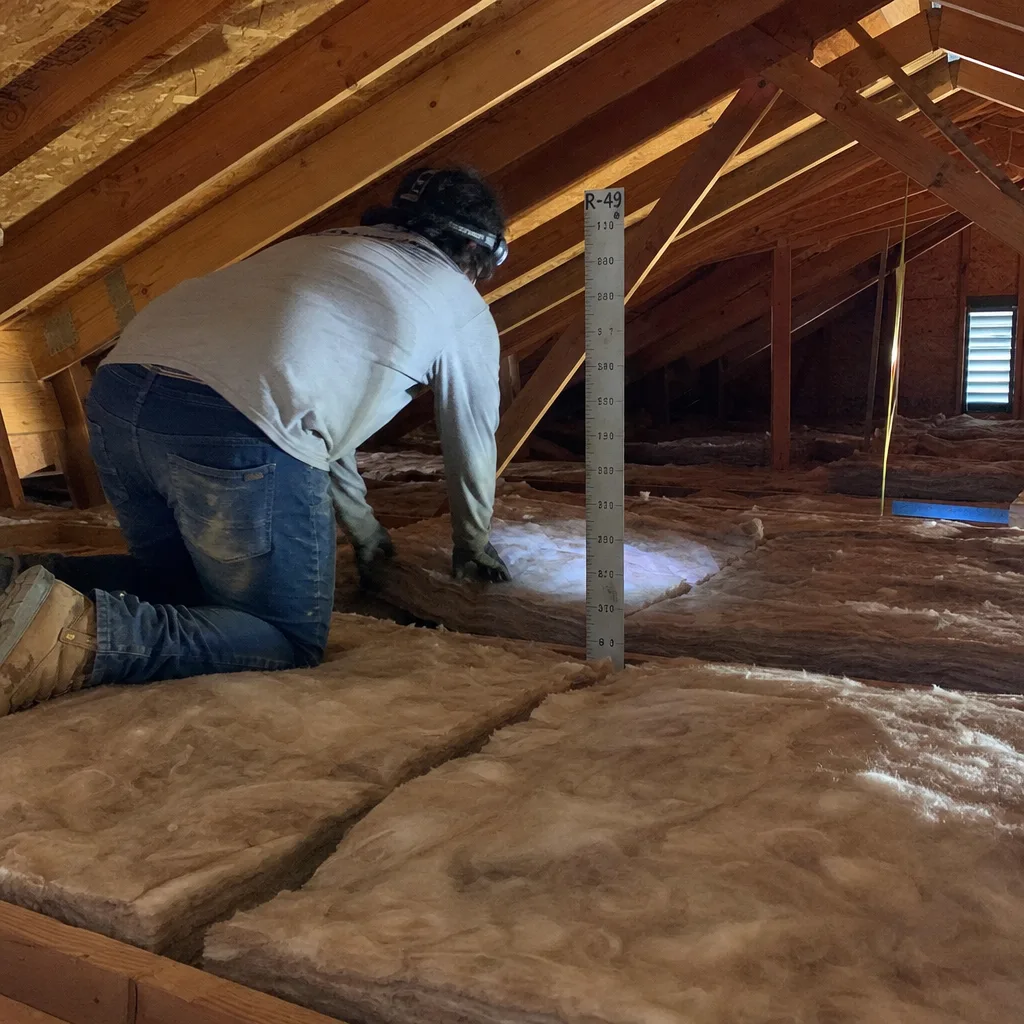
We often pair radiant barrier with an insulation top-up or replacement. The barrier handles the sun, the insulation handles the conducted heat. On a 1970s home near Holiday Harbor where we recently worked, the attic floor insulation had compressed to R-11 and the afternoon sun was pushing the attic past 140°F. After the barrier went in and new batts were tapered around the framing, the upstairs rooms finally held temperature.
Radiant Barrier with Vaulted Ceilings
Vaulted ceilings in Canyon Lake are tricky because there often isn’t enough rafter depth for a full R-38 cavity. Radiant barrier stapled to the underside of the roof deck reduces the heat load before the insulation in the shallow cavity has to do all the work. We install barrier in a way that leaves an air gap, which is the only way it actually functions.
Trusted Brands We Service in Canyon Lake
We carry Owens Corning fiberglass, GreenFiber recycled cellulose, Icynene spray foam, Demilec spray foam, Rockwool mineral wool, and more, eight brands in total. That means when we walk into a Canyon Lake attic, we’re not trying to make one material fit every situation. A lakefront home with high humidity might get Rockwool for its moisture resistance. A steep-roof hillside home with shallow rafter bays might get Icynene open-cell foam. A standard 1980s rancher off Goetz Road might get a GreenFiber blown-in fill. We keep common material stock available for Canyon Lake jobs, so we don’t have to order and wait when a small attic job needs the right product fast. Call (877) 265-5712 to get matched to the right system.
Common Attic Insulation Problems We See in Canyon Lake Homes
- Original 1960s – 1980s fiberglass batts that have sagged and compressed. Decades of lake humidity and gravity pull batts away from the drywall, dropping R-value from R-30 to R-11 or worse. The insulation is still there, but it’s not doing its job, and the AC is working against it every afternoon.
- Blown-in insulation missing the tapered eave and ridge zones on steep roofs. Most blown-in installs from the 1980s and 1990s were intended for flat attic floors. On a steep hillside roof with limited access, the installer often couldn’t reach the edges. Those gaps become hot spots and condensation points.
- Unvented attics trapping lake moisture in the insulation. Canyon Lake’s humidity works its way into attics through recessed lights, bathroom fans, and gaps around framing. When that moisture hits poorly vented attic air, it condenses inside the insulation. Mold and rot follow, and R-value drops further.
- Vaulted and exposed-beam ceilings with no cavity depth for proper insulation. Many Canyon Lake custom homes feature vaulted ceilings with exposed beams, which look great and insulate terribly. The shallow rafter bays don’t hold enough material, and the ceiling becomes a heat exchanger in summer and a condensation surface in winter.
Pricing for Attic Insulation in Canyon Lake, CA
Attic insulation in Canyon Lake runs $1,800 to $6,500 for a full replacement, with the work typically done in one day. Blown-in cellulose for a standard 1,500-square-foot ranch off Canyon Lake Drive South comes in around $1,800 to $2,800. A top-up over existing insulation runs $900 to $1,800. A steep-roof hillside home with vaulted sections and limited access runs higher, from $3,500 to $6,500, because the installer has to taper material around the roof framing rather than simply blow it flat. Radiant barrier adds $700 to $1,900, and full ventilation correction runs $800 to $2,400. Call (877) 265-5712 for an exact quote. The estimate is free and we won’t push a material you don’t need.
We Also Serve Cities Near Canyon Lake
Our Attic Insulation teams also cover Meadowbrook, Sedco Hills, Lakeland Village, and Quail Valley. If you’re in Canyon Lake or anywhere nearby and the attic’s not keeping the heat out, call (877) 265-5712. We’ll send someone who knows the area and the houses in it.
Serving Canyon Lake, CA — Our Local Coverage Area
We’re based in the Canyon Lake area and know this community well. Use the map below to see our service coverage — if you’re nearby, we can almost certainly help.
FAQs About Attic Insulation in Canyon Lake
The moisture is coming from the air, not from rain. Canyon Lake’s lake-effect humidity rises at night and works into the attic through bypasses like recessed light cans, bathroom exhaust fans, and unsealed framing. When warm, moist attic air meets cooler roof decking in the early morning, it condenses into the insulation. The fix is usually a combination of ventilation correction and replacing the damaged insulation. Call (877) 265-5712 and we’ll identify where the moisture is entering.
Yes, but not the default way. Blown-in insulation is designed for flat attic floors, not steep roof decks with exposed beams. In those homes we often use spray foam in the shallow rafter bays or manually place mineral wool batts fitted to the irregular beam spacing. The standard approach of blowing material to a uniform depth doesn’t work on a sloped deck and leaves the eaves and ridge under-insulated. That’s exactly what we avoid.
If the insulation was installed with the house and hasn’t been touched since, it’s probably degraded. Look for sagging batts, torn vapor barriers, white or gray dust from compressed fiberglass, and any dark staining from moisture. The clearest sign is the AC running continuously on a 95°F day while the upstairs rooms stay warm. If any of that sounds familiar, call (877) 265-5712. We’ll measure the actual R-value in your attic and give you a straight answer.
No. Radiant barrier in Canyon Lake handles a separate problem from humidity. It reflects radiant heat from the roof deck before that heat reaches your insulation, and the humidity doesn’t reduce its performance. The thing to watch is that radiant barrier doesn’t fix a ventilation problem. If your attic is already trapping moisture, the barrier doesn’t address that, and ventilation work or moisture-resistant insulation may be needed alongside it. We’ll tell you which pieces your home actually needs. Estimates are free.
The best approach is usually spray foam in the rafter bays when the cavity depth allows it, or mineral wool batts carefully cut and fitted when it doesn’t. Standard fiberglass batts compressed into a shallow rafter bay lose most of their R-value and still trap heat against the drywall. For homes with exposed beams where spraying is impractical, we use Rockwool for its density and moisture resistance, fitted tightly to the irregular framing. Call (877) 265-5712 and we’ll assess your specific ceiling and recommend the material that actually works.
Get Your Canyon Lake Attic Insulation Fixed Today
If your attic’s original insulation has stopped doing its job and the AC is fighting uphill every afternoon, call North Tustin Insulation at (877) 265-5712. We’ll inspect the attic, explain exactly what’s going on, and give you a written estimate with no obligation. Allen Decker and the team serve Canyon Lake and answer every call directly. Comfort is the outcome. The material is just how we get there.
Written by Allen Decker, Owner at North Tustin Insulation, serving Canyon Lake and southwest Riverside County.