
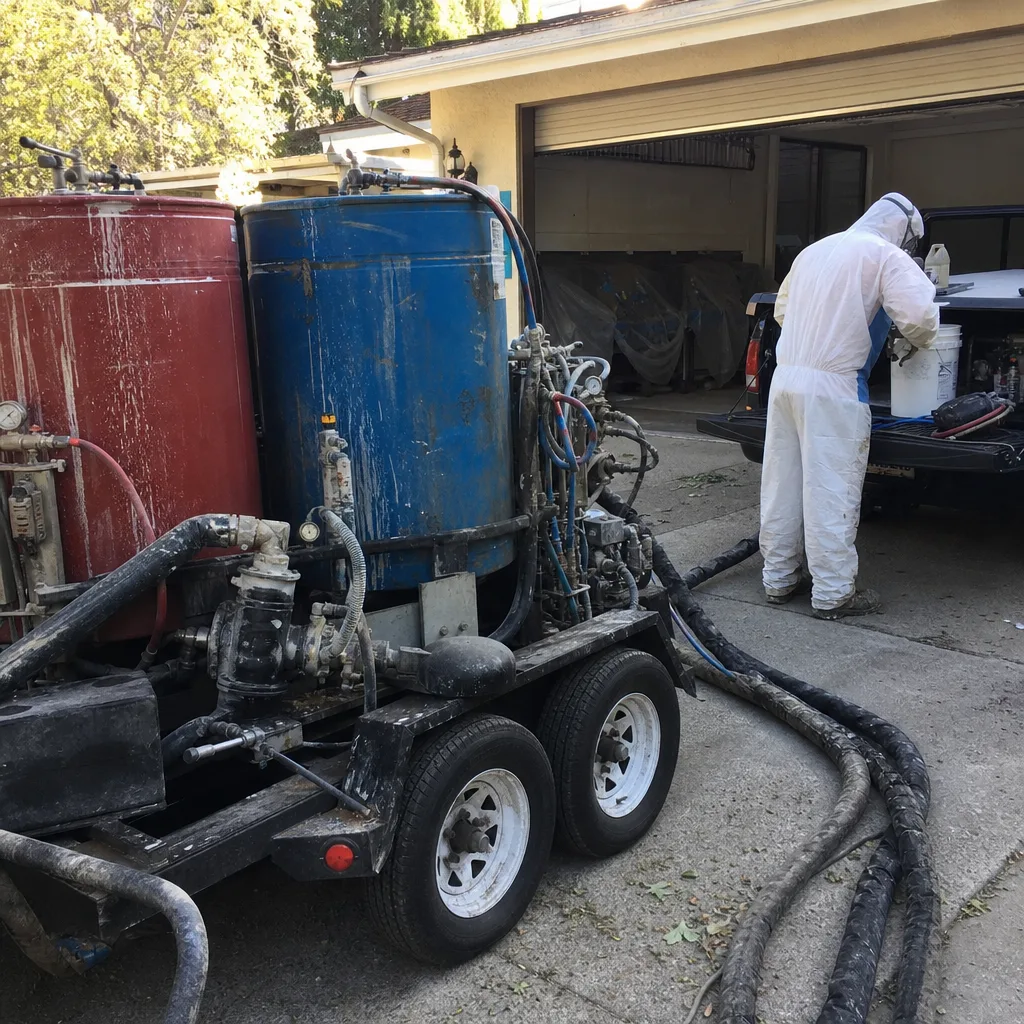
Spray Foam Insulation in Hermosa Beach: What It Costs, What Goes Wrong, and What Actually Works
Spray foam insulation in Hermosa Beach typically runs $2.50 – $6.00 per board foot depending on whether you need open-cell or closed-cell, with a standard 2-car garage lid landing between $1,900 and $3,400. That’s the direct answer. The real conversation most Hermosa Beach homeowners actually need to have is different : you’re not just insulating against temperature. You’re managing marine-layer damp, salt air, and 1920s – 1950s framing that was never designed to hold modern insulation. Call (877) 265-5712 and we’ll tell you honestly whether spray foam is the right fit for your walls, your garage, or your roof deck – not just whether it’s the most profitable install for us.
Key Takeaways:
- Closed-cell spray foam in Hermosa Beach runs $3.50 – $6.00 per board foot; open-cell runs $2.50 – $3.75.
- On this side of the 405, the marine layer makes spray foam a moisture-management job first, a thermal upgrade second.
- Our crew regularly opens Hermosa Beach bungalow walls and finds zero insulation and damp bottom plates.
- North Tustin Insulation carries both Icynene and Demilec spray foam systems, plus the vapor-control detailing that beach framing demands.
What We Routinely Find Behind Hermosa Beach Walls
Here’s a field story from the Hermosa Beach service area, and it’s one we’ve repeated enough times that it’s become shorthand on the truck. On a remodel near the Hermosa Beach Strand, our crew opened an exterior wall of a 1940s bungalow and found no insulation and visible moisture staining at the bottom plate. Not a little condensation. Actual staining, the kind that hangs around and feeds mold if you’re not deliberate about it. We removed the damp framing, applied closed-cell spray foam to the irregular cavities, and sealed the plate and penetrations with vapor-control detailing before the wall was closed. The homeowner reported the wall felt dry and draft-free through the next June Gloom cycle. That one sentence from her – “the wall finally feels dry” – matters more than any R-value we could quote.
That’s the honest reality of spray foam work in a beach town where the ocean is never more than a few blocks away and the June Gloom presses damp air against every uninsulated stud bay. Hermosa Beach is 1.4 square miles of bungalows, block after block of homes built between the 1920s and 1950s, most of them remodeled in waves. The walls don’t follow modern framing logic. The bottom plates carry marine moisture. And foam applied without vapor-control thinking can trap what it’s supposed to stop.
Why Marine-Layer Damp Changes How Spray Foam Should Be Done in Hermosa Beach
In Hermosa Beach’s 1920s – 1950s beach bungalows, the bottom plate and lower wall cavity are the first places marine-layer condensation collects. Air leaks through old sheathing, hits the cooler framing, and deposits moisture exactly where the wall sits on the foundation. That means spray foam here must be paired with a continuous vapor-control and sealing strategy rather than applied as a stand-alone thermal layer. If you skip the sealing step and just shoot foam into the cavity, you can create a vapor trap. The foam stops air, sure – but the damp that’s already cycling in from the crawlspace or through the plate gets sealed in with it. We see this on jobs where a previous contractor quoted “spray foam insulation” without ever opening the wall to check what was actually happening at the base.
This is the difference between a crew that insulates walls and a crew that understands Spray Foam Insulation as a system. The foam, the sealing, the corrosion check, the moisture barrier: they all have to work together, or you’re paying for an expensive foam job that’ll be opened up again in three years.
Closed Cell Spray Foam Insulation in Hermosa Beach
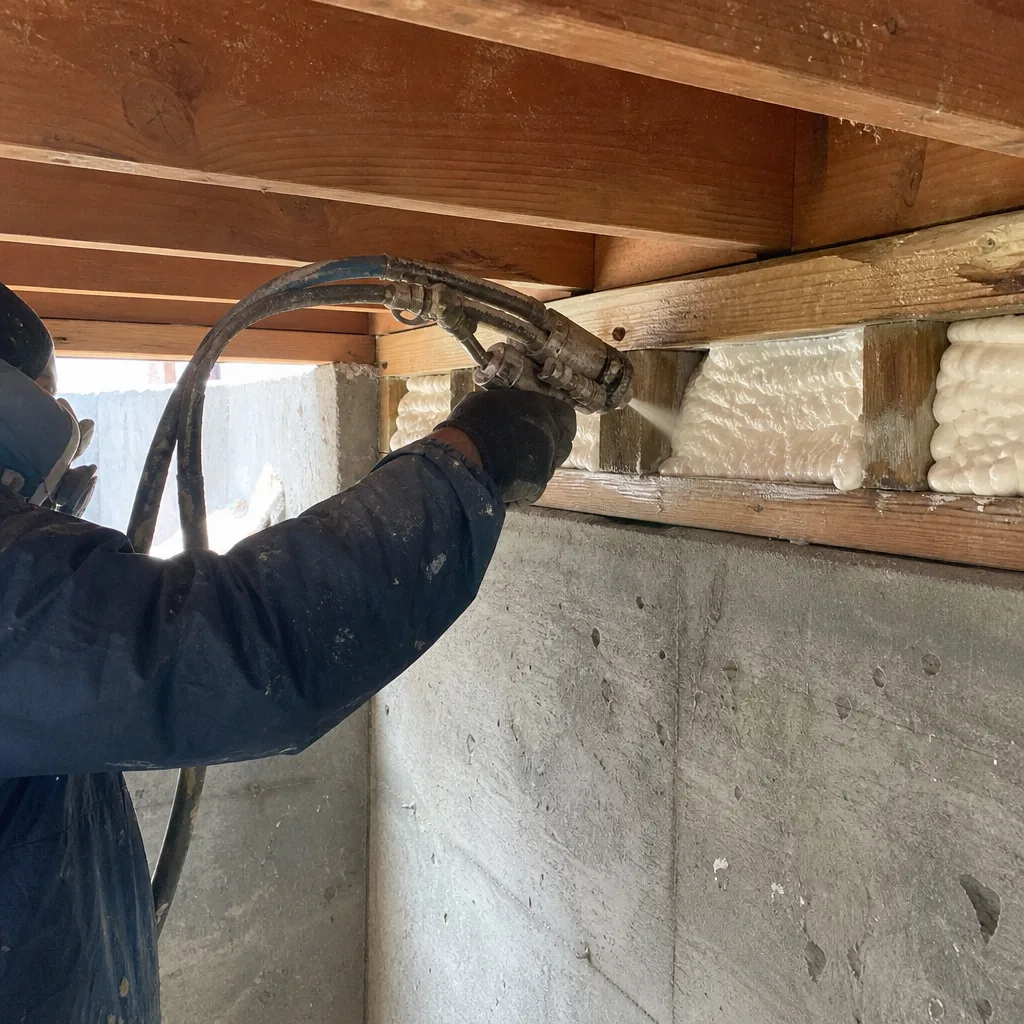
Closed Cell Spray Foam Insulation is the workhorse for Hermosa Beach wall cavities, rim joists, and roof decks because it’s dense and acts as a vapor retarder and an air seal in one shot. In a town where the air itself is wet for long stretches of the year, that dual function is why we recommend it for bungalow walls and any spot where framing meets foundation. A closed-cell rim joist job in Hermosa Beach typically runs $400 – $900 depending on access, and a full wall cavity application on a typical 1,200-square-foot beach bungalow lands in the $5,000 – $11,000 range. It’s a serious investment, and it’s the one that actually stops marine-layer damp from moving through the wall.
Why Closed-Cell Earns Its Cost on Coastal Framing
Open-cell foam is soft and breathable, which is fine in some climates. Hermosa Beach is not that climate. Closed-cell’s density – and its structural contribution to old, irregular framing – is what keeps it from becoming a sponge when the June Gloom sits over the neighborhood for a week straight. We carry Demilec closed-cell systems specifically because of how they perform on irregular mid-remodel cavities, the kind you get when a 1949 bungalow has been opened up, added onto, and re-framed three times since it was built.
When to Choose It Over Open-Cell Here
If you’re insulating a garage ceiling that separates a cold, damp crawlspace from living space, or a rim joist band that sits right at the damp plate zone, closed-cell is almost always the right call. If you’re doing a roof deck on a Strand-adjacent hillside home, closed-cell also gives you the air-sealing performance that keeps moist ocean air from cycling through the deck and into the attic. We carry Icynene for open-cell applications too, so this isn’t a one-trick recommendation – it’s about what your specific wall needs.
Garage Spray Foam Insulation in Hermosa Beach
Garage Spray Foam Insulation in Hermosa Beach usually means treating the garage ceiling (the lid between the garage and the room above, if there is one), plus the band joist around the perimeter. On a typical 2-car garage in the 90254 ZIP, a full lid and band treatment with open-cell runs $1,900 – $3,100. Closed-cell runs closer to $3,400 – $5,500. The real driver in Hermosa Beach isn’t heat – it’s the damp air that rises off a cool garage slab and meets the warmer framing above, condensing on the bottom chord of the joists. That’s where you’ll see black streaking and hardware rust, and that’s exactly where foam seals the path.
What the Job Actually Involves
We remove or access the cavity, check the framing and fasteners for salt-air corrosion, repair or replace the plate if it’s softening, then spray and seal. The foam goes in, the penetrations get vapor-control treatment, and the garage goes from damp and musty to dry and usable. On attached garages, we also treat the shared wall between garage and living space, because that’s a primary air-infiltration path in small-lot Hermosa Beach homes where the garage sits right against the kitchen or laundry room.
Salt Air and Fasteners: Why Prep Matters Here
Salt air attacks fasteners, plates, and penetrations in open framing before the foam even goes in. The exposed metal on old garage framing near the beach develops surface rust and sometimes pitting. If you spray foam over that corroded metal, the foam bonds to a failing substrate and the whole assembly degrades from the inside. On garage jobs in Hermosa Beach, we treat or replace rusted hardware as part of the prep, then foam. Skip that step and you’re building on a failing surface.
Common Problems We See in Hermosa Beach Homes
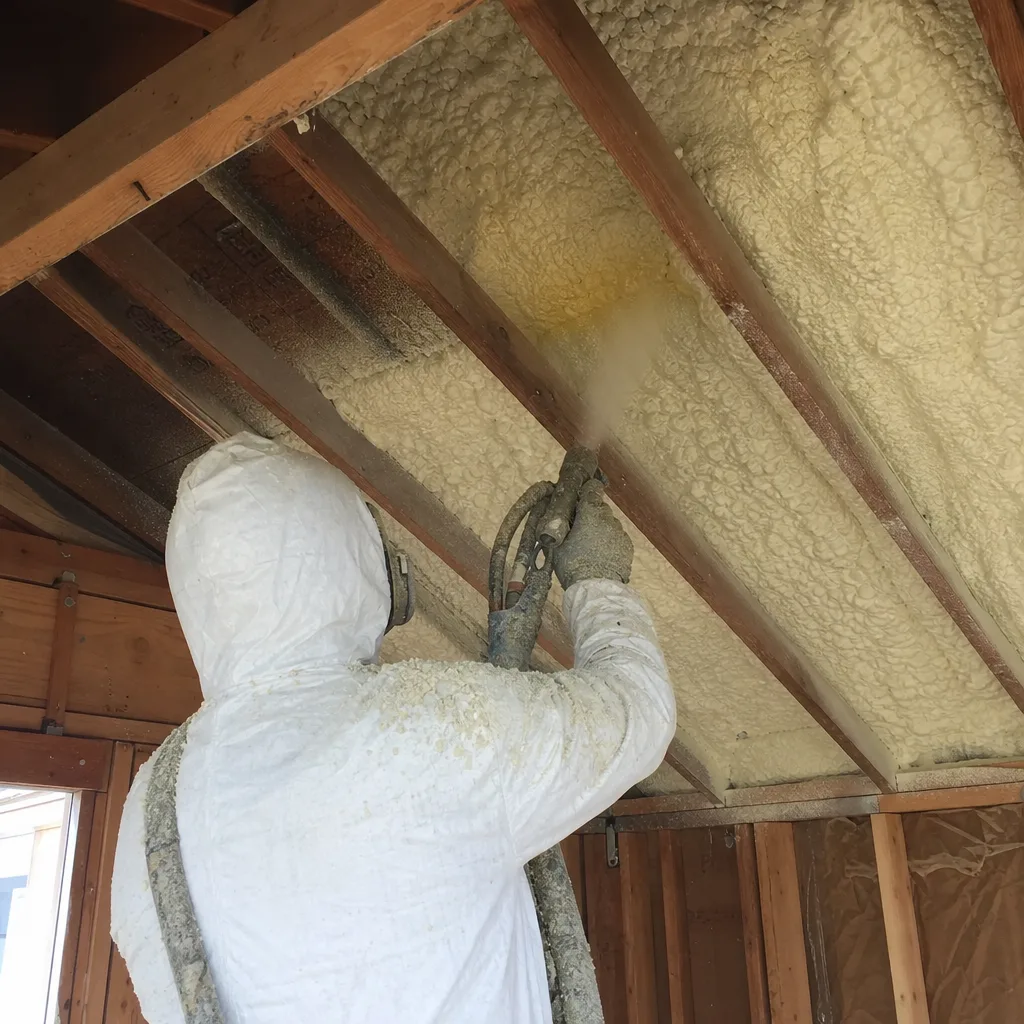
- Bottom-plate moisture pooling in uninsulated bungalow walls. Marine-layer condensation collects at the lowest point of the wall and saturates the plate. Foam without vapor-control sealing can trap that moisture and accelerate rot.
- Irregular mid-remodel wall cavities causing uneven foam thickness. Hermosa Beach’s constant rebuild cycle means walls get opened, added to, and reframed at different eras. Uneven cavity depths produce thin spots where damp air keeps migrating.
- Salt-air corrosion on fasteners and plates before installation. The same ocean breeze you love in the morning is working on your exposed framing fasteners. We treat or replace corroded metal before spraying, or the foam bonds to a failing surface.
- Uninsulated original bungalow walls from 1920s – 1950s construction. Many Hermosa Beach homes have zero insulation in exterior walls. Closed-cell spray foam is often the only practical retrofit, given the irregular cavities and the need for an integrated air seal.
What Spray Foam Insulation Costs in Hermosa Beach, CA
Open-cell spray foam in Hermosa Beach runs $2.50 – $3.75 per board foot. Closed-cell runs $3.50 – $6.00 per board foot. A rim joist treatment typically lands between $400 and $900. A garage lid on a 2-car garage runs $1,900 – $3,400 for open-cell and $3,400 – $5,500 for closed-cell. A full exterior wall retrofit on a beach bungalow starts around $5,000 and can push past $11,000 when you’re dealing with difficult access and extensive prep work: corrosion treatment, vapor-control detailing, and irregular cavity work all add labor hours. What changes your price in Hermosa Beach more than anything is what we find when we open the wall. If the bottom plate is wet, that’s prep time. If the cavities are irregular, that’s slower spraying and more trimming. Call (877) 265-5712 and we’ll walk through it with you. Estimates are free, and we don’t push a material you don’t need.
Serving Hermosa Beach, CA — Our Local Coverage Area
We’re based in the Hermosa Beach area and know this community well. Use the map below to see our service coverage — if you’re nearby, we can almost certainly help.
Trusted Brands We Install in Hermosa Beach
We’re insulation specialists first, and that’s why we carry eight nationally recognized brands across every major category. For spray foam specifically, we install Icynene and Demilec – both industry leaders for open- and closed-cell applications. For homes where spray foam isn’t the right answer, we have alternatives like GreenFiber recycled cellulose, Rockwool mineral wool, and Owens Corning or Johns Manville fiberglass. We match the material to your home, not the other way around. If a Hermosa Beach bungalow needs closed-cell on the exterior walls but blown-in cellulose in the attic, we don’t try to sell you foam everywhere. That’s the difference between a brand-pusher and an insulation contractor who’s thinking about your house.
## Frequently Asked Questions About Spray Foam Insulation in Hermosa Beach
Why does spray foam insulation matter more in Hermosa Beach than in inland cities?
Spray foam in Hermosa Beach matters because the marine layer and persistent onshore damp mean insulation here is a moisture-management and bottom-plate sealing job first, not a thermal upgrade. Inland cities insulate to stop heat; Hermosa Beach insulates to stop damp, mold, and the slow rot of uninsulated bungalow framing. That’s the whole ballgame.
What do you find when you open an exterior wall in a Hermosa Beach bungalow?
We routinely find no insulation at all and signs of marine-driven moisture at the bottom plate. The 1920s – 1950s construction was built vapor-open, and decades of June Gloom have left their mark. If you’re going to insulate, the cavity has to be evaluated for damp framing first.
Can closed-cell spray foam go into the irregular wall cavities of a mid-remodel Hermosa Beach home?
Yes, it’s actually the recommended approach for those cavities. Closed-cell foam expands to fill odd shapes and seals uneven depths better than any batt. On irregular wall cavities from multiple remodels, we spray and trim to the stud face for a continuous air and vapor barrier.
Does the salt air affect garage spray foam insulation in Hermosa Beach?
Yes, the salt air attacks the fasteners and plates in open garage framing before foam goes in. Corroded metal will degrade underneath the foam if it isn’t treated or replaced. That’s why our garage prep in Hermosa Beach includes a corrosion check.
How does spray foam help with June Gloom damp in Hermosa Beach?
Closed-cell foam stops the damp ocean air from cycling through exterior walls and condensing at the plate line. When it’s sealed correctly around the rim joist and bottom plate, the wall stays dry through the gloom cycle. It’s the only insulation method that also functions as an air seal and vapor retarder in one layer.
## We Serve All of Hermosa Beach and the Nearby Coast
From the Strand to the Greenbelt, we work throughout the 90254 ZIP and the tight residential blocks around Pier Avenue, Valley Drive, and Ardmore. We also serve Redondo Beach, Marina del Rey, Palos Verdes Estates, and Lawndale. If you’re on a steep hillside lot or a flat beach block, the access situation changes, and so does the quote. Call us first.
## Get a Straight Answer About Spray Foam in Hermosa Beach
Tell us what you’re trying to fix: a damp garage, an uncomfortable bedroom, a drafty bungalow wall. We’ll tell you what we’d do, what it costs, and whether spray foam is even the right call. Sometimes it’s not. Sometimes the right answer is Rockwool, or blown-in GreenFiber, or fixing the moisture path first. Whatever it is, you’ll hear it from an insulation specialist, not a generalist trying to upsell you. Reach us at (877) 265-5712 for a free estimate. We’re North Tustin Insulation, and we serve the South Bay coast with honest material recommendations and spray foam work that’s built for salt air, marine damp, and old beach framing.
Written by Allen Decker, Owner at North Tustin Insulation, serving Hermosa Beach and the South Bay coast.