
Spray Foam Insulation in Indio: What It Costs and Who Should Install It
Spray foam insulation in Indio typically runs $2.50 – $5.50 per board foot for open-cell and $4.00 – $8.00 per board foot for closed-cell, with most full-attic projects landing between $4,500 and $12,000 depending on square footage and foam type. The real question in Indio isn’t whether foam works. It’s whether your roof assembly can handle it in a climate where attic truss bays hit 160°F by noon. That’s the question we answer before we ever spray a drop.
At Spray Foam Insulation, we’re not a general contractor who picked up a foam rig last year. North Tustin Insulation carries both Icynene and Demilec spray foam systems, and we’ve spent enough time in Indio attics to know which foam goes where and which houses need a venting plan first. If you’re in Indio and tired of rooms that bake by 2 p.m., call us at (877) 265-5712. We’ll tell you straight whether foam is the fix or whether the problem is somewhere else entirely.
Why North Tustin Insulation Knows Indio Attics
Indio isn’t like coastal California, and spray foam decisions here don’t follow the same playbook as a foggy beach town. The houses are different, the heat load is different, and the failure modes are different. That’s why we approach every Indio project by looking at the roof first, not the foam. A 1970s single-story in 92201 with no ridge vents and a west-facing vaulted ceiling needs a completely different setup than a 2005 stucco tract home in a gated community off Avenue 50.
Our work in Indio has taught us the patterns. We see blown insulation that settled to an inch. We see can lights leaking air into 170°F attics. We see west-facing vaulted rooms that homeowners have just learned to abandon after 1 p.m. from May through October. And we see foam jobs from other contractors that made things worse because no one asked what the roof deck was built to do.
We carry eight insulation brands, but for Indio spray foam work, Icynene and Demilec are the two we reach for most. They’re different systems for different situations. We match the material to your home, not the other way around.
Closed Cell Spray Foam Insulation in Indio
Closed Cell Spray Foam Insulation in Indio is the go-to when you need a rigid air barrier that also adds structural strength and blocks moisture. It cures dense, usually around R-6.5 to R-7 per inch, which means a 3-inch application on the underside of a roof deck gives you roughly R-20 plus a full air seal. In an Indio attic that sees 160°F truss bays, that air seal matters more than the R-value alone. Heat doesn’t just radiate into a house. It moves through gaps, cracks, top plates, and can-light housings. Closed-cell foam stops all of it at once.
For Indio homeowners, closed-cell foam makes the most sense in a few specific situations. A 1990s tract home with exposed attic duct runs benefits because closed-cell seals the ducts inside conditioned space, cutting duct heat gain that open-cell wouldn’t fully address. A 1970s home in 92201 with a vaulted ceiling and a west-facing roof slope benefits because closed-cell’s density blocks the radiant heat load that turns those rooms into saunas.
What Closed Cell Foam Costs per Board Foot
A typical closed-cell spray foam attic in Indio runs $5.00 – $7.00 per board foot installed. A 1,500-square-foot attic with a roof deck application usually lands between $7,500 and $12,000. Smaller jobs, like rim joist sealing or a single vaulted ceiling, run less. Call us at (877) 265-5712 and we’ll price your specific roof rather than guessing over the phone.
Roof Deck Sealing and Vented Attics
In a vented Indio attic, closed-cell foam goes on the attic floor and the top plates, not the roof deck. That keeps the attic itself hot but sealed off from the living space. In a vaulted or unvented application, the foam goes directly to the underside of the deck. That second scenario is where 1970s-era homes need a careful look before any spraying happens. A roof deck that was never designed to dry inward can trap moisture if you seal it without a plan.
Open Cell Spray Foam in Indio
Open Cell Spray Foam in Indio is the lighter, more breathable option, usually running $2.50 – $4.50 per board foot. It expands dramatically, fills odd-shaped cavities in 1970s and 1980s framing, and does an excellent job of air sealing for the cost. At R-3.5 to R-3.8 per inch, it won’t match closed-cell’s thermal punch, but in an Indio home where the attic is properly vented and the real problem is air movement through recessed lights, wall plates, and knee walls, open-cell often gets the job done at a lower price.
Open-cell is not the right material for every Indio roof. If you’re sealing a roof deck directly, especially on a west-facing vaulted slope, open-cell won’t block the radiant heat the way closed-cell will. It’s also vapor-permeable, which means moisture can move through it. In a climate where attics bake dry all summer, that permeability works in your favor under the right venting conditions. Under the wrong ones, it doesn’t matter what foam you use. The roof assembly itself has to be right.
Open Cell for Attic Floors and Duct Sealing
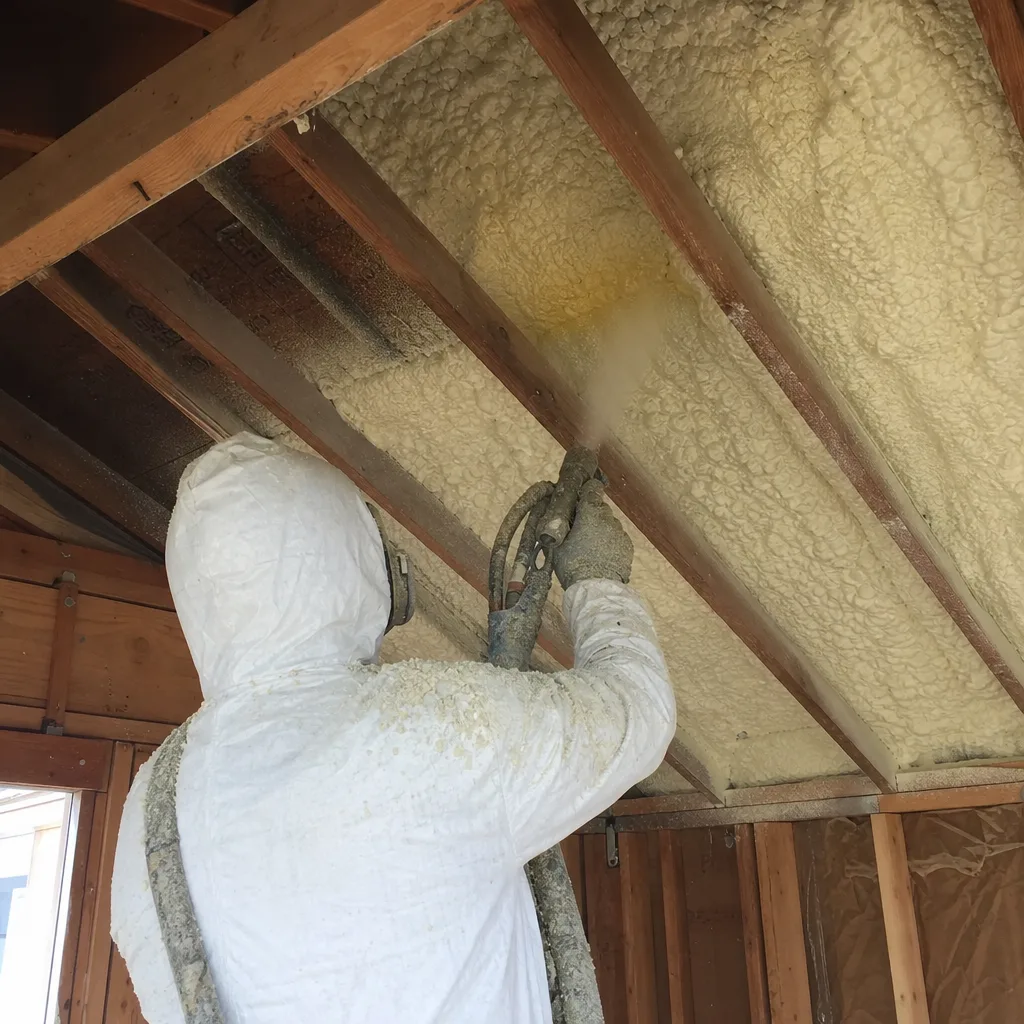
In a 1990s tract home with a vented attic and flex ducts running across the attic floor, open-cell sprayed over the attic floor plus duct boot sealing often cuts the afternoon heat gain dramatically. The foam seals the ceiling plane, stops air leakage through drywall penetrations, and keeps the 160°F attic heat from bleeding into the duct system. That’s a material and method match, not a one-brand push.
When Closed-Cell Is the Better Call
West-facing vaulted ceilings in Indio’s gated desert communities are a chronic complaint. The roof slope cooks all afternoon, the framing bays heat up, and the ceiling radiates heat down into the room no matter how much open-cell sits above it. In those cases, closed-cell foam on the underside of the deck is the stronger recommendation. It’s denser, it stops the radiant transfer, and it air-seals the assembly in one pass. We’ve pulled open-cell out of vaulted bays in La Quinta and Palm Desert where it just wasn’t dense enough to stop 170°F deck heat. The fix was closed-cell every time.
Trusted Brands We Service in Indio
For spray foam work in Indio, we rely on Icynene and Demilec, both industry leaders with a long track record in hot-climate applications, alongside our broader Reflectix service in Indio. Icynene open-cell is a workhorse for vented attics and wall cavities. Demilec closed-cell delivers the density and thermal performance that Indio’s west-facing roof decks demand. We also carry Owens Corning and GreenFiber products for blown-in and batt applications, which matters when a project calls for a hybrid approach: closed-cell on the vaulted deck, foil-faced barrier over the flat attic, blown-in over the rest. Eight brands. One contractor. The right fit for your home.
Common Spray Foam Insulation Problems We See in Indio Homes
- Closed-cell foam trapped against an unvented 1970s roof deck. Houses in 92201 were often built with no ridge vents and minimal soffit intake. Sealing a roof deck that was never designed to dry inward can trap moisture and rot the sheathing. We check venting before we spec foam.
- Thin foam in west-facing vaulted bays. A half-inch of foam in a vaulted ceiling doesn’t stop 160°F deck heat. The room stays hot, the homeowner blames the foam, and the real issue was an under-spec’d application.
- Foam over degraded duct insulation. In 1990s tract homes, attic ducts often sit in blown insulation that’s settled or been pushed aside. If the duct boots aren’t sealed and the ducts aren’t addressed, spray foam on the ceiling plane only solves half the heat gain problem.
- Ignoring the venting question entirely. We’ve inspected Indio attics where foam was sprayed wall to wall with no intake or exhaust path and no plan for moisture. That’s not insulation. That’s a future roof replacement.
Pricing for Spray Foam Insulation in Indio, CA
Let’s get specific. In Indio, open-cell spray foam generally runs $2.50 – $4.50 per board foot installed. Closed-cell runs $4.00 – $7.00 per board foot. A 1,200-square-foot vented attic with open-cell on the attic floor might run $3,000 – $5,500. The same attic done with closed-cell on the roof deck could hit $7,000 – $10,000. Vaulted ceiling work, rim joist sealing, and small garage ceiling applications fall in between depending on square footage and prep. The biggest variable in Indio is roof accessibility: homes with tight attics or steep roof pitches take longer, and labor in summer months is constrained by the early-morning work window. Call (877) 265-5712 for a free estimate on your specific house, not a generic per-square-foot guess.
We Also Serve Cities Near Indio
North Tustin Insulation serves the entire Coachella Valley. If you’re in Bermuda Dunes, La Quinta, Indian Wells, or Palm Desert, we bring the same brand lineup and the same attic-heat expertise we bring to every Spray Foam Insulation in Indio project. Different city, same 160°F summer. Call us and we’ll make the drive.
Serving Indio, CA — Our Local Coverage Area
We’re based in the Indio area and know this community well. Use the map below to see our service coverage — if you’re nearby, we can almost certainly help.
FAQs About Spray Foam Insulation in Indio
It can, but only if the venting question is answered first. In 92201 homes built in the 1970s, many attics have little or no ridge venting and barely any soffit intake. Sealing a roof deck in that house without adding ventilation or designing for an unvented assembly can trap moisture. We inspect the roof structure before recommending anything, and sometimes the right answer is venting upgrades plus blown insulation rather than foam. Call (877) 265-5712 and we’ll tell you which path fits your roof.
In most cases, yes, provided it’s closed-cell foam applied at the right thickness to the underside of the west-facing deck. A vaulted room that bakes by early afternoon is usually getting radiant heat through the roof deck, not just air leakage. Closed-cell foam at 2 to 3 inches stops that transfer. On a 1970s single-story in 92201, we found a vaulted living room with blown insulation that had settled to about an inch and a west-facing slope baking the room by early afternoon. We sprayed closed-cell on that deck, air-sealed the top plates and can lights, and the homeowner reported the room dropping out of the afternoon sauna for the first time in years.
For most 1990s tract homes with vented attics and flex ducts across the attic floor, open-cell on the attic floor plus duct boot sealing is the cost-effective answer. If the home has a vaulted ceiling or the ducts run in a hot attic space you plan to seal, closed-cell on the deck is the stronger choice. We’ll tell you which one your house actually needs, not which one we prefer to spray.
Because attic truss bays can hit 160°F by midday, and spray foam chemistry doesn’t perform the same at 120°F+ surface temperatures. Foam needs substrate temps within the manufacturer’s range to cure properly, and working in a 160°F attic isn’t just miserable, it produces a worse result. Our crews knock out Indio jobs at dawn, before the truss bays spike, then handle prep and cleanup during the heat of the day. It’s a scheduling reality every serious Indio insulation crew deals with from May through September.
No. Spray foam won’t adhere to loose blown-in insulation, and trying to spray over it creates a mess and a failed air seal. The old material gets removed or pushed aside where the foam will be applied. In some attics, we combine methods: closed-cell on the vaulted deck, existing blown insulation left in place over the flat attic sections, foil-faced barrier over the west slope. It’s a hybrid approach that fits many older Indio homes without wasting material you already paid for. Call (877) 265-5712 for a free attic inspection and we’ll map out what should stay and what should go.
Written by Allen Decker, Owner at North Tustin Insulation, serving Indio and the Coachella Valley.