
Fast, Reliable Spray Foam Insulation Across Manhattan Beach
Spray foam insulation in Manhattan Beach does something ordinary fiberglass can’t: it seals the envelope against the marine layer that rolls in most mornings, not just against heat. In a coastal city where attics and garages sit at near-condensation humidity for half the year, open-cell and closed-cell foam perform very differently, and choosing wrong means trapping moisture inside your walls instead of keeping it out. We’re North Tustin Insulation, and we carry both Icynene and Demilec spray foam systems so the recommendation you get is based on your home’s actual conditions, not the one product we happen to stock. Call (877) 265-5712 for a free estimate on spray foam work anywhere in Manhattan Beach, from the Sand Section to the Tree Section to the Hill.
Why North Tustin Insulation Is Manhattan Beach’s Preferred Spray Foam Insulation Company
Manhattan Beach homeowners don’t need a generalist who throws in insulation between roofing jobs. They need a contractor who understands what happens when salt-laden fog meets an unvented attic west of Sepulveda, or when a three-story rebuild leaves a garage at grade with living space above it. That’s what we do, all day. Our Spray Foam Insulation crews work exclusively on insulation, which means every estimate, every install, and every follow-up conversation is about one thing: making your home perform.
We carry eight brands across four material categories. For spray foam specifically, that means Icynene and Demilec, two of the industry’s most respected systems. One is open-cell, one is closed-cell, and the difference matters more in Manhattan Beach than almost anywhere else in the South Bay. We’ll tell you which one your walk-street bungalow or hillside rebuild actually needs, and why.
Allen Decker leads our team, and his approach is straightforward: match the material to the home. Not the other way around. That philosophy is why we’re the first call for Manhattan Beach homeowners who’ve already tried the low-bid route and ended up with condensation-soaked foam or corroded fasteners.
Spray Foam Wall Insulation in Manhattan Beach
Spray Foam Wall Insulation in Manhattan Beach is a different job than it is 10 miles inland. The mild coastal climate means your walls aren’t fighting extreme heat or cold as much as they’re fighting the daily moisture cycle of marine-layer fog, onshore wind, and salt air. In the older 1950s bungalows on the flats and walk streets, original insulation is often settled, missing, or never installed in the first place. In newer three-story rebuilds, wall cavities in unconditioned garage and bonus-room assemblies collect humid air that condenses on cool framing. This is why we typically specify closed-cell spray foam for Manhattan Beach wall work. Closed-cell foam creates an air seal and a moisture barrier in one step, which matters when the air itself is the problem.
Cost for spray foam wall insulation in Manhattan Beach typically runs $2.50 to $4.75 per square foot of wall area for closed-cell, and $1.60 to $3.20 per square foot for open-cell. A standard 1950s bungalow with 1,800 square feet of wall surface will land somewhere between $4,500 and $8,500 depending on access, existing insulation removal, and whether we’re working around old wiring and plumbing.
Marine-Layer Resistance
The walk streets west of Sepulveda see fog that condenses on every cool surface. Closed-cell foam stops that water vapor from reaching your framing. Open-cell foam, in the wrong assembly, lets it through. We’ll tell you which one your walls need before we quote a dollar figure.
Existing Wall Cavities
If you’re retrofit-insulating walls in a mid-century Manhattan Beach home, we’re not going to spray foam over settled, damp fiberglass and call it done. We remove the old material, inspect for hidden moisture damage, and only then apply the foam. Skipping that step is how you end up with mold behind a beautiful new spray foam job.
Rim Joist Spray Foam in Manhattan Beach
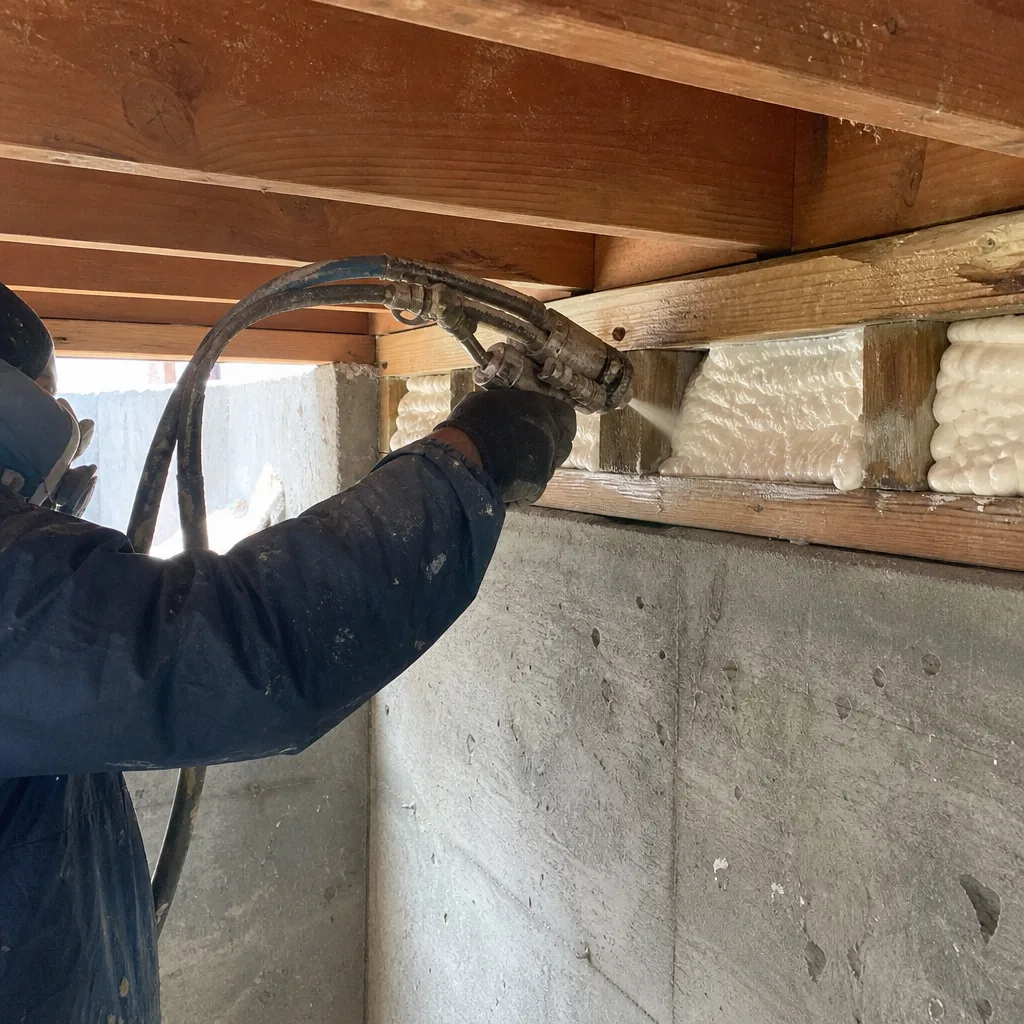
Rim Joist Spray Foam in Manhattan Beach matters more than in most South Bay cities because of where your rim joists sit. In a three-story rebuild, the garage is at grade with living space above it. The rim joist is the seam between those two zones. When salt air and damp crawlspace or garage air hit that seam, standard fiberglass or foam board leaves gaps that let moisture and air move freely. Spray foam, especially closed-cell, seals the entire rim joist band in one continuous application. For Manhattan Beach homes, this is the highest-ROI insulation job per square foot you can do.
In the walk streets and flats west of Sepulveda, we routinely find corroded fasteners and rusted metal studs in garages where the rim joist was never sealed. Salt-laden fog does damage that heat alone never will. Sealing the rim joist with closed-cell foam stops the air movement that carries salt and moisture into your framing.
Pricing for rim joist spray foam in Manhattan Beach ranges from $8 to $16 per linear foot. A typical two-car garage with 60 linear feet of rim joist runs $500 to $1,000. Crawlspace rim joists run slightly higher if access is tight and the space is wet.
Garage-to-Living-Space Transitions
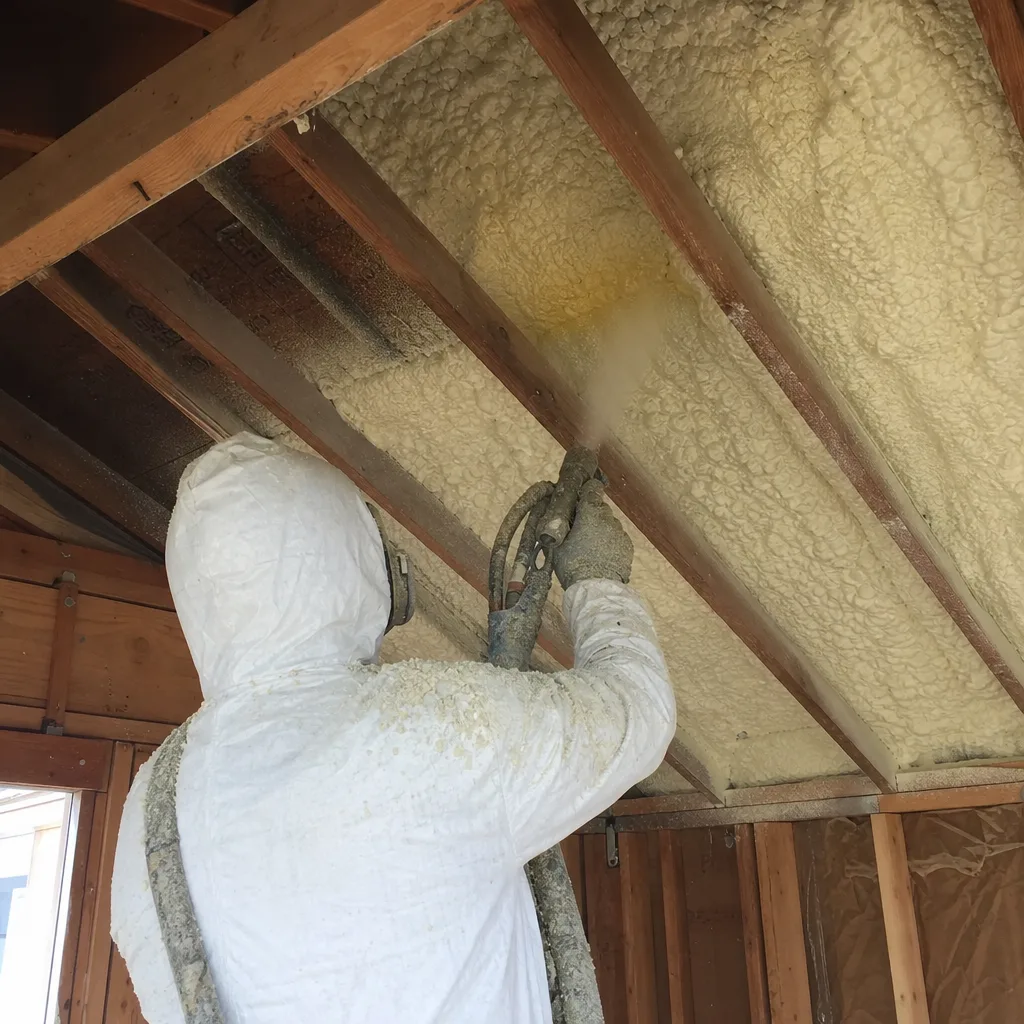
When a bonus room sits above a garage, the rim joist is the boundary between conditioned and unconditioned air. One continuous foam application seals that boundary. We’ve done this on dozens of Manhattan Beach rebuilds where the builder left it untouched.
Salt-Air Fastener Protection
We use corrosion-resistant fasteners and mesh when working in beach-adjacent garages. Standard fasteners fail quickly in salt air, and foam adhesion drops with them. The marine layer is unforgiving, and the details matter.
Trusted Brands We Service in Manhattan Beach
We’re authorized to install Icynene and Demilec spray foam systems, which means we stock the specific parts, hoses, and application equipment for both brands. For Manhattan Beach customers, that means no waiting on a special order when your job calls for a specific foam chemistry. We also carry Owens Corning and GreenFiber for homes where a hybrid approach makes sense, spray foam in the rim joists and attic, cellulose or fiberglass in the walls. Eight brands, one contractor, and the recommendation always comes from your home’s actual conditions. That’s the way it should work.
Common Spray Foam Insulation Problems We See in Manhattan Beach Homes
- Marine-layer condensation soaking open-cell foam in unvented attics west of Sepulveda. We open up these attics and find foam that’s lost R-value and started supporting mold. The fix is removal, then closed-cell foam applied to the roof deck.
- Salt-air fog corroding fasteners and metal studs in garages at grade. Three-story rebuilds with garages on the ground floor are especially vulnerable. Corroded fasteners loosen foam adhesion, and the assembly fails quietly over time.
- Settled or missing original insulation in mid-century bungalows letting damp ocean air into wall cavities. We see this in the 1950s tracts east of Sepulveda all the time. The walls look fine from the outside, and hidden moisture is doing damage behind the drywall.
- Builders leaving rim joists unsealed in newer rebuilds. It’s a cost-cutting shortcut that Manhattan Beach homeowners pay for later in cold floors, drafty bonus rooms, and moisture in the garage ceiling. The fix is closed-cell foam applied in one continuous band.
Pricing for Spray Foam Insulation in Manhattan Beach, CA
Spray foam insulation in Manhattan Beach costs more per square foot than inland South Bay cities, and there’s a reason: marine-layer moisture management requires specific foam chemistry and corrosion-resistant details that a standard Torrance or Gardena install doesn’t need. Open-cell spray foam in Manhattan Beach runs $1.60 to $3.20 per square foot. Closed-cell runs $2.50 to $4.75 per square foot. Roof deck applications run $4.00 to $7.00 per square foot. A full attic and rim joist package on a 2,000-square-foot home typically lands between $6,500 and $14,000 depending on existing insulation removal, access, and whether we’re sealing an unvented assembly or a vented one. Every estimate is free, and we give you the number before we start. Call (877) 265-5712 and we’ll walk your specific home.
We Also Serve Cities Near Manhattan Beach
We work throughout the coastal South Bay, including Redondo Beach, Rolling Hills Estates, Palos Verdes Estates, and Torrance. If you’re in one of those cities and wondering whether spray foam is right for your home, the same brand portfolio and the same material-matching approach applies. For a deeper look at our local work, see Spray Foam Insulation in Manhattan Beach and call us at (877) 265-5712.
Serving Manhattan Beach, CA — Our Local Coverage Area
We’re based in the Manhattan Beach area and know this community well. Use the map below to see our service coverage — if you’re nearby, we can almost certainly help.
FAQs About Spray Foam Insulation in Manhattan Beach
No, not when it’s specified correctly. A too-tight home becomes a moisture problem only when the foam is applied to an assembly that already has water vapor moving through it without a plan for where that moisture goes. In Manhattan Beach, the risk is real only when open-cell foam is sprayed in an unvented attic without a vapor strategy. Closed-cell foam acts as its own vapor barrier, which is why we typically specify it for roofs and rim joists west of Sepulveda. Call (877) 265-5712 for a moisture assessment before you spray anything.
Because of the salt-laden marine layer that settles into garages at grade and accelerates corrosion on any exposed metal. In Torrance or Gardena, the rim joist is a thermal weak point. In Manhattan Beach, it’s a moisture and corrosion weak point. Closed-cell spray foam seals the entire rim joist band and keeps salt air from reaching your framing, fasteners, and the underside of your living space. The fix pays for itself in longer assembly life.
Yes, in most cases the cold floors trace back to air movement through the crawlspace or rim joist area, not a lack of floor insulation per se. Sealing the rim joist band with closed-cell foam and addressing any crawlspace air leaks stops the draft that makes tile and hardwood feel like ice in the winter. We see this exact pattern in the 1950s tracts east of Sepulveda. Free estimates are available at (877) 265-5712.
Closed-cell spray foam. Vaulted ceilings in newer three-story rebuilds have limited cavity depth, and closed-cell gives you more R-value per inch while also functioning as a vapor barrier. Marine-layer moisture that would otherwise condense on the underside of the roof sheathing gets stopped at the foam. Open-cell just doesn’t perform the same job in a vaulted assembly near the beach.
We remove the failed insulation first, then apply closed-cell foam directly to the roof deck and rim joists. The existing condensation means moisture is already getting in, so sealing the assembly from the outside with an air- and vapor-impermeable foam is the repair. On a walk street near the Strand, we opened a 1950s bungalow’s unvented attic and found the original fiberglass batts soaked and sagging, with rusted staples bleeding down the rafters. After removing the saturated material, we applied closed-cell spray foam to the roof deck and rim joists, sealing out the marine-layer damp and halting the corrosion. That’s the fix for unvented attics in this city.
Manhattan Beach homes need spray foam insulation specified for marine-layer moisture and salt-air corrosion, not just R-value. If you’re in 90266 or 90267 and you want a straight answer about what your home actually needs, call Allen Decker and the North Tustin Insulation team at (877) 265-5712. Estimates are free, and we’ll tell you what we’d do if it were our own house.
Written by Allen Decker, Owner at North Tustin Insulation, serving Manhattan Beach and the coastal South Bay.