
Spray Foam Insulation in Temple City: What It Costs and Why Sequencing Matters
Spray foam insulation in Temple City costs $2.10 – $4.85 per board foot installed, putting most retrofit jobs between $1,900 and $6,400 depending on the surface area and foam type. On a typical 1950s tract home, rim joist work runs $1,400 – $2,800, crawl space encapsulation with closed-cell foam runs $3,200 – $5,800, and a full attic air-seal plus foam package runs $4,200 – $7,500. The catch in Temple City is sequencing: on these older homes, air-sealing around legacy wiring, recessed cans, and plumbing chases has to happen before any foam goes in, or you’re sealing in the very problems you’re trying to fix. Call (877) 265-5712 and we’ll walk you through what your specific tract home actually needs.
Fast, Reliable Spray Foam Insulation Across Temple City
We work in Temple City every week, and we know these blocks. The homes off Las Tunas Drive, the streets east of Temple City Park, the 91780 zip code from Cloverly Avenue down to Live Oak Avenue – they share a common DNA: single-story stucco tract houses built between 1950 and 1970, most on raised foundations with uninsulated crawl spaces and attics that turn into ovens by noon in August. When you call us about Spray Foam Insulation, you’re not getting a generalist who’ll push whatever product is sitting in the warehouse. You’re getting an insulation-only contractor who knows which of the eight brands we carry – Icynene, Demilec, CertainTeed, Rockwool, and more – actually fits a low-pitch 1960s roof with two soffit vents. Call (877) 265-5712 for a straight answer and a free estimate.
Response to Temple City is usually same-week. We don’t promise clock-timed emergency response we can’t back up, but we do prioritize attic and crawl space jobs where the heat is already costing you money. If your AC is running all afternoon and the back bedrooms still hit 85°F, the insulation conversation is overdue.
Why North Tustin Insulation Is Temple City’s Preferred Spray Foam Insulation Company
Temple City homeowners don’t want a sales pitch. They want someone who can look at a 1958 tract house, recognize the original recessed can layout, spot the knob-and-tube paths, and tell them honestly whether spray foam is the right call or whether blown-in cellulose with better air-sealing makes more sense. That’s the conversation we have. We carry eight nationally recognized insulation brands, and we’re certified to install both Icynene and Demilec spray foam systems – two names that matter if you’re serious about open-cell versus closed-cell performance. We don’t have a single brand pushing us toward one answer, which means our recommendation is driven by your house, not our invoice.
The team is led by Allen Decker, and every estimate he or his technicians produce is based on what the attic and crawl space actually show us. In Temple City, that usually means compacted 50-year-old batts, unsealed can penetrations, and rim joists that have never been touched since the day they were framed. We know how to fix that correctly. Allen Decker has built this company around one trade: insulation. Not roofing. Not HVAC. Not remodeling. Just insulation, done right.
That focus shows up in the details. We don’t foam over debris. We don’t skip the air-sealing step because it’s faster. And we don’t quote a job without looking at the attic, because on these Temple City tracts, what’s hiding under the old batts changes the entire plan.
Rim Joist Spray Foam in Temple City
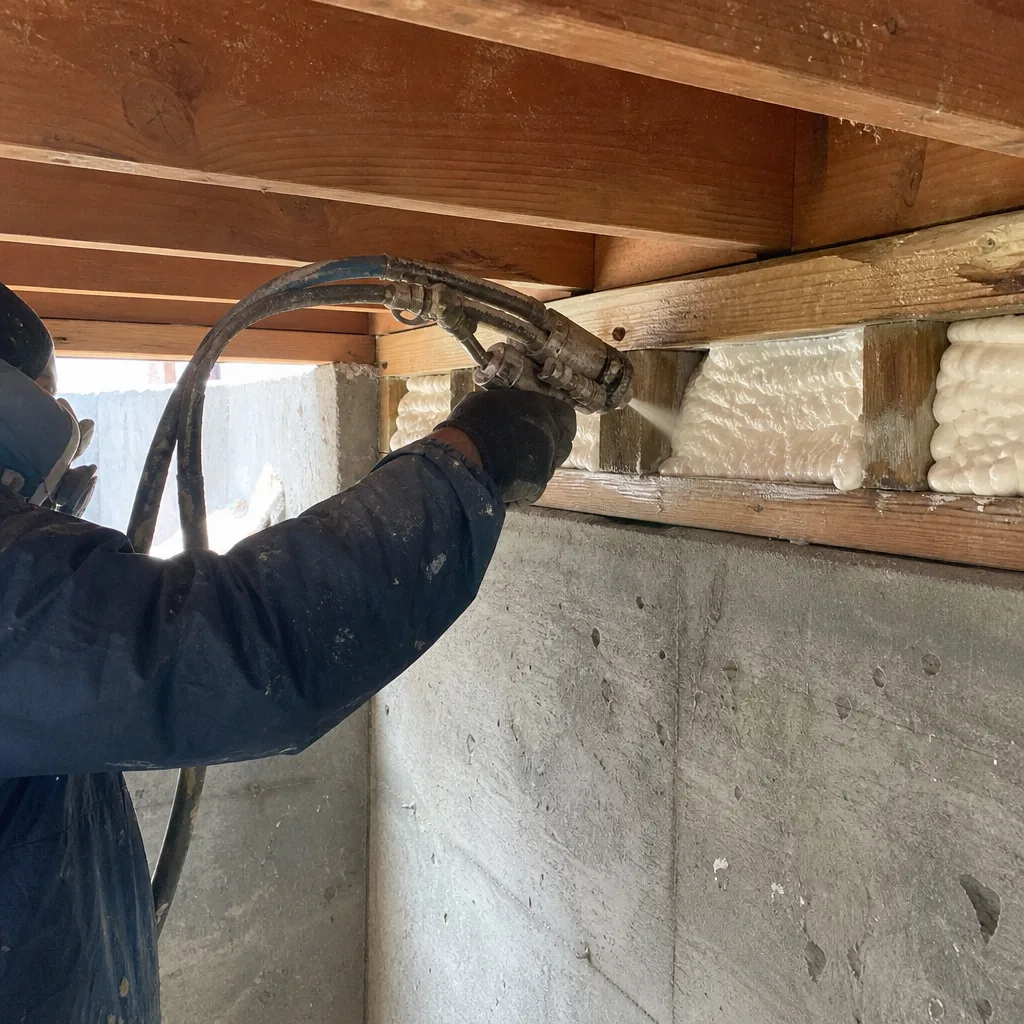
Rim joist spray foam in Temple City addresses the uninsulated band board where your floor framing meets the foundation, a spot that leaks conditioned air year-round and lets summer heat ride straight up into the floor system of these mid-century raised-foundation homes. Most Temple City tract houses have never had the rim joist touched, and it’s one of the highest-ROI air-sealing points on the entire house. We typically apply closed-cell foam at 2 inches, which gives you air sealing, moisture control, and roughly R-14 in one pass. A standard Temple City raised-foundation home runs $1,400 – $2,800, and the job is done in a day.
Where the Air Actually Escapes
On a 1950s or 1960s stucco-on-frame tract house, the rim joist runs around the perimeter where the floor platform sits on the mud sill. It’s a narrow band most people never see, but it’s also where the subfloor stops being insulated and the outside air starts working its way in. In Temple City’s summer heat, that warm infiltration pushes the floor temperature up and forces your AC to fight a load it shouldn’t have to carry.
Why We Foam, Not Batt
Fiberglass batts stuffed into rim joist bays sag, fall out, and leave gaps. Spray foam expands into the cavity, adheres to the wood, and stops the air movement that drives the problem. That matters on Temple City homes because the crawl space is usually vented, so any gap in the rim area is a direct channel into the house.
Crawl Space Spray Foam Insulation in Temple City
Crawl space spray foam insulation in Temple City transforms the dank, musty space under these mid-century stucco homes into a clean, sealed, conditioned zone that keeps summer heat and winter damp out of your floor system. Most Temple City homes sit on raised foundations with vented crawl spaces full of compacted batts that have been sagging for decades. We remove the old material, seal the foundation vents, and apply closed-cell foam to the foundation walls or encapsulate the crawl space depending on what the structure tells us. A full crawl space encapsulation in Temple City runs $3,200 – $5,800, and we’ll show you exactly what’s in that number before any work starts.
Vented vs. Sealed on These Older Homes
Those small foundation vents that were standard on 1950s construction do more harm than good in the San Gabriel Valley. They pull hot, humid summer air into the crawl space, where it condenses on the cold floor framing and feeds the musty smell that creeps up through the floor. Sealing the space stops that cycle at the source.
Open-Cell vs. Closed-Cell Below Grade
In a crawl space, we almost always recommend closed-cell foam. Open-cell absorbs moisture, and below grade there’s always moisture nearby. Closed-cell (typically Demilec or Icynene depending on the project) gives you a vapor barrier and air seal in one application, and it doesn’t become a sponge if the ground stays damp during a wetter-than-average winter.
Trusted Brands We Service in Temple City
We carry both Icynene and Demilec spray foam systems, the two major premium brands that dominate high-performance residential retrofit work. On the fiberglass side, we’re authorized to install CertainTeed and Owens Corning products. For homeowners in Temple City who want a lower-carbon or non-toxic option, we also install GreenFiber recycled cellulose and Rockwool mineral wool. If you’ve read about open-cell versus closed-cell and you’re not sure which applies to a 1961 tract loft with no attic ventilation, ask us directly – we’ll give you the material answer, not a brand answer. Call (877) 265-5712.
Common Spray Foam Insulation Problems We See in Temple City Homes
- Foam applied over unsealed original recessed cans and legacy knob-and-tube-era wiring paths. This is the most serious problem we encounter in Temple City’s 1950s tracts. Spray foam traps heat against these older electrical components, creating a fire risk that never should have passed inspection. Air-sealing and IC-rated can detailing have to happen first, every time.
- Foam sprayed into attics with only two tiny soffit vents and zero added ventilation. Those low-pitch 1950s and 1960s rooflines were barely vented when they were built. If you seal the attic plane with closed-cell foam without addressing the roof deck, you can trap moisture against the underside of the sheathing. On Temple City homes, this is a recurring failure when someone foamed first and thought later.
- Rim joists foamed without clearing 50-year-old batt debris and dust first. Foam needs a clean surface to adhere. We regularly see jobs where someone sprayed over settled fiberglass dust, and the foam peeled off the band board within a year. On these old tract homes, the prep work is non-negotiable.
- Closed-cell foam applied to attics without attic ventilation or without sealing can penetrations around original 1960s kitchen and bath exhaust fans. That old exhaust fan in the hall bath was vented into the attic, not outside. Foam over it and you’ve just sealed moisture into the roof cavity. We trace every exhaust path before we spray.
Pricing for Spray Foam Insulation in Temple City, CA
Here’s what you’re looking at in Temple City’s market. Rim joist spray foam: $1,400 – $2,800 on a raised-foundation tract home with accessible band board. Crawl space encapsulation with closed-cell foam: $3,200 – $5,800 depending on square footage and how much demolition of old batts is involved. Full attic air-seal plus spray foam: $4,200 – $7,500, which includes can detailing, wiring chase sealing, and the foam itself. A straight attic floor foam (closed-cell, 2 inches) runs $2,100 – $3,400 on a 1,000 – 1,400 square foot Temple City ranch. What moves the number is prep: how much legacy wiring is in the way, how many recessed cans need IC-rated boxes, and how much old material has to come out. That’s exactly why we walk the attic before we quote. Call (877) 265-5712 for a free estimate, and we’ll give you a real number tied to your actual house.
We Also Serve Cities Near Temple City
If you’re in Temple City or anywhere nearby, we cover the same territory. North El Monte, Rosemead, San Gabriel, and Arcadia all get the same insulation-only focus and the same honest material recommendations. These neighboring communities share the same mid-century housing stock and the same San Gabriel Valley heat, which means the same retrofit sequencing applies.
Serving Temple City, CA — Our Local Coverage Area
We’re based in the Temple City area and know this community well. Use the map below to see our service coverage — if you’re nearby, we can almost certainly help.
FAQs About Spray Foam Insulation in Temple City
Not directly against them. The original recessed cans in 1950s Temple City homes are almost never IC-rated, which means spray foam applied directly against them is a fire hazard. The correct sequence is to air-seal the penetration, install an IC-rated barrier or box around each can, and then apply the foam. We include this in every attic quote on these older tracts. Call (877) 265-5712 and we’ll tell you what your specific cans need.
Because the attic floor was insulated without addressing the air leaks and the lack of ventilation. Temple City’s low-pitch roofs with two tiny soffit vents trap heat against the underside of the sheathing, and if the insulation is doing its job but the attic is still reading 150°F in the afternoon, you’re dealing with a ventilation failure, not an insulation failure. The fix is usually air-sealing first, then adding foam at the roof deck or improving the venting. We’ve seen this exact pattern on dozens of Temple City tract homes.
Yes, if the house has the raised-foundation design almost every 1950s Temple City tract home has. Your floor system is sitting on uninsulated joists over a vented crawl space, which means summer heat and winter damp are rising into the living space year-round. Closed-cell foam on the foundation walls or a full encapsulation will stop that transfer, and the comfort difference is measurable. The job runs $3,200 – $5,800 on these homes.
Yes. The rim joist is accessed from inside the crawl space, not from the exterior, so the stucco never gets touched. We work from below, clear the settled debris, and apply closed-cell foam directly to the band board. Most Temple City rim joist jobs are done in a single visit and run $1,400 – $2,800.
We carry Icynene and Demilec, both premium spray foam systems with strong track records on retrofit work. We’re also authorized CertainTeed and Owens Corning installers if the project calls for fiberglass, and we carry GreenFiber cellulose and Rockwool mineral wool for homeowners who want lower-toxicity options. The brand follows the need, not the other way around. Call (877) 265-5712 and we’ll tell you which material fits your attic.
Why Sequencing Matters on Temple City’s 1950s Tracts
Here’s the part most spray foam pages skip, and it’s the single biggest reason Temple City jobs go wrong. These attics were wired during the knob-and-tube era. We walk attics off Las Tunas Drive and Cloverly Avenue every month, and we still find live knob-and-tube runs and original recessed cans buried under compacted 50-year-old batts. If you spray foam over those, you’re sealing a heat source inside an insulation layer that’s now in direct contact with aging cloth-wrapped wire. That’s a code violation and, frankly, a fire waiting to happen. Air-sealing, can detailing, and IC-rated barriers are not optional on Temple City homes. They’re the prerequisite that makes the foam safe and effective.
On a 1958 single-story tract home off Las Tunas Drive near Temple City Park, our crew pulled back compacted batts to find them shoved aside around the original recessed cans and exposed knob-and-tube-era wiring runs under a low-pitch roof with only two small soffit vents. We air-sealed the can penetrations and wiring chases first, then applied Icynene to the rim joist and the attic plane. The homeowner called back after the first 100°F afternoon and said the back bedrooms finally held their temperature through the whole day. That’s what correct sequencing does. It’s not faster, and it’s not what you’ll get from someone who quotes over the phone without looking, but it’s the only way to do spray foam right in Temple City’s housing stock.
If your Temple City home still has its original attic insulation – and most do – the first step isn’t foam. It’s finding out what’s buried under the batts we’re about to seal.
Call (877) 265-5712 for a free estimate. We’ll walk your attic, check the rim joist, look at the crawl space, and tell you exactly what your house needs. No brand pushing. No skipped steps. Just the right insulation for a 1950s Temple City tract home.
Written by Allen Decker, Owner at North Tustin Insulation, serving Temple City and the San Gabriel Valley.