
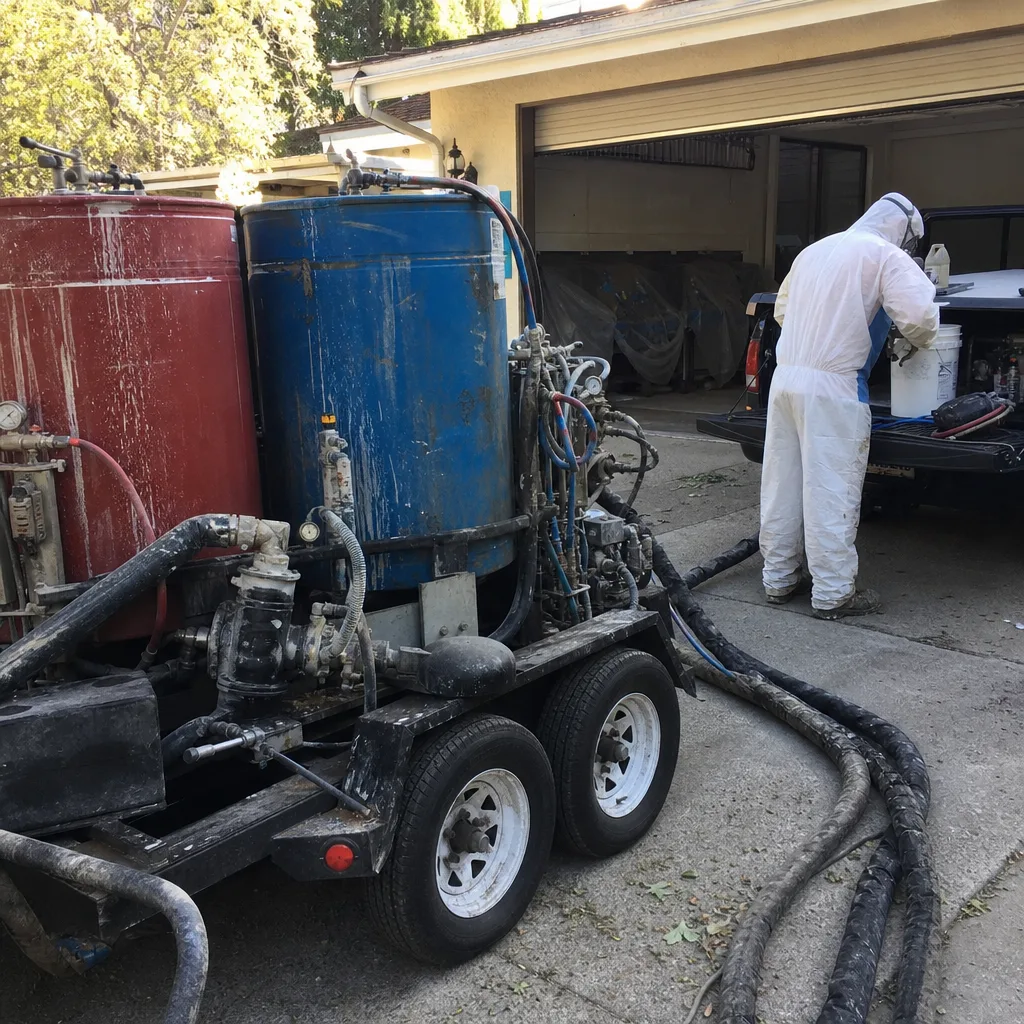
Fast, Reliable Spray Foam Insulation Across Wildomar
Spray foam insulation in Wildomar runs $2.75 to $6.50 per board foot installed depending on open-cell versus closed-cell, with most whole-attic jobs landing between $3,400 and $8,200. The reason we know that range cold is that Wildomar’s inland heat punishes insulation harder than almost anywhere in southwest Riverside County. When it’s 103°F outside and your attic is cooking at 140°F, the difference between a properly sealed foam envelope and tired builder-grade batts shows up on your next electric bill. Our spray foam crew serves every Wildomar neighborhood, and we answer live at (877) 265-5712 when you need a straight answer instead of a voicemail.
Why North Tustin Insulation Is Wildomar’s Preferred Spray Foam Insulation Company
We’re the insulation-only contractor that Wildomar homeowners call when the attic heat finally wins. The difference starts with the fact that we don’t spread ourselves across roofing, HVAC, and remodeling. Every estimate we write in Wildomar is about one thing: stopping heat and air from moving where they don’t belong. Our team works throughout the 92595 ZIP, from the master-planned pockets near Sedco Hills to the larger-lot tract homes off Bundy Canyon Road and Clinton Keith Road. When a Wildomar homeowner describes an upstairs bedroom that never cools down or a July AC bill that hit $600, we already know what we’ll find in the attic before we climb the ladder. Local feedback from Wildomar customers routinely highlights two things: we show up when we say we will, and our estimates don’t change after we open the attic hatch. Those aren’t marketing claims. They’re what happens when a crew knows the housing stock and doesn’t guess at the scope.
Allen Decker set the standard here: name the brands, name the material, and let the homeowner decide with real information. That’s why a Wildomar consult covers Icynene and Demilec spray foam options side by side, not just whatever product happens to be loaded in the truck. It’s also why we tell you honestly when blown-in cellulose or Rockwool mineral wool would do the job better for less money. We match the material to your home, not the other way around.
Spray Foam Wall Insulation in Wildomar
Spray Foam Wall Insulation in Wildomar is the fix for rooms that stay ten degrees warmer than the rest of the house no matter how long the AC runs. In 92595 tract homes built between the late 1980s and mid-2000s, we regularly find wall cavities that were only partially filled during original construction, or fiberglass batts that slumped inside the wall over time. The result is wall studs acting as thermal bridges and hot exterior air finding its way into living spaces. We remove the failed material, air-seal the top plates and penetrations, then apply open-cell or closed-cell foam directly to the stud bays. On a typical Wildomar home of 2,000 to 2,800 square feet, spray foam wall insulation for a full exterior wall retrofit runs $4,000 to $9,500 depending on access, stud depth, and whether we’re working from inside or out.
Closed-Cell for Wildomar’s Hot Summers
Closed-cell foam carries an R-value around R-7 per inch and adds structural rigidity and moisture resistance, which matters in Wildomar where day-night temperature swings cause condensation cycles inside wall cavities. It’s the right call for exterior walls and any space where humidity or water contact is possible. We carry Demilec closed-cell systems for exactly those applications.
Open-Cell for Interior Wall Cavities
Open-cell Icynene foam runs about R-3.8 per inch and is our standard recommendation for interior partition walls and sound control between rooms. It’s also the more economical route for Wildomar homeowners who want air sealing in the attic but don’t need the vapor-barrier properties of closed-cell. Either way, the first step is always the same: remove the old batts so the foam bonds directly to the sheathing.
Rim Joist Spray Foam in Wildomar
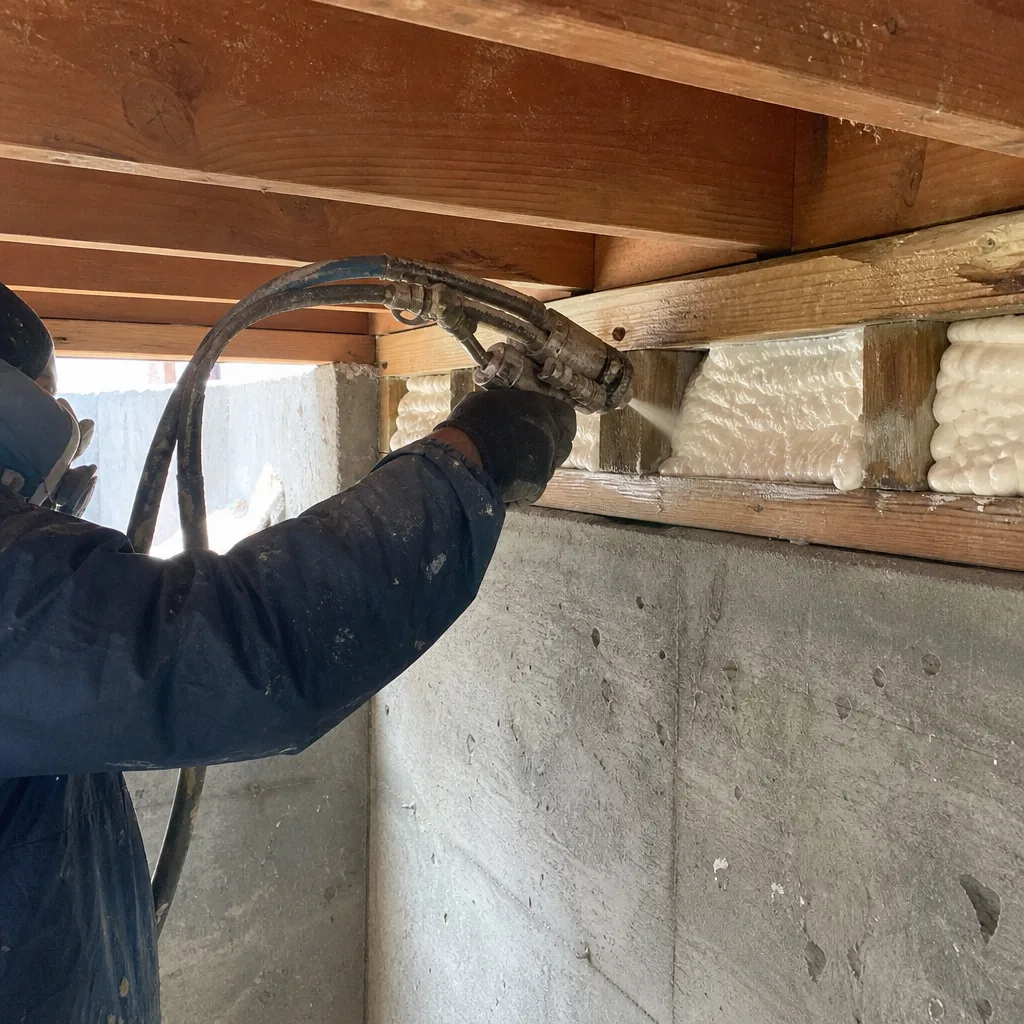
Rim Joist Spray Foam in Wildomar is the highest-ROI foam job most homeowners have never heard of. The rim joist is the perimeter band where your floor framing meets the foundation wall, and in newer master-planned Wildomar homes it’s often left completely unsealed by the builder. Hot attic air pours down into the joist bays, moves along the open rim, and cooks the walls from inside. We seal every rim joist bay with closed-cell foam, typically one to two inches, which blocks the airflow path and adds continuous insulation at the weakest thermal boundary in the house. For a typical Wildomar two-story home, rim joist foam runs $1,800 to $3,200 all in. That’s often the single most effective dollar we spend on an insulation project in this market.
Newer Builds Are Not Exempt
We’ve foamed rim joists in Wildomar homes built as recently as 2015 and found the same story: unsealed gaps, no sill sealer worth mentioning, and hot wall cavities. Builders rarely spend on this detail, so the homeowner inherits it. In a 92595 tract home, rim joist sealing can drop upstairs bedroom temperatures by four to seven degrees within a week.
Pairing Rim Joist Work With Attic Foam
We recommend rim joist foam as part of any whole-attic spray foam project in Wildomar. The two applications work together. Air-seal the attic floor or deck, and seal the rim. You close the top of the envelope and the bottom of it. Skip the rim and you’ll still feel warm air seeping up through the walls on a 100°F afternoon.
Trusted Brands We Service in Wildomar
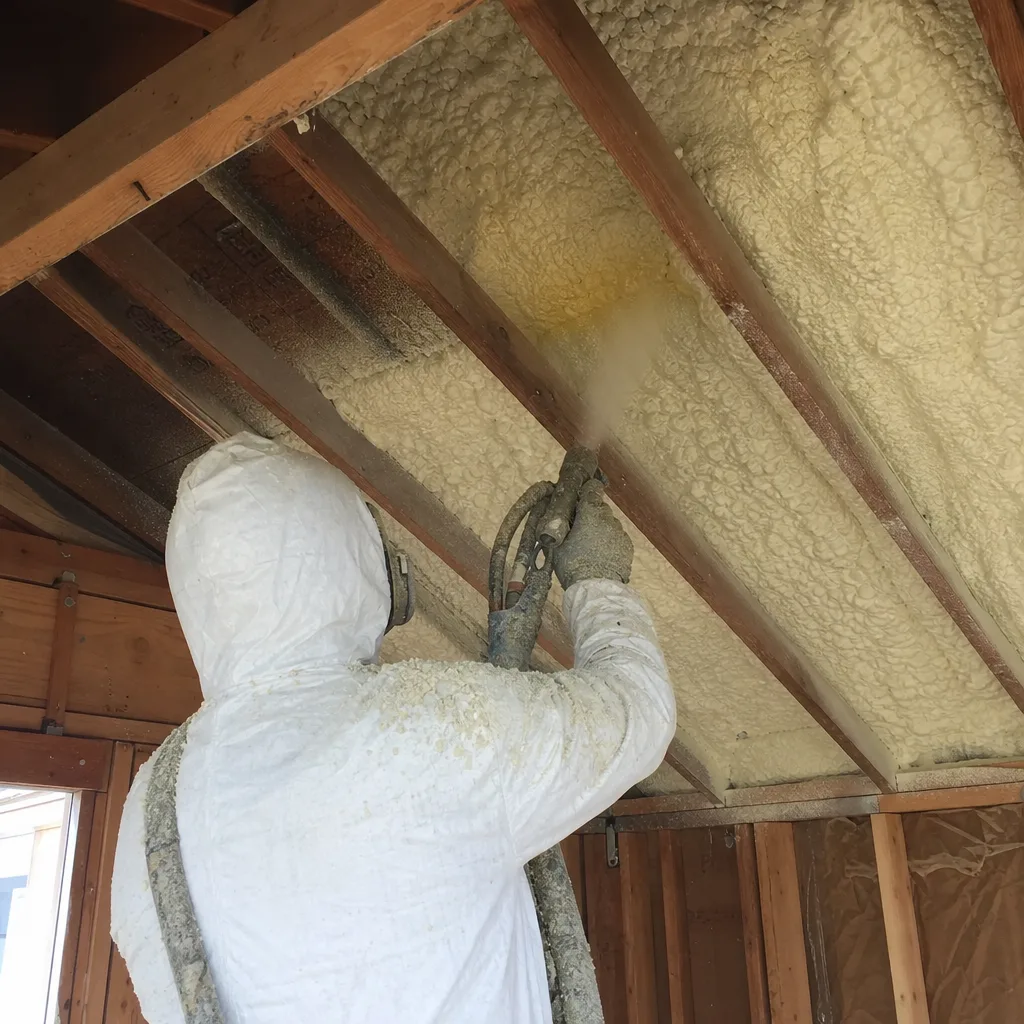
We carry Icynene and Demilec for spray foam, two names that dominate open- and closed-cell markets respectively. For Wildomar homeowners who want a non-foam comparison, we also install GreenFiber recycled cellulose and Owens Corning fiberglass systems. That’s the point: eight brands across four material categories, under one contractor. When we recommend foam in Wildomar, it’s because foam is genuinely the right tool for the heat and air-sealing problem, not because it’s the only thing we know how to install. We keep spray foam rigs stocked and scheduled for Wildomar jobs with typical turnaround in three to seven business days after an accepted estimate.
Common Spray Foam Insulation Problems We See in Wildomar Homes
- Baked-flat builder batts under fresh foam. Some contractors will spray foam directly over old R-13 or R-19 batts in a Wildomar attic to save on removal labor. The result is foam that never bonds to the ceiling and trapped heat that degrades both layers. We always remove and dispose of failed batts before foam goes in.
- Trapped moisture from sealed attics with no ventilation plan. Wildomar’s day-night temperature swings cause condensation inside sealed attics when the foam job ignores ridge or soffit venting. A sealed attic without a ventilation strategy becomes a humid box that shortens the life of the roof deck. We address ventilation on every Wildomar attic foam job before the spray gun starts.
- Unsealed rim joists in newer planned communities. We keep finding wide-open rim joist bays in Wildomar homes built after 2000. Hot attics pressurize wall cavities through the rim, and the homeowner wonders why the upstairs never cools. This is a builder shortcut that shows up on the first real heat wave of June.
- DIY or low-bid foam over a dark shingle roof with no radiant consideration. Wildomar’s dark composite shingle roofs will push attic surface temperatures over 150°F in August. Foam helps, but only if it’s paired with proper radiant strategy. We evaluate the roof color and orientation on every 92595 consult because a light-colored re-roof changes the foam equation entirely.
Pricing for Spray Foam Insulation in Wildomar, CA
Here’s what Wildomar residents should expect to pay. Rim joist spray foam on a standard two-story tract home runs $1,800 to $3,200. Wall insulation retrofits with closed-cell foam run $4,000 to $9,500 for a full exterior wall scope. Whole-attic open-cell spray foam on a 1,500 to 2,500 square foot Wildomar home lands between $3,400 and $8,200, with closed-cell running higher due to material cost. Garage ceiling spray foam, a popular job for Wildomar homeowners with converted garages or bonus rooms above, typically runs $1,200 to $2,800. Roof deck foam for a sealed-attic conversion is a $6,000 to $14,000 project depending on roof area and foam depth. Material choice, existing insulation condition, attic access, and wall access all push numbers within those ranges. Call (877) 265-5712 for a free estimate that gives you a hard number, not a vague range that changes after the crew arrives.
We Also Serve Cities Near Wildomar
From our base in North Tustin, our spray foam crews cover Wildomar and the surrounding Riverside County communities. We work regularly in Murrieta, Murrieta Hot Springs, Sedco Hills, and Lakeland Village, and we know how different the heat profile is between a Sedco Hills hillside lot and a Lakeland Village slab home. If you’re in a nearby city and want the same straight-talking Spray Foam Insulation in Wildomar approach applied to your home, call us. Our Spray Foam Insulation team handles jobs across southwest Riverside County with the same material transparency we bring to every Wildomar estimate.
Serving Wildomar, CA — Our Local Coverage Area
We’re based in the Wildomar area and know this community well. Use the map below to see our service coverage — if you’re nearby, we can almost certainly help.
FAQs About Spray Foam Insulation in Wildomar
Because Wildomar’s heat problem is not just about R-value, it’s about air movement and radiant load through a dark shingle roof. Batts only slow conductive heat; they do almost nothing to stop hot attic air from pushing into wall cavities and living spaces. In a 100°F Wildomar afternoon, the air temperature inside an unsealed attic can hit 140°F while the roof deck reads 160°F. Spray foam seals the building envelope so that superheated air never enters the thermal boundary in the first place. Batts can’t do that. Call (877) 265-5712 and we’ll explain the physics in plain English during a free estimate.
You check three things, and the first two are free. Go upstairs on a 95°F afternoon and feel the wall near the ceiling line; if it’s warm to the touch, the wall cavities are exchanging heat. Second, look at your July electric bill from two years ago against this year. If the per-kilowatt rate didn’t change much but the bill climbed 20 percent, the insulation has lost effectiveness. Third, pull the attic hatch and look for batts that sit below the top of the ceiling joists. In 1980s and 1990s Wildomar homes, builder-grade R-19 batts are often compressed to R-9 or worse after decades of inland heat. A quick visual check usually confirms it.
No, and we refuse to do it that way. Applying foam over old batts means the foam never bonds to the ceiling surface, and you’re left with a sandwich of failed material and expensive foam. In a 2003 tract home off Bundy Canyon Road in the 92595 ZIP, we found the original R-13 batts compressed to less than half their rated thickness after years of 100°F summers. We removed the failed batts, air-sealed the top plates and can lights, then applied Icynene spray foam to the attic deck and rim joists, dropping attic temps by over 30°F and cutting the homeowner’s AC runtime dramatically. Proper removal and air sealing first, foam second. Always.
Foam the roofline, not the attic floor, and pair it with a ventilation or radiant strategy. On a dark composite shingle roof in Wildomar, the roof deck will heat well past 150°F in August, and that heat radiates straight down into the attic space. Foaming the underside of the roof deck with open-cell Icynene creates a conditioned attic that stops radiant gain before it enters the house. We also evaluate soffit and ridge ventilation because a sealed Wildomar attic without a moisture plan will condense during the cold nights that follow hot days. The dark roof is the enemy; closed-cell or open-cell on the deck plus a sane ventilation plan is the fix.
Closed-cell foam handles it best because it acts as an air barrier and a vapor retarder at the same time. Wildomar commonly swings from 100°F days to 55°F nights in the same week, and those swings push moisture into every unsealed gap in the building envelope. Open-cell foam seals air but allows vapor to pass, which can work in some Wildomar attics with proper ventilation. Closed-cell blocks both. For rim joists and wall cavities in 92595 homes, we lean closed-cell Icynene or Demilec for exactly this reason. Not sure which material your Wildomar home needs? Call (877) 265-5712 and we’ll tell you straight.
Written by Allen Decker, Owner at North Tustin Insulation, serving Wildomar and southwest Riverside County with honest material recommendations and straight pricing.