
Last updated October 31, 2026
The Complete Guide to Insulation in North Tustin
Most North Tustin homes were built between 1960 and 1985, long before California’s Title 24 energy code set real performance standards for insulation. That means the original material in your attic, walls, and crawl space was installed for one reason only: it was cheap. Hot upstairs rooms in August, cold floors in January, and utility bills that climb every year are the direct result. This guide breaks down insulation by material, by zone of the house, and by the actual construction types we walk through every week across North Tustin so you’ll know exactly what to ask for and what to skip, or explore more guides & resources for related projects.
Quick Answer
Attic insulation is the highest-impact upgrade for North Tustin homes, followed by crawl space and wall retrofits. R-38 to R-60 is the realistic ceiling value for our climate, and the material choice depends on your attic’s condition, access, and whether you’re sealing air leaks at the same time. For older North Tustin homes, air sealing plus blown-in cellulose or fiberglass delivers the best cost-to-comfort ratio, while closed-cell spray foam earns its higher price on awkward rooflines and attached garages.
Table of Contents
- Why North Tustin’s Climate Makes Insulation Different
- What Your 1960s-1980s House Actually Has Installed
- R-Value Requirements Under Title 24 vs. Reality
- Material Breakdown: Fiberglass, Mineral Wool, Cellulose, and Spray Foam
- How Inland Heat Affects Attics vs. Walls Differently
- Why Open-Cell Spray Foam Struggles in North Tustin Attics
- Sequencing a Whole-Home Insulation Upgrade Without Ripping Out Walls
Why North Tustin’s Climate Makes Insulation Different
North Tustin sits inland enough that we skip most of the coastal marine layer. That means July and August afternoons regularly climb into the high 80s and low 90s, with roof deck temperatures above 140 degrees. Radiant heat from the sun beating down on the roof is the dominant load on your insulation, not cold winter air. In a coastal city like Newport Beach, the conversation centers on moisture and temperature swings. In North Tustin, we’re solving for sustained heat radiating into the attic and migrating down through ceilings into living spaces.
Rainfall here is minimal, which has an underappreciated effect on insulation longevity. Attics stay dry nearly year-round, so fiberglass batts degrade slowly compared to humid climates. What actually breaks down insulation in North Tustin is settling, pest activity, and the repeated expansion and contraction from large day-to-night temperature swings. Blown-in materials like cellulose and fiberglass settle over two decades and lose depth. Batts get compressed by boxes, technicians working on HVAC equipment, and rodents nesting in the kneewalls along second-story bedrooms.
The practical takeaway is that a North Tustin attic at R-30 on paper may be performing closer to R-20 in reality if the material has settled, shifted, or been disturbed. Before you add material, the existing layer needs inspection, and in many cases, removal or topping based on what’s there.
What Your 1960s-1980s House Actually Has Installed
Homes built in North Tustin during the 1960s and 1970s typically have one of three original insulation scenarios. Tract homes from builders like S&S Construction often got a thin blanket of fiberglass batts, R-11 to R-19, laid in the attic floor only. Walls were frequently left empty or got a token amount of batt material stuffed around window and door rough openings before drywall went up. Some custom homes on Cowan Heights Drive or along Foothill Boulevard fared better with full wall cavity batts, but the attic remained the weak point.
Homes from the 1980s generally have R-19 to R-30 in the attic floor and fiberglass batts in the walls. That’s better than the 60s and 70s stock, but still far short of what Title 24 now demands for new construction. The big divide is between what’s on paper and what’s actually there. We regularly open attics in North Tustin where the original R-19 has been flattened by decades of foot traffic from HVAC service calls, roof work, and cable installers. Compressed fiberglass loses meaningful R-value per inch because so much of its performance depends on the trapped air pockets, not the glass fibers themselves.
If your home was built before 1978, there’s a secondary issue: vermiculite and older loose-fill products occasionally appear in these attics. That’s a removal-and-replace job, not a top-and-go situation. A quick look at the attic and a check of the home’s build date tells us most of what we need to know before any material gets ordered.
R-Value Requirements Under Title 24 vs. Reality
Title 24 currently requires R-38 ceiling insulation for new residential construction in our climate zone, which is Zone 8. For walls, the requirement is R-13 plus R-4 continuous insulation or an equivalent U-factor tradeoff. That’s the standard for homes permitted today. A 1972 ranch in North Tustin with R-11 in the attic is operating at less than a third of the mandated performance level.
The R-value itself measures resistance to conductive heat flow. Higher number, slower heat transfer. Attics get the most attention because heat rises and the sun’s radiant load hits the roof directly. Walls matter less in our climate, but they still contribute to uneven room temperatures when one side of the house bakes in afternoon sun. Floors and crawl spaces are the third zone, often ignored but relevant for homes where cold air sneaks up through the subfloor in winter or hot air infiltrates in summer.
What Realistic R-Value Should You Aim For in North Tustin?
- Attic floor: R-38 to R-49 for typical vented attics. R-49 is the sweet spot without seeing the performance gains go flat against the added cost.
- Cathedral ceilings and bonus rooms: R-30 to R-38 using closed-cell spray foam or a hybrid foam-and-batt approach. These are often the hottest rooms in the house.
- Walls: R-13 to R-15 in 2×4 framing. Full cavity fill with blown-in fiberglass or cellulose is the least invasive retrofit.
- Crawl spaces and floors: R-19 to R-30 depending on whether the crawl space is ventilated or encapsulated.
One point we make on every estimate in North Tustin: adding R-value without air sealing is a half measure. A fiberglass batt at R-38 loses a large portion of its effectiveness when attic air leaks through recessed lights, top plates, and plumbing penetrations. Sealing those gaps first, then insulating, is the correct sequence.
Material Breakdown: Fiberglass, Mineral Wool, Cellulose, and Spray Foam
Four material families cover nearly every residential insulation job in North Tustin. Each has strengths and each has a best-fit application. We match the material to your home, not the other way around.
Fiberglass
Fiberglass comes in batts and blown-in loose fill. Owens Corning and CertainTeed are the two product lines we install most. Blown-in fiberglass is our go-to for attic floors because it delivers high R-value per dollar, settles less than cellulose, and doesn’t hold moisture in our dry climate. Batts work better in wall cavities during remodel openings and in joist bays where access allows precise fitting. The limitation is that fiberglass does nothing to stop air movement. It filters air, but it doesn’t block it.
Mineral Wool
Rockwool mineral wool has a different structural profile. The material is denser and firmer than fiberglass, which means it stays put in horizontal and vertical cavities years after installation. It’s non-combustible, water-repellent, and has higher sound-dampening performance than similarly rated fiberglass. In North Tustin homes, we use Rockwool more often on interior walls for noise control between rooms, in garage ceilings under bedrooms, and in rim joist bays where rigidity matters. The cost is higher than fiberglass, so it earns its place in specific thermal and acoustic applications rather than as a blanket attic fill.
Cellulose
GreenFiber cellulose is recycled newsprint treated with borate for fire and pest resistance. It’s denser than blown fiberglass, which helps it fill odd cavities and irregular joist spacing more completely. The density also gives it a higher R-value per inch on average. For North Tustin attics with uneven framing, lots of cross-bracing, or low-slope sections where loose fill settles into awkward spots, cellulose works exceptionally well. In wall retrofits, blown-in cellulose is a top choice because the dense pack fills cavities completely around existing wiring and plumbing.
Spray Foam
Spray foam is the only insulation that functions as an air barrier, vapor barrier (in closed-cell form), and thermal barrier simultaneously. Icynene and Demilec are the two product lines we install. Closed-cell foam runs roughly R-6.5 to R-7 per inch and adds structural rigidity to framing. Open-cell foam at R-3.5 to R-4 per inch is a different product with a different job description. We’ll get into the open-cell caveat for North Tustin attics below.
Material Comparison at a Glance
- Blown-in fiberglass (Owens Corning AttiCat): $1.40-$1.80 per sq ft installed at R-38, fast install, great attic floor value.
- Cellulose (GreenFiber): $1.60-$2.10 per sq ft installed at R-38, denser fill, better for tricky cavities and walls.
- Fiberglass batts (CertainTeed): $1.80-$2.40 per sq ft installed at R-38, ideal for accessible joist bays and wall openings.
- Rockwool batts: $2.50-$3.50 per sq ft installed at R-38, premium for sound and fire resistance.
- Closed-cell spray foam (Demilec): $3.50-$5.50 per sq ft installed at 3 inches, premium air-sealing and moisture control.
- Open-cell spray foam (Icynene): $2.50-$4.00 per sq ft installed at R-38 equivalent depth, best for interior sound dampening and wall cavities.
How Inland Heat Affects Attics vs. Walls Differently
An attic in North Tustin can hit 150 degrees on a 95-degree August day. That heat radiates down through the ceiling framing and into your home. The insulation on the attic floor is the only thermal barrier between that heat and the rooms below. Over time, sustained high temperatures accelerate the breakdown of some materials more than others. Cellulose holds up well in dry heat. Fiberglass doesn’t degrade, but it compresses and loses loft if disturbed. Spray foam, when properly installed and protected from UV exposure, is stable for the life of the building.
Walls face a different stress profile. On the south and west faces of a North Tustin house, the wall cavity bakes in direct sun. The exterior stucco or siding heats up, and the framing conducts that heat into the cavity. Without insulation, that heat transfers into drywall and starts warming rooms by mid-afternoon. That’s why west-facing bedrooms and living rooms in older homes are consistently 8 to 12 degrees hotter than north-facing rooms at the same time of day. Adding wall insulation doesn’t completely eliminate the delta, but it flattens it significantly.
The material choice for walls depends mostly on access. If a wall is already open during a remodel, batt insulation gives you controlled placement. If the wall is finished, blown-in dense pack is the only retrofit option that doesn’t tear out drywall.
Why Open-Cell Spray Foam Struggles in North Tustin Attics
Open-cell spray foam has a meaningful role in some parts of the country. It’s cheaper than closed-cell, it expands more per inch, and it’s an excellent sound dampener. But using it as the sole insulation layer in a North Tustin vented attic is a mistake, and here’s why.
Open-cell foam is air impermeable but vapor permeable. It stops air leakage, but it allows moisture vapor to pass through. In a humid climate that can be a benefit. In North Tustin, the problem is temperature performance. At R-3.5 to R-4 per inch, an open-cell foam layer thick enough to hit R-38 would need to be 10 to 11 inches deep. That’s a huge amount of foam, and the cost starts approaching closed-cell territory without delivering the temperature-stopping power. Worse, in our dry inland summers the foam’s open-cell structure allows some heat to radiate through more readily than denser materials at the same R-value.
Closed-cell foam at R-6.5 to R-7 per inch achieves R-38 at around 6 inches. It also adds a vapor barrier, which matters more in wall cavities than attic floors in our climate. For most North Tustin attics, the best-performing option is either a thick layer of blown-in insulation on the attic floor with proper air sealing, or a hybrid approach where closed-cell foam seals the roofline in specific trouble zones like cathedral ceilings, garage ceilings under rooms, and cantilevered floors. Open-cell foam works well in interior walls for sound and in crawl space rim joists. It’s a useful tool in the right spot, but not the right material for the main attic cavity in our heat profile.
Sequencing a Whole-Home Insulation Upgrade Without Ripping Out Walls
A sensible whole-home insulation plan for a North Tustin house works in phases. The goal is to capture the biggest comfort and energy gains early without opening up finished walls on day one. Here’s the sequence we recommend.
- Inspect and air seal the attic floor. Before any new insulation goes in, find and seal every air leak: can lights, plumbing stacks, electrical chases, top plates, and the attic hatch. Use a low-expansion foam or caulk rated for high heat. This step alone often cuts air leakage by 30 to 40 percent.
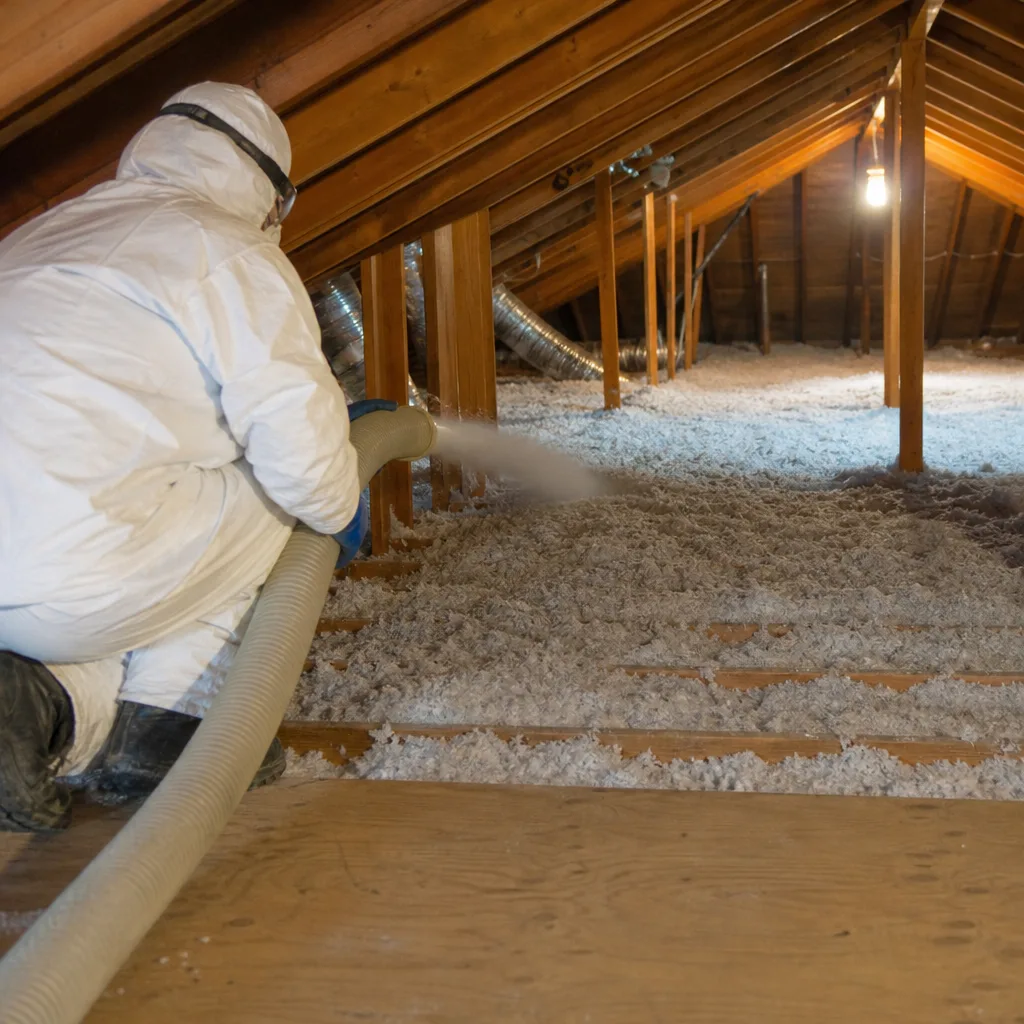
- Upgrade the attic floor insulation. Top up or replace loose fill to R-38 through R-49. Blown-in fiberglass or cellulose depending on the attic’s condition. This is the single highest-ROI insulation project for a North Tustin home.
- Address attached garage ceilings. If a bedroom sits above the garage, insulate that ceiling to R-38 minimum. The garage roof gets the full afternoon sun without the attic buffer. This is a common missed spot.
- Insulate the crawl space rim joists. If your home has a raised foundation, seal and insulate the rim joist perimeter with mineral wool or closed-cell foam. This blocks outside air from moving under the floor in winter and hot air in summer.
- Dense pack the walls in target rooms. The south and west facing rooms that run consistently hot are the priority. Dense pack from the exterior or interior with minimal drywall damage. Do this room by room, not whole house at once, to spread the cost.
- Address thermal bypass zones last. Cathedral ceilings, knee walls, skylight shafts, and cantilevered overhangs are the tricky zones. Closed-cell foam or a hybrid foam-and-batt detail is usually required here.
This sequence means you’re not sitting in a torn-up house for two months. Phase one and two are two-day jobs in most cases. Phase three through six can happen over one or two seasons.
Common Mistakes to Avoid
- Adding insulation without air sealing first. Blowing R-38 over an unsealed attic floor is like putting a thick sweater on over a leaky shirt. The air gaps bypass the insulation and the room stays uncomfortable. Seal first, then insulate.
- Covering recessed can lights with insulation. In a North Tustin attic, old non-IC-rated can lights get extremely hot. Insulation packed around them creates a fire hazard. Non-IC-rated cans need insulated enclosures or replacement with LED retrofits before loose fill goes over them.
- Using open-cell foam on the attic floor. It’s the wrong product for the temperature load in our microclimate. Save open-cell for walls and sound control.
- Ignoring the attic hatch. An uninsulated pull-down staircase or hatch door is a hole in your thermal barrier. A properly weatherstripped and insulated hatch box matters more than most homeowners realize.
- Blocking soffit vents with loose fill. Blown-in material that covers the intake vents chokes attic ventilation. In our radiant-heat-driven summers, ventilation keeps the attic from becoming a pressure cooker. Baffles prevent this problem.
- Forgetting the crawl space. Floors over a vented crawl space account for a meaningful amount of winter heat loss in North Tustin’s older raised-foundation homes. This zone gets skipped on most quotes from generalist contractors.
- Compressing batts into shallow stud bays. A R-19 batt squeezed into a 2×4 cavity doesn’t perform at R-19. It performs at the R-value of the compressed depth. Using a denser material at the right thickness beats jamming a thicker batt that doesn’t fit.
Why Multi-Brand Access Matters for a North Tustin Project
Most insulation contractors carry one brand. Maybe two if they’ve been around a while. The problem isn’t the brand itself; Owens Corning, Johns Manville, and Knauf all produce quality fiberglass, and most installers can do a competent job with any of them. The issue is the squeeze. When a contractor only carries one brand, the recommendation tends to follow the inventory, not the home’s requirements. If the crew is set up for fiberglass batts, guess what gets specified for your cathedral ceiling.
We stock and install across eight product lines: Owens Corning and CertainTeed for fiberglass, Rockwool for mineral wool, GreenFiber for recycled cellulose, and Icynene and Demilec for spray foam, plus Johns Manville and Knauf for additional fiberglass options. That product breadth means the conversation starts with your attic’s dimensions, your roof pitch, your wall construction, and your budget, then works backward to the material that fits. Not the other direction.
The difference shows up in the details. A crawl space rim joist in a North Tustin hillside home off Newport Avenue benefits from Rockwool’s rigidity and moisture resistance. A cramped attic with irregular rafter spacing gets a cleaner fill with dense-packed cellulose. An attached garage ceiling under a master bedroom is a job for closed-cell Demilec on the roofline. A standard attic floor over a tract home rolls with blown-in Owens Corning loose fill. Eight brands. One contractor. The right fit for your home.
Insurance, Permits, and What You Won’t Get From a Sales Brochure
In Orange County, insulation retrofits don’t require a building permit in most single-family homes unless the project changes the building envelope in a structural way, like converting a vented attic to an unvented assembly with spray foam on the roofline. That work can trigger permit requirements in unincorporated parts of Orange County depending on the scope. North Tustin’s mix of tract and custom homes means some projects are straightforward blow-on-top jobs and others need a closer look at what the original builder did.
On the insurance side, the responsible approach is working with a contractor who carries proper liability coverage and understands how insulation plays with the rest of the home’s systems. Spray foam, for example, changes air-sealing dynamics and can interact with combustion appliances if vents aren’t handled correctly. A contractor who understands building science is worth more than one who just runs the blower machine.
If you’re exploring attic insulation for a North Tustin home, our guide to Attic Insulation in East La Mirada covers the nuance of attic floor retrofits in detail. For homes where air sealing is the priority, the case for Spray Foam Insulation in East La Mirada walks through open-cell vs. closed-cell decision logic. And if you’re unsure whether loose fill is right for your attic’s construction, Blown In Insulation in East La Mirada covers the method’s strengths and limitations. All three are services we provide across North Tustin and the surrounding communities.
When to Call a Professional
Some insulation jobs are straightforward enough for a determined homeowner. Blowing loose fill into an open attic floor is manageable with the right equipment. But several situations in North Tustin demand a trained eye, as covered in our DIY vs Professional Insulation: The North Tustin Homeowner’s Decision Guide. If your attic contains vermiculite or any material that predates 1980, don’t touch it until it’s been tested. If you see signs of rodent activity in the insulation, that material needs removal and the entry points need sealing before new insulation goes in. If your walls are finished and you want them insulated, dense packing requires specialized equipment and technique to avoid blowing out drywall or leaving voids. If your cathedral ceiling is hot in summer and you’re considering spray foam, the vapor profile and ventilation design have to be right the first time. North Tustin Insulation offers free estimates in North Tustin. Call (877) 265-5712 and we’ll walk the house with you.
Frequently Asked Questions
Attic insulation in North Tustin typically runs $1,400 to $3,200 for a standard R-38 upgrade on a 1,500 to 2,000 square foot attic floor, depending on material choice, access, and whether air sealing is included; see our Insulation Cost Breakdown: The North Tustin Homeowner’s Reference for 2026 for full details. Blown-in fiberglass is the most economical, closed-cell spray foam the most expensive. Call (877) 265-5712 for an exact quote; estimates are free.
R-38 is the minimum that makes sense for our climate zone, and R-49 is the realistic upper end where additional material stops paying for itself in a vented attic. Homes with cathedral ceilings or converted attic spaces have different requirements that depend on the framing depth and roof venting design.
Yes, dense-packed blown-in insulation through small holes in the drywall or exterior siding fills finished wall cavities. The holes are patched and the wall typically just needs touch-up paint. This is a standard retrofit for hot south-facing and west-facing rooms in North Tustin homes.
Closed-cell spray foam earns its price on cathedral ceilings, attached garage ceilings under living space, and hard-to-air-seal rooflines where traditional insulation can’t hit both thermal and air barrier targets. On a standard vented attic floor, blown-in material with proper air sealing delivers 90 percent of the benefit at a fraction of the cost.
Most attic floor upgrades in North Tustin are one-day jobs. Air sealing plus blown-in insulation on a 2,000 square foot attic typically takes 6 to 8 hours. Dense-packed wall retrofits take one day per room. Full spray foam rooflines on cathedral ceilings can run two to three days depending on the decking area.
Homes that upgrade from R-11 to R-38 in the attic typically see 15 to 25 percent lower summer cooling costs in North Tustin, with the biggest savings coming in July through September when AC runtime is highest. Comfort improvement, not bill reduction, is usually the first thing homeowners notice.
The Bottom Line
Insulation in North Tustin is a microclimate-specific decision. The right material for a vented attic floor is not the right material for a cathedral ceiling. The right approach for a 1970s ranch is not the right approach for a 1990s custom home. The foundation of a good insulation plan is understanding what’s already in the house, sealing the air leaks, and then matching the material to the zone. Do that, and the payback is lower cooling costs, more consistent room temperatures, and an attic that stops leaking heat into your living space every summer. Skip the sequencing and the air sealing, and you’ll spend money without moving the needle. Start with the attic. Seal first. Then insulate to the climate, not to the sales pitch.
Written by the team at North Tustin Insulation, serving North Tustin since 2011.