
Last updated October 31, 2026
Seasonal Insulation Care for North Tustin: Year-Round Homeowner’s Guide
Here’s a number that should get your attention: an under-insulated attic in North Tustin can hit 150°F in July, and that heat doesn’t stay in the attic. It bleeds into your living space, forces your AC to run longer cycles, and shows up on your SCE bill within 30 days. The counterintuitive part? Most insulation failures aren’t discovered in summer, when the damage is obvious. They’re discovered in February, when the attic is finally cool enough to inspect safely. This guide from North Tustin Insulation home walks you through exactly when to inspect, what to watch for, and when to act, timed to the actual thermal calendar of Orange County’s foothills, not some generic four-season framework that doesn’t apply to Southern California.
Quick Answer
Seasonal insulation care in North Tustin means two things: scheduling your attic inspection and any major retrofit work during the February – March or October – November transition windows, and monitoring your home’s thermal behavior from the living space during the extreme months of July – September. Insulation doesn’t need monthly maintenance, but it does need seasonal awareness and a clear Attic Insulation Maintenance Checklist for North Tustin Homeowners. The local climate creates two distinct threats, radiant summer heat loading and winter cold-snap heat loss, plus one unique wind event, Santa Ana pressure shifts, that can physically dislodge batt insulation and open air gaps. Time your inspections to the transition windows, act on what you find, and your insulation will perform year-round without drama.
Table of Contents
- The Real Thermal Calendar of North Tustin
- February – March: The Optimal Inspection and Top-Off Window
- June – September: Monitoring Without Entering the Attic
- October – November: The Post-Santa Ana Checklist
- Radiant Barrier in Summer vs. Mineral Wool in Winter: Two Different Mechanisms
- Why October – November Is the Smartest Time to Book Insulation Work
- Common Mistakes to Avoid
- When to Call a Professional
- Frequently Asked Questions
- The Bottom Line
The Real Thermal Calendar of North Tustin
North Tustin sits on the foothill slopes where Orange meets the Santa Ana Mountains. That geography does something specific to your home’s thermal envelope. You’re not dealing with four seasons in the way a homeowner in Minnesota or Maine understands them. You’re dealing with two thermal stress periods, summer radiant loading and winter heat-loss spikes, separated by two narrow transition windows when attic work is actually safe and effective.
From June through September, your attic becomes a solar oven. Dark composite shingles absorb direct sunlight, and without adequate ventilation and insulation, that heat transfers downward into your living space. This is radiant heat gain, and it’s the primary driver of summer cooling costs in North Tustin. In winter, the threat inverts. Nighttime temperatures in the foothills can dip into the 40s and occasionally the 30s, and your heated indoor air rises toward the attic. If your insulation is thin, gapped, or compressed, you’re paying to heat air that escapes through your roof deck.
Then there are Santa Ana wind events, typically October through November, though they can arrive earlier. Sustained northeast winds of 30 – 50 mph create pressure differentials across your roofline. Wind-driven air pushes into the attic through vent openings and can physically lift batts, shift blown-in material into uneven piles, and open air gaps at the eaves. No other season creates this kind of mechanical disruption.
Understanding this three-part rhythm, two stress seasons plus wind events and two safe work windows, is the foundation of smart insulation care in North Tustin, as detailed in our Attic Insulation Troubleshooting: Common Problems and How to Fix Them.
February – March: The Optimal Inspection and Top-Off Window
Late winter is the single best time to inspect your attic insulation in North Tustin. Here’s why this window matters and what to do with it, in that order.
The logic is straightforward. Attic temperatures in February and March typically range from 60°F to 80°F, comfortable enough for a thorough inspection without heat exhaustion or the compressed, sweaty shortcuts contractors take in July. The cooling season hasn’t started, so there’s no urgency bias. You have time to evaluate, get quotes, and make a deliberate materials decision—our Choosing the Right Insulation Brand: A Buyer’s Guide for North Tustin can help—rather than a panic-driven one.
And the performance stakes are real. If your insulation has settled, been disturbed by rodents, or was under-installed by a previous owner, you want to catch it before the first 90°F day hits, usually by late April or early May. Blown-in cellulose and fiberglass both settle over time. R-value drops as settling compresses the material and reduces its loft and air-trapping ability.
Here’s a step-by-step February – March inspection sequence:
- Check the attic hatch from below. Does the access panel feel warm or cold relative to the hallway? A temperature difference means the hatch itself lacks adequate insulation or weatherstripping.
- Look for daylight at the eaves. From inside the attic, can you see any slivers of daylight where the roof meets the exterior walls? This indicates air gaps that bypass insulation entirely.
- Measure insulation depth at multiple points. Bring a ruler. Check the center of the attic, the perimeter near the eaves, and the areas directly above each bedroom. Depth should be consistent. Significant variation suggests settling, wind disruption, or prior spot repairs.
- Inspect for moisture staining on the underside of the roof deck. Dark streaks or water rings indicate past or active leaks, which degrade fiberglass and cellulose performance and can lead to mold.
- Look for rodent activity. Trampled runways through blown-in insulation, droppings, or nesting material are signs that pests have compressed your insulation and created thermal bypasses.
- Document everything with photos. Even if you’re not sure what you’re looking at, photos give any insulation contractor a useful baseline for a remote assessment before they visit.
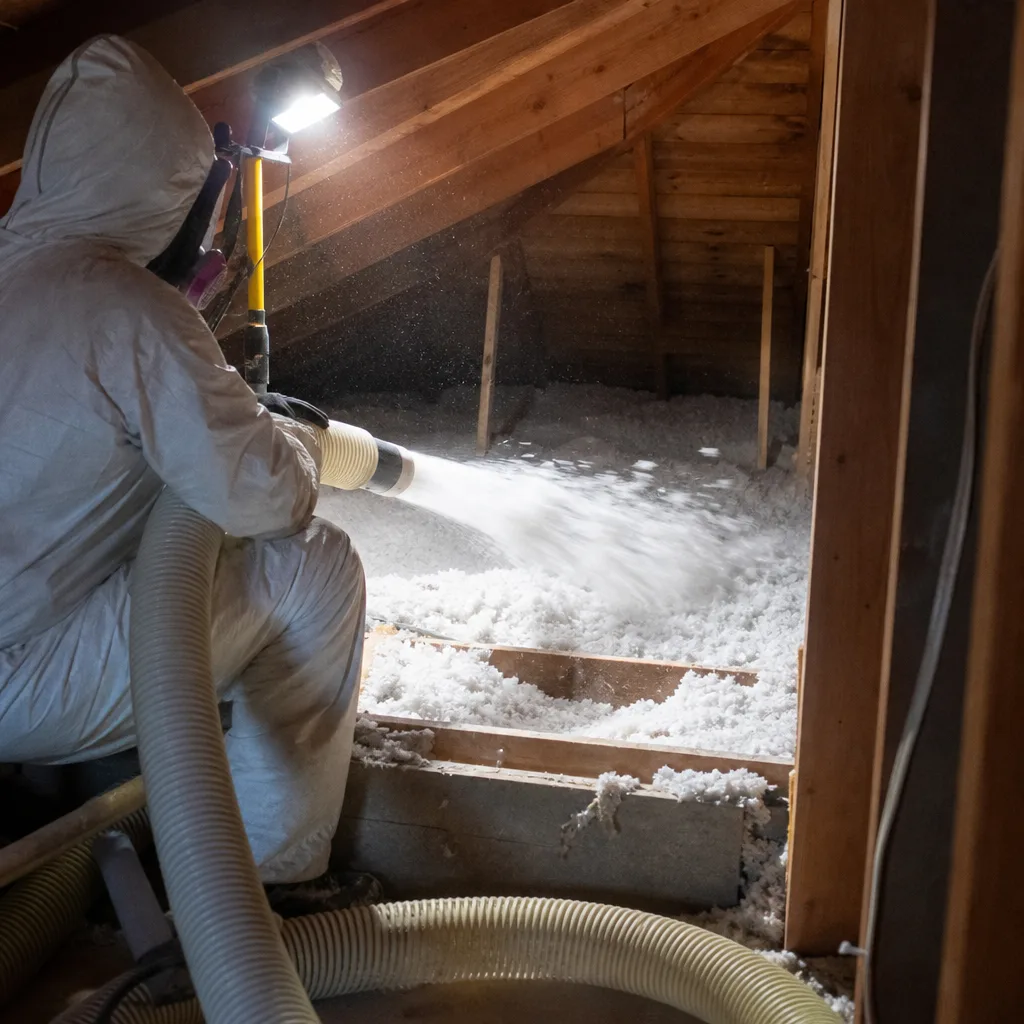
If the inspection reveals low depth or settled material, February and March are ideal months for a blown-in top-off. Adding 6 – 10 inches of cellulose or fiberglass over existing material restores lost R-value quickly and affordably. We’ve done top-offs in North Tustin where the existing insulation had settled by nearly 40% from its original installed depth. The homeowners noticed the difference within the first warm week.
June – September: Monitoring Without Entering the Attic
No one should be crawling into a North Tustin attic in August. Attic temperatures regularly exceed 140°F during peak heat, and even a brief inspection puts you at risk of heat exhaustion. But you don’t need to go up there. Your house gives you three proxy indicators that tell you exactly how your insulation is performing from the comfort of the living space.
The first is duct sweating. If you see condensation forming on exposed ductwork in the garage or utility closet, that’s a signal that the temperature difference between the conditioned air inside the duct and the surrounding air is too high. Well-insulated attics keep ducts in a cooler environment and reduce this sweating. It’s a canary signal that attic conditions are running hotter than they should be.
The second is room temperature differentials. Walk through your house at 3 p.m. on a 95°F day. Are the upstairs bedrooms 8 – 10 degrees warmer than the downstairs living room? Some variation is normal in any two-story home, but a consistent, wide gap suggests uneven attic insulation coverage. Bedrooms on the west and south sides of the house will always run warmer due to direct wall exposure, but the attic is often the bigger culprit.
The third is utility bill spiking. Compare your June, July, and August bills side by side. If July is triple your January bill and your thermostat setting hasn’t changed, your cooling system is fighting heat gain that insulation should be blocking. Southern California Edison usage data, available through your online account, lets you see hour-by-hour consumption patterns. A prolonged afternoon plateau of AC usage is the signature of an overworked system.
If any of these three signals shows up, document it. Note the dates, the outdoor temperatures, and which rooms were affected. This data is gold when you’re evaluating bids, because it tells a contractor exactly where the problem is concentrated, not just that a problem exists.
October – November: The Post-Santa Ana Checklist
Santa Ana winds are a unique North Tustin phenomenon that most generic insulation guides never address. Winds howl down through the Cajon Pass and Santa Ana Canyon, hitting foothill homes with sustained speeds that can top 40 mph. In attics with soffit or gable vents, this wind doesn’t just blow past the house. It pressurizes the attic and can physically move insulation material.
We’ve seen attics where blown-in fiberglass was stacked 10 inches deep in the center and scoured nearly bare at the eaves, all from years of wind-driven air movement. Fiberglass batts get lifted at the edges, creating seams that let conditioned air leak through. Even closed-cell spray foam, which adheres directly to the roof deck and doesn’t move, can’t prevent the general pressurization that stresses every other seal in the attic.
Here’s a numbered post-Santa Ana checklist for late October and early November:
- After the first significant wind event of the season, visually inspect the exterior soffit vents. Are any dented, displaced, or blocked with debris? Damaged vents create larger openings that let in more wind-driven air.
- Check the attic access hatch seal. Wind pressurization can flex the hatch frame and break the weatherstripping seal. A loose hatch is a direct thermal bypass.
- Feel for drafts around ceiling fixtures. On a windy day, hold a thin tissue near recessed lights, ceiling fans, and bathroom vent fans. If the tissue flutters, air is being pushed through the attic floor.
- Schedule a professional attic inspection if you haven’t had one in the previous 18 months. The goal is to check insulation depth and distribution before winter heating season begins.
- Look for roof debris and granule loss. Santa Anas carry grit and small branches. Significant roof granule accumulation in gutters means the shingle surface is degrading, and a degraded roof deck amplifies attic heat in summer.
The October – November window is also the best time to complete any insulation upgrades flagged during your February inspection. More on that in the scheduling section below.
Radiant Barrier in Summer vs. Mineral Wool in Winter: Two Different Mechanisms
North Tustin homeowners often ask whether they should install a radiant barrier or upgrade their conventional insulation. The answer is that these are two different tools addressing two different thermal mechanisms. Understanding which one helps in which season tells you what your home actually needs.
A radiant barrier is a reflective surface, typically aluminum foil, installed on the underside of the roof deck. In summer, it works by reflecting radiant heat away from the attic space. Roof decking can reach 150°F in July, and that heat radiates downward toward your insulation and ultimately your ceiling. A properly installed radiant barrier can reduce that radiant transfer significantly, keeping the attic air cooler and reducing the load on your insulation below.
But here’s the key point about radiant barriers in North Tustin’s climate: they do almost nothing in winter. When nighttime temperatures drop into the 40s, the primary heat-loss mechanism in your home is conductive and convective flow of heated indoor air through the ceiling into the attic, not radiant transfer. A reflective surface can’t stop warm air from rising through gaps and ceiling penetrations.
Winter thermal performance comes from mass insulation: fiberglass, cellulose, or mineral wool. Rockwool mineral wool, specifically, excels here because of its density and thermal mass. It slows conductive heat transfer through the ceiling plane and resists convective loops within the insulation itself. A home with R-38 mineral wool in the attic and no radiant barrier will outperform a home with a radiant barrier and R-13 batts during a cold January night.
The smart North Tustin approach, where budget allows, is a combined strategy: dense conventional insulation on the attic floor, plus a radiant barrier at the roof deck. The conventional insulation handles year-round conductive losses. The radiant barrier handles the summer radiant spike that’s unique to sun-exposed Southern California roofs.
Why October – November Is the Smartest Time to Book Insulation Work
Here’s the scheduling insight most North Tustin homeowners miss: insulation contractors in the 714 area code are running flat-out from June through September. Every AC failure sends homeowners searching for ways to cut cooling costs, and insulation retrofit projects surge accordingly. Wait times for estimates stretch to three weeks. Crews work in the hottest, most dangerous attic conditions of the year. And pricing reflects the demand spike.
October and November flip that equation. The first cool nights signal the end of the emergency cooling season. Homeowners stop thinking about their attics. Contractor schedules open up. Crews can work in safe, comfortable conditions. And because demand is soft, you’re more likely to get a competitive bid.
For most North Tustin homes, the ideal timeline looks like this: February inspection to identify issues, early October material selection and scheduling, installation completed before Thanksgiving. You head into the winter heating season with a fully upgraded attic, and you’re positioned to handle the following summer with zero drama.
One more scheduling variable: federal and local utility rebates for insulation upgrades often operate on calendar-year cycles. By scheduling work in the fall, you can typically capture any available incentives before the December 31 deadline, while avoiding the spring rush.
Common Mistakes to Avoid
- Inspecting the attic in July by yourself. Attic temperatures above 120°F create a genuine risk of heat exhaustion or worse. If you must check something in summer, do it from the hatch opening only and keep it under two minutes.
- Assuming new insulation means no further maintenance. Even fiberglass batts and spray foam settle, get disturbed, or develop bypasses over time. An inspection every 18 – 24 months is cheap insurance.
- Focusing only on winter heating costs when evaluating insulation ROI. In North Tustin, cooling costs are the bigger line item. A poorly insulated attic costs you money for seven months of the year, not just the four coolest ones.
- Using the same insulation depth for every attic zone. The east-facing side of a North Tustin roof gets different solar loading than the west-facing side. Some attics benefit from zone-specific depth adjustments.
- Ignoring the attic hatch as a thermal leak. An uninsulated hatch can account for a surprising share of total ceiling heat transfer. It’s the easiest fix on the whole checklist.
- Postponing post-Santa Ana inspections until spring. Wind-driven insulation displacement gets worse over time, and every winter cold snap after a wind event costs you additional heating dollars.
When to Call a Professional
There’s a clear line between homeowner-level monitoring and professional intervention. Cross it when you notice any of these: visible moisture staining on the underside of your roof deck, rodent activity in the attic, insulation depth below 6 inches in multiple locations, room temperature differentials above 10 degrees on a moderate day, or a utility bill spike you can’t explain with thermostat changes. These are structural or systemic issues, not maintenance items. A trained eye can identify the specific failure point and recommend whether you need a top-off, full replacement, air sealing, or a material switch like moving from fiberglass to spray foam or mineral wool. North Tustin Insulation offers free estimates in North Tustin – call (877) 265-5712 and we’ll help you figure out what your attic actually needs.
Frequently Asked Questions
Every 18 to 24 months is the right interval for most North Tustin homes, with the inspection timed for February – March or October – November when attic temperatures are safe. After major Santa Ana wind events, add a spot-check of the access hatch and eave areas. Call (877) 265-5712 if you want help scheduling your next inspection.
Most North Tustin homes perform best with R-38 to R-49 in the attic, which translates to roughly 12 to 16 inches of blown-in fiberglass or cellulose depending on the product. Older North Tustin homes often have R-19 or less, which is a significant performance gap in both the summer and winter seasons.
Yes, in most cases. Radiant barriers are especially effective in sun-exposed, dark-shingled North Tustin attics where July roof deck temperatures exceed 140°F. They work best alongside adequate conventional insulation, not as a replacement for it. Icynene spray foam applied to the roof deck can serve a similar function while adding air-sealing benefits.
Measure the depth in multiple locations across your attic floor. If depth varies by more than 2 inches between the center and the eaves, or if the total depth has dropped below 10 inches for fiberglass or 8 inches for cellulose, it’s time for a top-off. February and March are the ideal months for this work in North Tustin. Call (877) 265-5712 for an exact assessment and free estimate.
Yes. Sustained wind pressurization can lift fiberglass batts, push blown-in material into uneven piles, and break the weatherstripping seal on your attic hatch. Homes with older soffit or gable vents are most vulnerable. Inspect after the first major wind event each fall and address any displacement before winter heating season begins.
In many cases, yes. Closed-cell Icynene or Demilec spray foam seals air gaps that older fiberglass installations simply can’t address, especially in complex rooflines common to foothill custom homes. The tradeoff is cost: spray foam is significantly more expensive per square foot than blown-in coverage. The right answer depends on your attic geometry and your home’s specific air-leak profile.
The Bottom Line
North Tustin insulation care isn’t about seasonal to-do lists. It’s about understanding your home’s exposure to two distinct thermal threats, summer radiant loading and winter heat loss, plus one regional weather pattern, Santa Ana wind pressurization, that disrupts insulation physically. Inspect in February or March to catch problems before cooling season. Monitor from the living space in June through September. In October and November, check for wind damage and schedule any needed upgrades when contractor availability is highest and pricing is most reasonable. Your attic is doing silent work every day of the year. Make sure it’s set up to succeed, and it will pay you back in lower utility bills, fewer hot rooms, and a home that holds its temperature no matter what the Santa Anas bring.
Written by the team at North Tustin Insulation, serving North Tustin since 2011.