
Spray Foam Insulation in Running Springs: Cost, Brands, and Real Mountain-Home Solutions
Spray foam insulation in Running Springs typically costs $2,800 to $7,500 for a full attic or roof deck application, with wall cavity work running $3,200 to $6,800 depending on square footage and access. Rim joist spray foam for the pier-and-beam foundations common up here is usually a $1,000 to $2,800 project. For a free, line-item estimate on your Running Springs home, call North Tustin Insulation at (877) 265-5712.
Running Springs is not like the flatland cities down the mountain. At roughly 6,000 feet in the San Bernardino range, your home deals with sub-freezing winters, real snow load, and Santa Ana wind events that push embers into roof vents and eaves. That changes what spray foam needs to do here. Our Spray Foam Insulation work in Running Springs gets built around two pressures most insulation contractors never think about together: wildfire ember resistance and ice dam prevention.
What Makes Spray Foam in Running Springs Different
Most spray foam guidebooks were written for tract homes in Riverside or Ontario. They focus on cooling loads and summer heat gain. That’s not the problem here. In Running Springs, the insulation in your roof deck, kneewalls, and rim joists has to hold heat through hard winter freezes while also sealing the vent path against ember intrusion during red flag days. Single-digit nights and three-foot snow dumps mean the assembly has to be both air-tight and ignition-aware.
A cabin built in 1965 up off Highway 18 doesn’t behave like a 2010s stucco home in Highland. The rafter bays are often open to the outside at the top plate. The kneewalls were handed a strip of R-11 batt, maybe, if anyone bothered. The raised foundation lets cold air pour up through the floor. Spray foam is the only single material that addresses air movement, thermal resistance, and, in closed-cell form, a measure of ember protection at the same time.
Why North Tustin Insulation Handles Running Springs Homes
We’re an insulation-exclusive contractor. That means when we show up to a job in Running Springs, we’re not trying to sell you a roof or a furnace on the side. Allen Decker built North Tustin Insulation around one trade, and that focus shows in how we carry materials and how we approach a mountain retrofit. We stock Icynene and Demilec spray foam systems, so your estimate is based on what your cabin actually needs, not whatever foam kit happens to be on the truck.
Running Springs homes are a particular kind of challenge. Pier-and-beam foundations flex with freeze-thaw cycles. Vaulted open-beam ceilings from the 1960s leave nowhere to hide a mistake. Roads tighten up in snow years. We plan material staging so a full spray foam crew isn’t stuck halfway up a switchback in February. When you call North Tustin Insulation at (877) 265-5712, you’re talking to a team that knows Highway 330, Highway 18, and the kind of house that waits at the top of both.
Spray Foam Wall Insulation in Running Springs
Spray Foam Wall Insulation in Running Springs means filling wall cavities with open-cell foam for sound and air sealing, or closed-cell foam where you also need structural strength and an ignition-resistant surface. For older cabins in the 92382 area, wall work usually means opening interior drywall or working from the exterior sheathing side, depending on what’s behind the siding. A typical whole-wall retrofit in Running Springs runs $3,200 to $6,800, with a single wall or kneewall job coming in on the low end.
Kneewalls in Older Mountain Cabins
If you have a 1960s or 70s cabin with upstairs bedrooms, those short angled walls between the living space and the unheated attic are usually empty. We spray directly against the kneewall framing and then add a thermal barrier. The goal is to kill the cold-air channel that turns that bedroom into an icebox by morning.
Closed-Cell for Fire-Aware Assemblies
Closed-cell foam gives you roughly R-6.5 to R-7 per inch and creates a finished surface that resists ignition better than open-cell. In a Running Springs wall assembly, that distinction matters during Santa Ana conditions when embers find their way into wall cavities through vents and gaps.
Rim Joist Spray Foam in Running Springs
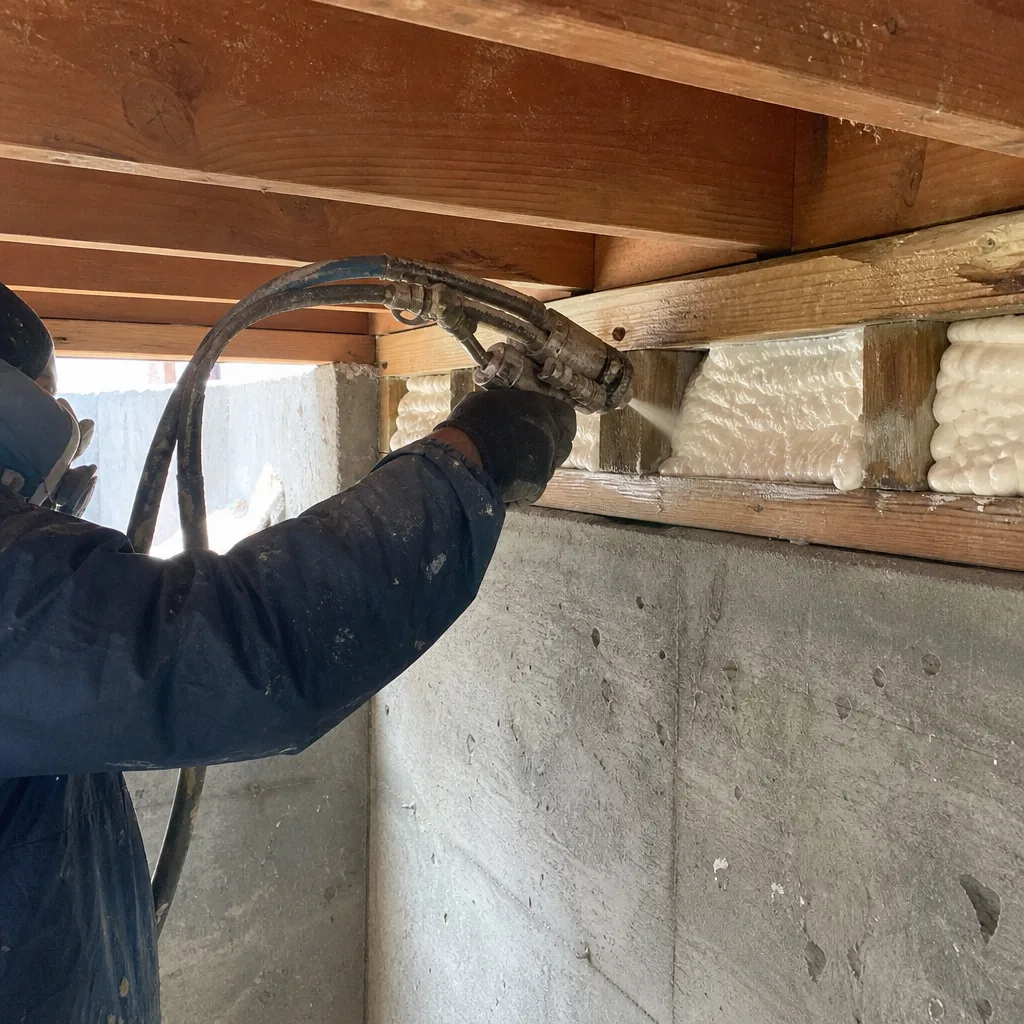
Rim Joist Spray Foam in Running Springs attacks the gap between your foundation and your floor framing, the exact place where cold mountain air pours into raised foundations all winter. In a pier-and-beam cabin, that rim joist band is one of the leakiest parts of the structure. Sealing it with closed-cell foam runs $1,000 to $2,800 for a typical Running Springs home, depending on crawlspace access and how many linear feet we’re covering.
Freeze-Thaw and Ground Movement
Running Springs foundations move. Snow melt saturates the soil, temperatures swing hard, and the ground shifts slightly each season. Standard spray foam can crack at the rim joist seams over a few years. That’s why we use flexible foam formulations and pay attention to joint prep here, so the air seal survives the movement instead of splitting at the edges.
Stopping the Cold Floor Problem
Rooms over a raised foundation stay cold because the floor assembly acts like a heat sink. The rim joist is the main air leak, but the full band needs addressing. Sealing the rim stops the air movement that makes your feet cold even when the thermostat says 70.
Trusted Brands We Service in Running Springs
North Tustin Insulation carries Icynene and Demilec, two of the spray foam industry’s most tested systems. For Running Springs customers who want a hybrid approach, we also work with GreenFiber cellulose and Owens Corning fiberglass in specific applications. That matters because a 1940s cabin off Highway 18 needs different materials than a newer custom build near the lake side. Eight brands in our lineup means we recommend what the house calls for. No fake choices. No brand-in-the-truck sales pitch.
Common Spray Foam Insulation Problems We See in Running Springs Homes
- Foam sprayed directly over pine needles and tar paper. In rafter bays of older cabins, we find the “insulation” is just organic debris. Closed-cell foam will not bond to that surface. Any contractor who sprays over it is sealing in moisture and inviting condensation inside the roof deck. We remove debris first, always.
- Ice dams at the eaves from uninsulated roof decks. Heat leaks through the open rafter bays, melts the snow on the roof, and water refreezes at the cold eave line. Closed-cell foam on the roof deck stops the heat leak that starts the whole cycle.
- Missing thermal barriers around recessed lights and vents. In vaulted open-beam ceilings, spray foam without proper covers creates a path for embers during Santa Ana events. Proper thermal barrier installation is not optional up here.
- Cracked rim joist foam from ground movement. Freeze-thaw cycles in the 92382 area shift pier-and-beam foundations enough to split rigid foam at the rim. We see it on cabins that were sealed once and left alone. The fix is flexible closed-cell foam reapplication, not more of the same.
Pricing for Spray Foam Insulation in Running Springs, CA
Here’s what we see in the Running Springs market right now. Roof deck spray foam in open rafter bays runs $2,800 to $7,500 for a typical cabin, depending on roof area and whether we need to remove old debris first. Wall cavity work lands between $3,200 and $6,800. Rim joist sealing is $1,000 to $2,800. Closed-cell foam runs higher than open-cell on a per-board-foot basis, but you get roughly twice the R-value per inch plus the ignition-resistant surface. Access is a factor too: a narrow driveway off a winding side road adds staging time. Call (877) 265-5712 and we’ll give you a straight range for your specific house, free.
We Also Serve Cities Near Running Springs
North Tustin Insulation covers the San Bernardino mountain communities. In addition to Running Springs, we regularly work in Lake Arrowhead, Highland, Mentone, and Crestline. Same materials, same crew standards, same straight pricing, whether your home is at 6,000 feet or down in the valley.
Serving Running Springs, CA — Our Local Coverage Area
We’re based in the Running Springs area and know this community well. Use the map below to see our service coverage — if you’re nearby, we can almost certainly help.
FAQs About Spray Foam Insulation in Running Springs
Spray foam stops ice dams by sealing the air leaks in your roof deck that let warm interior air melt snow on the roof. In Running Springs, ice dams form at eaves when heat escapes through under-insulated rafter bays, melts the snowpack, and the meltwater refreezes at the cold eave. Closed-cell foam on the roof deck cuts the heat movement so snow stays put instead of melting, refreezing, and backing water under shingles. Call (877) 265-5712 to have someone assess your roof deck before the next heavy snow year.
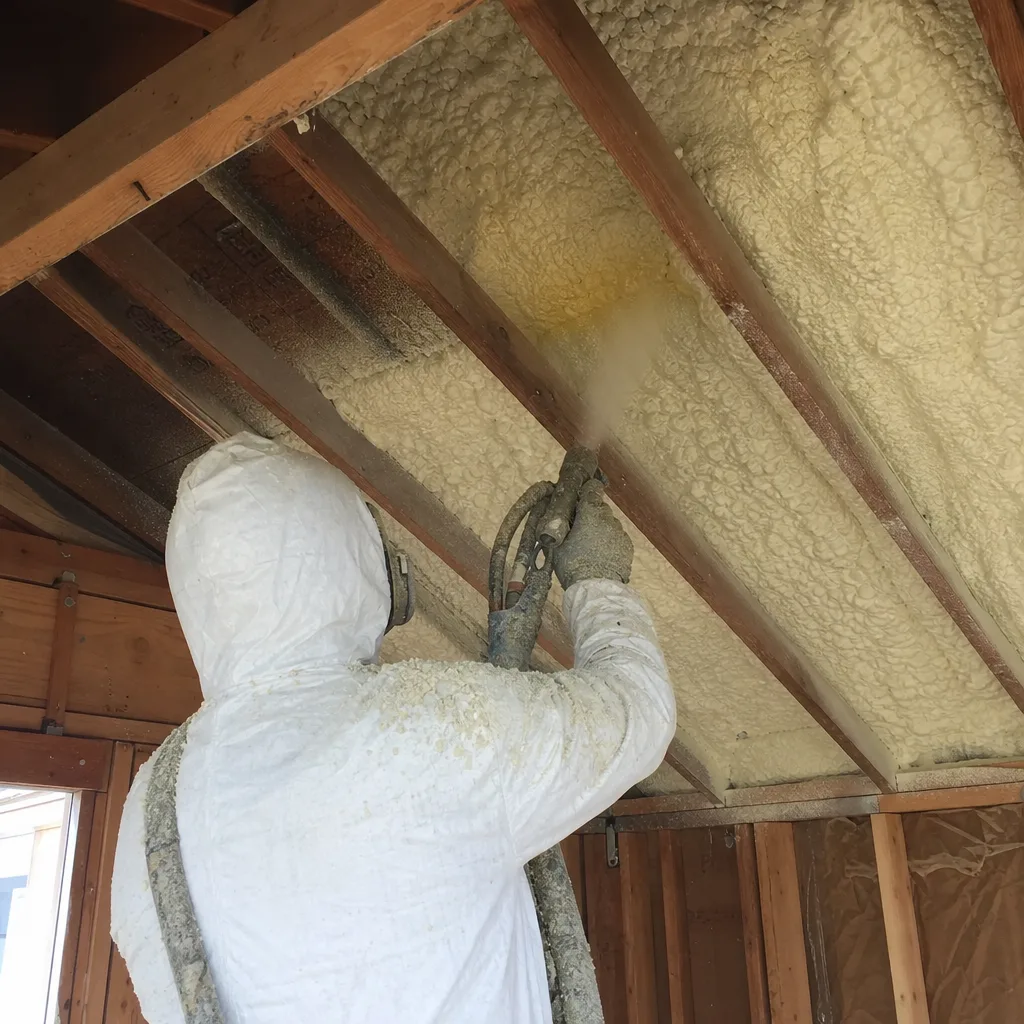
Yes, and it’s one of the best retrofits for that exact construction. The rafter bays in a 1960s Running Springs cabin are often open to the ridge, with nothing but tar paper or pine needles sitting in them. We remove the debris, prep the wood surface, then spray closed-cell foam directly to the roof deck between rafters. It air-seals and insulates in one step, and it creates a continuous surface that holds heat in winter. This is one of the most common jobs we do in the 92382 area.
Closed-cell foam is the better choice for wildfire-aware assemblies. It creates a denser, ignition-resistant surface than open-cell foam, which matters at vents, eaves, and gaps where embers enter during Santa Ana wind events. In Running Springs, where defensible space is a real concern up and down Highway 18, we recommend closed-cell at the roof deck and any place related to exterior vent paths. Call North Tustin Insulation for a material-specific recommendation on your house.
We stage materials in stages for Running Springs jobs, not by loading a full truck at the base of the hill and hoping the road is clear to the top. In snow years, roads off Highway 18 and 330 can be tight, and our crews plan around what a flatland contractor never has to think about: where to park the trailer, how to get foam barrel sets up a steep driveway, and how to schedule around plowing. If you live on a winding mountain lane, tell us when you call so we can plan your estimate around actual access conditions.
For a roof deck or ceiling application in Running Springs, we recommend an R-value between R-30 and R-49, depending on your heat source and whether the space is open or vaulted. Closed-cell foam delivers roughly R-7 per inch, so 5 to 7 inches on the roof deck works for most cabins. Wall cavities need R-20 to R-25, which translates to about 3 inches of closed-cell or more if you’re using open-cell. The real number depends on your exact framing depth and whether the house has a traditional attic or open-beam construction. We calculate it free during an estimate.
Get Your Running Springs Spray Foam Estimate
If your Running Springs home is leaking heat in winter, sweating in summer, or developing ice dams at the eaves, spray foam may be the fix. But the right answer depends on your roof structure, foundation type, and what your existing insulation is actually doing. Call North Tustin Insulation at (877) 265-5712. Allen Decker and our team will walk your house, look at the real conditions, and give you a material-specific recommendation and a straight price. No generic pitch. Just the right foam system for a mountain house that has to handle both fire and freeze.
Written by Allen Decker, Owner at North Tustin Insulation, serving Running Springs and the San Bernardino mountain communities.