
Spray Foam Insulation in San Antonio Heights, CA: What It Costs and Why Foothill Homes Need a Different Approach
Spray foam insulation in San Antonio Heights typically runs $2,800 – $7,200 for a full attic project and $1,100 – $3,400 for wall applications, depending on whether you need open-cell or closed-cell foam and how much of the roof plane is vaulted or open-beam. Most homes in the 91784 zip code were built between the 1950s and 1990s, and many have framing that flatland tract homes don’t, so a one-size-fits-all quote from an out-of-area contractor usually misses what’s actually happening in your attic. We carry both Icynene and Demilec spray foam systems because the right chemistry depends on where you’re spraying: closed-cell for wind-driven ember resistance and structural stiffness at the roof plane, open-cell for cavity walls and interior sound control. That material choice matters up here, and it’s a decision we make with you, not for a truckload of whatever’s cheapest. Call (877) 265-5712 for a free estimate that starts with what’s actually in your attic, not a square-footage guess.
Key Takeaways for San Antonio Heights Homeowners
- Closed-cell spray foam doubles as an air seal at eave and gable vents, which matters when Santa Ana winds push fine dust and embers into foothill attics.
- Vaulted and open-beam ceilings, common in San Antonio Heights custom homes from the 1950s through 1990s, often leave no flat deck for blown-in batts. Spray foam reaches the roof plane directly.
- We carry eight insulation brands including Icynene, Demilec, Owens Corning, and Johns Manville, so the material recommendation comes from your home’s actual framing and exposure, not our inventory.
- The same crew handles the detached garages and shops that sit on these large foothill lots, not just the main house.
Why Spray Foam Beats Flatland Insulation Logic in San Antonio Heights
San Antonio Heights isn’t Upland or Rancho Cucamonga, and the difference isn’t just elevation. Homes here sit at 1,500 to 2,000-plus feet on the southern slope of the San Gabriel Mountains. That means the sun hits harder in summer, the nights cool faster in winter, and when the Santa Anas blow, they do not blow gently. They funnel through the foothills with enough force to drive dust and embers into attic vents that flatland contractors never think to seal. Here’s the thing: spray foam in San Antonio Heights has to do two jobs at once. It needs to insulate, yes. But it also needs to act as an ember- and dust-blocking air seal at eave and gable penetrations. Foam that doesn’t seal those openings leaves the house exposed even after the R-value goes up. We’ve seen it. On a ridge-side custom home above 91784, our crew found a vaulted open-beam great room where the original batts had settled and pulled away from the roof plane. Santa Ana winds had been pushing fine dust through the gable vents for years. We sealed the gable and eave penetrations, sprayed closed-cell Icynene tight to the roof deck and rafter bays, then finished the detached shop’s walls with open-cell foam for a quiet, draft-free workspace. The homeowner told us the upstairs rooms held temperature through the afternoon sun and the wind-driven dust intrusion stopped. That’s the kind of fix a generic Spray Foam Insulation contractor in the flatlands won’t think to do, because their job sites don’t behave like this.
Spray Foam Attic Insulation in San Antonio Heights
Spray Foam Attic Insulation in San Antonio Heights usually means working with roof planes that were never designed for standard batts. Homes here were often custom-built with vaulted or open-beam ceilings, which leaves little or no flat attic deck. Most of these houses date from the 1950s through the 1990s, and the original insulation, where it existed at all, has settled, thinned, or been pulled apart by decades of temperature swings and wind. A typical attic spray foam project in San Antonio Heights runs $2,800 to $7,200, with closed-cell foam at the higher end because it air-seals and adds racking strength in one pass. We use Icynene and Demilec systems, and the choice between open-cell and closed-cell depends on how exposed the roof is and whether the framing needs the stiffness closed-cell provides.
Vaulted and Open-Beam Ceilings
Spray foam is often the only insulation that can reach the roof plane on these ceilings without invasive framing work. Blown-in or batts simply have nowhere to sit when the ceiling follows the roofline. We spray directly against the underside of the roof deck, filling rafter bays completely. That stops radiant heat from getting into the living space at all, which matters when summer afternoons here push into the triple digits.
Removing Old Batts First
One mistake we see repeatedly in San Antonio Heights is spraying new foam over old, settled fiberglass. The old batts trap heat and hide gaps, and the new foam can’t do its job. We remove and evaluate the existing insulation before spraying. If you’ve got an addition that was never properly insulated in the first place, pulling the old material is the only way to see what’s actually going on at the roof plane.
Spray Foam Wall Insulation in San Antonio Heights
Spray Foam Wall Insulation in San Antonio Heights typically costs $1,100 to $3,400 for a single-story exterior wall application, and it solves a different problem than attic work. These homes sit on large lots, but many have additions, bump-outs, and detached workshops that were built at different times, sometimes with inconsistent or missing wall insulation. Open-cell spray foam works well in those cavities because it expands to fill odd framing and doesn’t require tearing out drywall in most cases. For exterior walls facing the Santa Ana wind path, closed-cell foam adds an air barrier that batts can’t match.
Additions and Bump-Outs
Additions on foothill homes are notorious for framing that doesn’t match the original structure. Stud bays vary in depth, there are gaps at the rim joist, and the old insulation, if any, was usually an afterthought. Spray foam handles irregular cavities better than any batt or blown-in material. We spray the walls, the band joist, and any chases where air moves between floors. The result is a contiguous air seal on walls that previously leaked heat all winter.
Detached Garages and Shops
Most San Antonio Heights properties have a detached garage, shop, or both. These structures are rarely insulated at all, which makes them brutally hot in summer and freezing on cool winter mornings. Open-cell spray foam on the walls and under the roof deck turns a tin-walled shop into a usable workspace on a July afternoon. The quiet difference is noticeable too. Foam cuts the noise from outside and the echo inside, which matters if the shop doubles as a workshop or studio.
Trusted Brands We Service in San Antonio Heights
North Tustin Insulation carries eight insulation brands across fiberglass, mineral wool, cellulose, and spray foam, and the reason we do that is simple: no single material is right for every house in San Antonio Heights. When a ridge-side custom home needs closed-cell foam for ember resistance, we reach for Icynene or Demilec. When a client wants a recycled-content option, GreenFiber cellulose is on the truck. When a project calls for fiberglass in specific cavity applications, Owens Corning and Johns Manville are both in our lineup. We match the material to your home, not the other way around. For San Antonio Heights customers, carrying multiple brands means we don’t have to force a square peg into a round hole just because it’s what we happen to stock.
Common Spray Foam Insulation Problems We See in San Antonio Heights Homes
- Old batts settling in vaulted ceilings: The original fiberglass in 1950s through 1990s custom homes has usually slipped or compressed over the decades, leaving the roof plane essentially bare. Spraying foam without removing it first hides the problem instead of fixing it.
- Santa Ana wind dust and ember intrusion: Wind forces fine particulate through eave and gable vents. Foam that doesn’t seal those penetrations leaves the home exposed, even with a brand-new R-value elsewhere.
- No flat attic deck to work with: Vaulted and open-beam ceilings mean standard blown-in insulation plans don’t translate. Off-the-shelf spray foam estimates fail here because site-built rafter-bay detailing is required.
- Uninsulated additions and bump-outs: Many foothill homes grew over time, and the added rooms often skipped insulation entirely. These areas leak conditioned air and undo the performance of the rest of the house.
Pricing for Spray Foam Insulation in San Antonio Heights, CA
We Also Serve Cities Near San Antonio Heights
North Tustin Insulation works throughout the foothill communities and the cities below. If you’re in Upland, Claremont, Rancho Cucamonga, or Montclair, we run crews there regularly. The same eight-brand lineup and the same foam expertise applies, whether the house sits on a ridge or in a flatland tract. Call us and we’ll tell you which material makes sense for your specific roof and wall assembly.
Serving San Antonio Heights, CA — Our Local Coverage Area
We’re based in the San Antonio Heights area and know this community well. Use the map below to see our service coverage — if you’re nearby, we can almost certainly help.
FAQs About Spray Foam Insulation in San Antonio Heights
San Antonio Heights sits at 1,500 to 2,000-plus feet on the south slope of the San Gabriels, so attics here take intense afternoon sun and get hit by Santa Ana winds that push dust and embers into eaves and gable vents. Spray foam does double duty on these homes: it controls radiant heat and seals the penetrations that let wind-driven debris into the attic. Flatland homes don’t face the same wind exposure, so their insulation needs are simpler. Call (877) 265-5712 to talk about what your specific roofline is up against.
Yes. Spray foam is often the only insulation that works well on vaulted and open-beam ceilings because it’s applied directly to the underside of the roof deck, filling rafter bays completely. Blown-in or batt insulation needs a flat attic floor to sit on, and these homes often don’t have one. We spray closed-cell Icynene or Demilec tight to the roof plane, which stops radiant heat before it enters the living space and adds structural stiffness at the same time.
Remove it. We don’t spray over old, settled fiberglass in San Antonio Heights homes because the old material traps heat and hides gaps, defeats the purpose of the new foam. We pull the old insulation, assess what’s underneath, seal the air penetrations, and then spray. Skipping this step is the most common mistake we see from contractors who don’t work in this housing stock. Estimates are free, and we’ll show you exactly what we’re removing before any foam goes in.
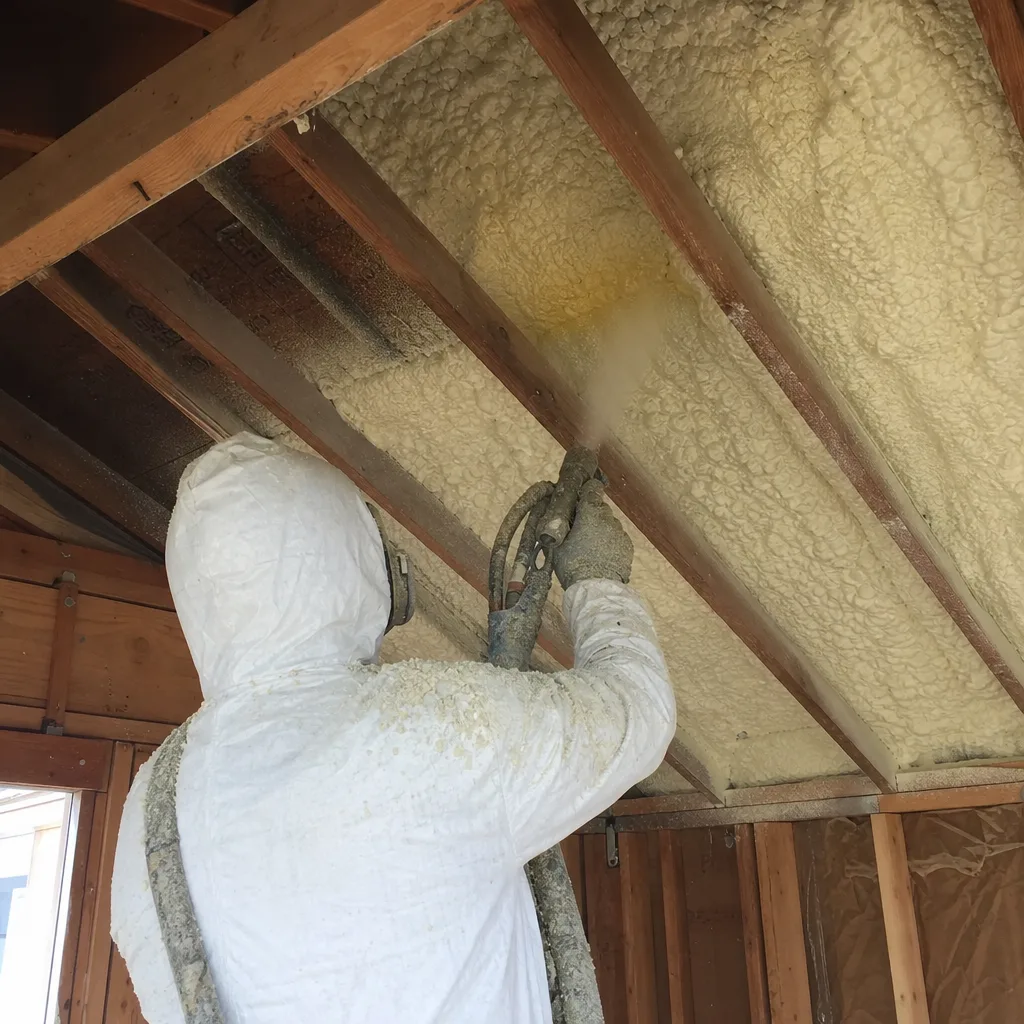
Closed-cell spray foam is dense enough to act as an air barrier at eave and gable vents, and it stops fine dust and embers from entering through those openings. That’s the big advantage over fiberglass, which filters air rather than sealing it. On ridge-side properties in San Antonio Heights, we treat ember sealing as a primary function of the foam, not a bonus. Call (877) 265-5712 and we’ll walk you through which vents need sealing on your house.
We do them regularly. Most San Antonio Heights properties have detached garages, shops, or both, and they’re usually uninsulated, which makes them unusable on hot summer afternoons and cold winter mornings. Open-cell spray foam on the walls and under the roof deck turns these structures into conditioned workspace, and it cuts exterior noise noticeably. The cost is separate from the main house quote, and we’ll break it out clearly so you know exactly what each structure costs.
Get a Free Estimate for Spray Foam Insulation in San Antonio Heights
If you live in the 91784 area and you’re tired of rooms that roast in summer, freeze in winter, or fill with dust every time the Santa Anas blow, we can tell you exactly what’s going on in your attic and what it’ll take to fix it. North Tustin Insulation carries eight brands, three installation methods, and a spray foam team that’s worked the vaulted, open-beam, wind-exposed houses that define this community. Call (877) 265-5712 for a free estimate. Allen Decker and the crew will give you a straight answer about what your house actually needs.
Written by Allen Decker, Owner at North Tustin Insulation, serving San Antonio Heights and the surrounding foothill communities.