
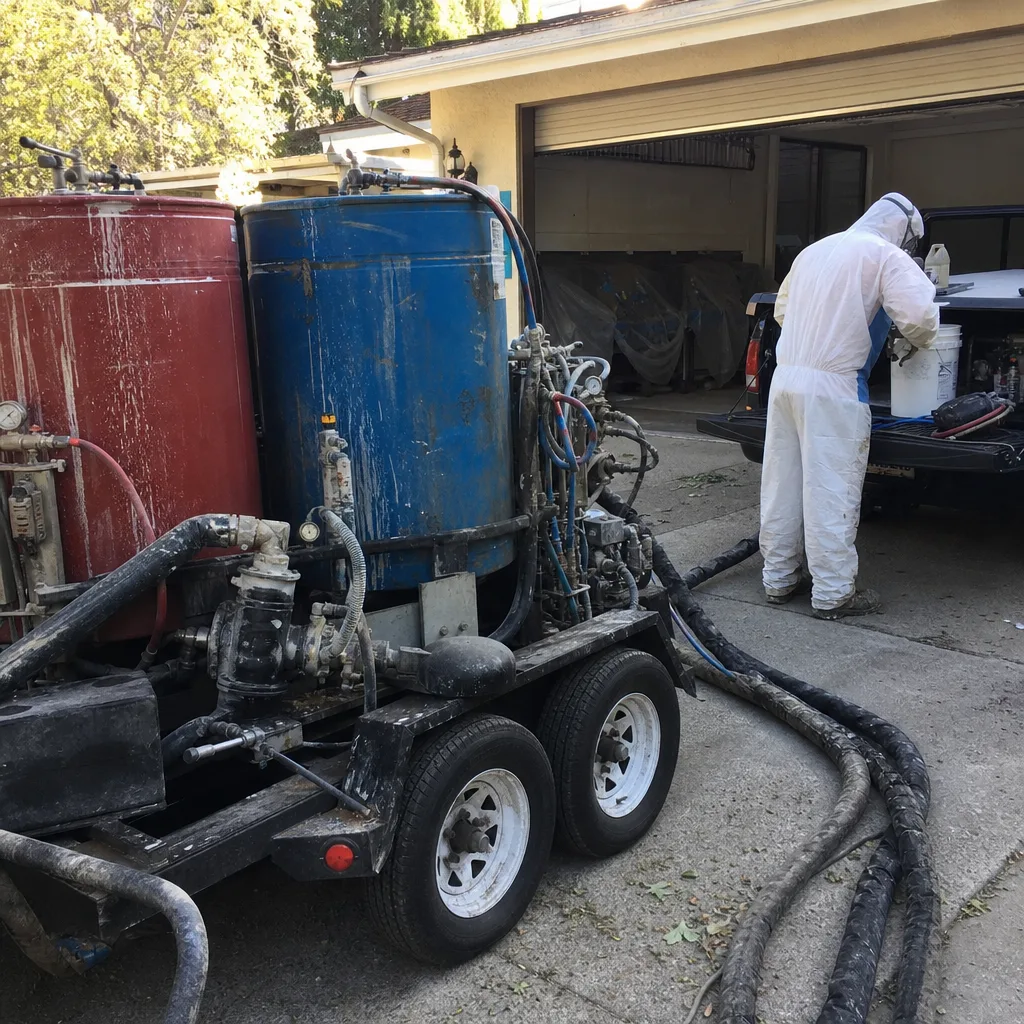
Fast, Reliable Spray Foam Insulation Across Stanton
Spray foam insulation in Stanton typically costs $2,800 to $7,500 for a full attic retrofit, with rim joist sealing running $1,200 to $2,400. Most Stanton jobs are completed in one to two days, and we work around tight lot lines and zero-lot-line setbacks that make this city different from its neighbors. If you live in a 1950s-to-1970s tract home south of Katella or off Beach Boulevard, you already know the drill: summer attics that hit 140°F and electric bills that spike past $300. Call (877) 265-5712 and we’ll walk the attic with you, tell you exactly what’s there now, and give you a number you can plan around.
Why North Tustin Insulation Is Stanton’s Preferred Spray Foam Insulation Company
We’re an insulation-only contractor. That’s not a tagline. Every estimate we write in Stanton, every call we take from a homeowner near Cerritos Avenue or Orangewood Avenue, is focused on one trade. We carry Icynene and Demilec spray foam, alongside Owens Corning and Johns Manville products, so the material conversation starts with your attic’s actual condition, not whatever happens to be on our truck. Stanton’s housing stock is specific: compact 1,100-to-1,400-square-foot tract homes, low-slung roofs, and walls that were never insulated. We know what lurks in those attics because we’ve opened dozens of them in the 90680 zip code.
Allen Decker runs our estimating team. When you call, you get a straight answer about what your attic needs, what it doesn’t, and what it’ll cost. No generalist pitch for a roofing job. No add-on window replacement scare. Just insulation, done by people who understand how foam behaves in Orange County’s heat and in Stanton’s tight building envelopes.
Our crews are in Stanton every week. We keep our scheduling tight enough that a standard attic spray foam job can usually be booked within a week, and we’ll tell you upfront if your project needs a permit or if knob-and-tube wiring needs to be addressed before we spray anything.
Spray Foam Wall Insulation in Stanton
Spray Foam Wall Insulation in Stanton is almost always a retrofit job, not new construction. Walls in 1950s and 1960s stucco boxes were rarely insulated at all, which is why rooms on the west side of these homes bake in the afternoon. We usually inject open-cell Icynene foam through small drilled holes in the stucco or from the interior drywall, filling the stud cavities without tearing open entire walls. Expect to pay between $3,000 and $6,500 for a typical 1,200-square-foot Stanton home, depending on how many exterior walls you’re treating.
Open-Cell Wall Injection
Open-cell foam expands gently, so it fills irregular stud bays without bowing drywall or pushing out stucco. It also seals small air pathways that fiberglass batts simply rest against, which matters a lot in Stanton’s older houses where wall cavities are open to the attic.
Zero Lot-Line Access
Many Stanton homes sit within feet of their neighbor’s property line. Exterior stucco drilling isn’t always possible on those walls. We work from inside, cutting small access holes at the top and bottom of each stud bay, injecting foam, then patching. It’s slower work, but it’s the only way to get insulation into a wall you can’t physically reach from outside.
Rim Joist Spray Foam in Stanton
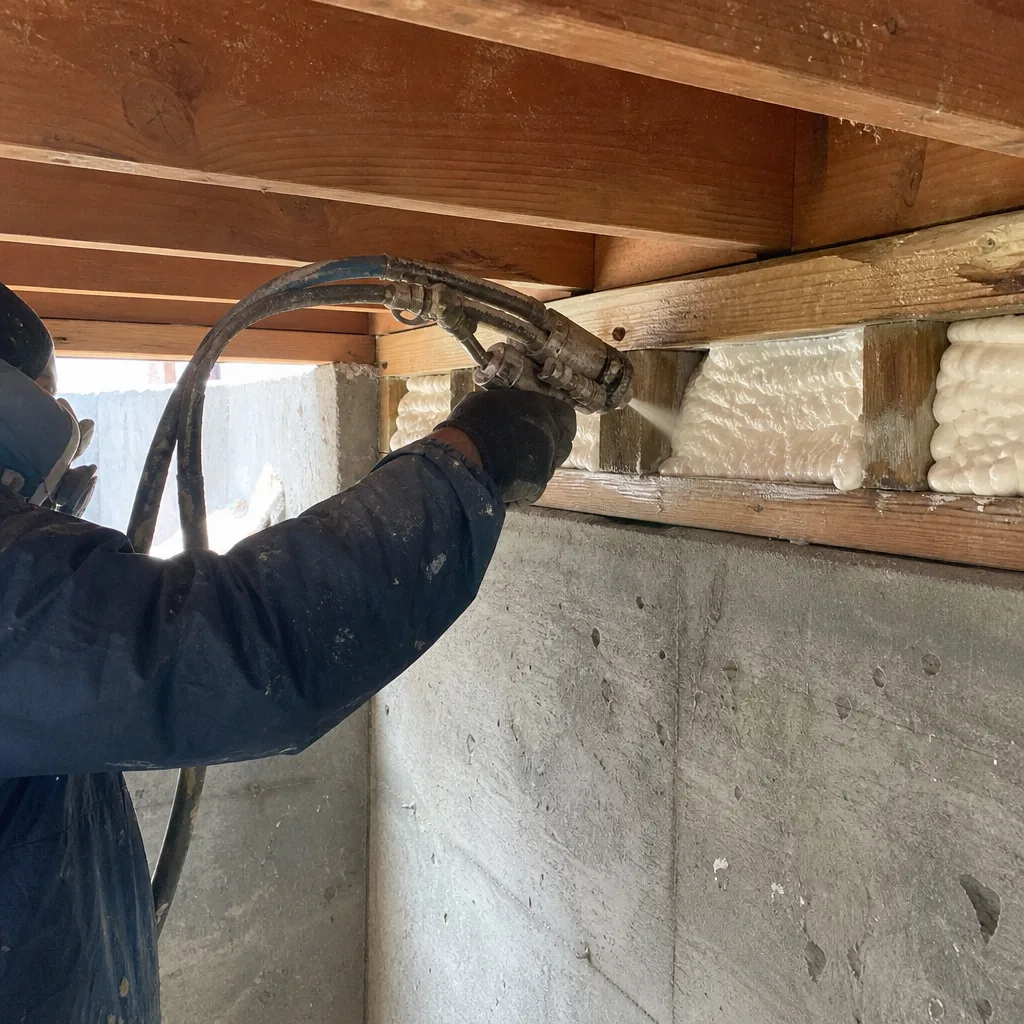
Rim Joist Spray Foam in Stanton is one of the most cost-effective upgrades we do. The rim joist is the wood band where your floor framing meets the foundation, and in Stanton’s slab-on-grade tract homes it’s often completely uninsulated. Warm air leaks out here all winter, and humid air pulls in during summer. Sealing a full rim joist line with closed-cell Demilec foam typically costs $1,200 to $2,400 in Stanton, and it takes most crews less than a day.
Crawlspace and Slab Encounters
Some of Stanton’s older homes have perimeter crawlspace sections, even on lots that look like pure slab. We spray closed-cell foam against the rim board and the first few inches of the foundation wall, which stops both air movement and the moisture that invites termites.
Why Closed-Cell Here
Closed-cell foam gives you an air barrier, a vapor barrier, and about R-6.5 per inch in a single pass. In Stanton’s climate, that’s the right call for rim joists because it handles both the dry summer heat and the occasional coastal marine layer that rolls through and pushes damp air against foundation wood.
Trusted Brands We Service in Stanton
We’re not married to one manufacturer. North Tustin Insulation carries Demilec and Icynene spray foam, so we can match open-cell or closed-cell to the job. We stock Owens Corning batts for hybrid attic builds, and we keep Johns Manville products on hand for vent chute and air-sealing details. For Stanton customers, that means the recommendation comes from the home’s framing, wiring, and ventilation, not from a brand rep’s kickback. If you already have an insulation spec from a home energy audit, we can source and install to meet it.
Our Spray Foam Insulation team works from a product matrix that covers eight nationally recognized brands across fiberglass, mineral wool, cellulose, and spray foam categories. For Stanton specifically, the most common combination we recommend is Demilec closed-cell foam for air sealing plus Owens Corning batts for additional attic depth, because that pairing handles the extreme attic heat without overbuilding.
Common Spray Foam Insulation Problems We See in Stanton Homes
- Foam over knob-and-tube wiring. Stanton’s 1950s attics still contain live knob-and-tube circuits. Spraying foam directly over these wires traps heat, which can degrade the cloth insulation and create a fire risk. We inspect every attic before spraying and flag wiring that needs an electrician’s attention first.
- Closed-cell foam on a vented roof deck. Some contractors spray the underside of roof sheathing in a vented attic and call it done. In Stanton’s low-slope, low-clearance roofs, this traps moisture against the wood and rots the deck from the inside. We never do this without a full ventilation redesign.
- Rim joist sealing that ignores termite pathways. Zero lot-line homes in Stanton have stucco walls that touch the neighbor’s property. Sealing rim joists without checking for existing termite galleries can hide activity that’s still eating the framing. We inspect the sill plate and mudsill before foam goes in.
- Open-cell foam in areas that get wet. Open-cell is great for walls and sound control, but it absorbs water. In Stanton homes with old roof leaks or bathroom exhaust fans venting into the attic, open-cell foam can sit wet and grow mold. We recommend closed-cell for any area with moisture exposure.
Pricing for Spray Foam Insulation in Stanton, CA
A typical spray foam attic retrofit in Stanton runs $2,800 to $7,500, depending on square footage, foam type, and whether we need to remove old insulation first. Rim joist sealing runs $1,200 to $2,400. Wall injection on a 1,200-square-foot home starts around $3,000. The biggest variable in Stanton is the condition of what’s already up there: if we have to vacuum out old, degraded fiberglass or address knob-and-tube wiring before spraying, that adds labor. We give free estimates in Stanton, and the number we quote is the number you pay. No change orders mid-job. Call (877) 265-5712 and we’ll schedule a walkthrough.
We Also Serve Cities Near Stanton
North Tustin Insulation works throughout the surrounding area, including Garden Grove, Cypress, Westminster, and Midway City. If you’re in any of those communities or elsewhere in Stanton, the same crews, the same brands, and the same honest pricing apply. We schedule projects in this part of Orange County every week.
Serving Stanton, CA — Our Local Coverage Area
We’re based in the Stanton area and know this community well. Use the map below to see our service coverage — if you’re nearby, we can almost certainly help.
FAQs About Spray Foam Insulation in Stanton
Yes. Spray foam creates an air seal that stops superheated attic air from entering your living space. But foam alone won’t fix a 140°F attic. You also need ventilation or a radiant barrier to keep the attic itself from baking. Our standard Stanton retrofit pairs closed-cell foam on the attic floor with a radiant barrier above it. That combination is what moves the needle on summer electric bills.
No, not effectively. Spray foam needs to bond to the attic floor or the drywall below the old batts to form an air seal. If you spray over 60-year-old compressed fiberglass, the foam just sits on top and doesn’t seal anything. We remove the old insulation first, then spray. The only exception is when the old material is already gone or pushed aside.
We work from inside. For walls that butt against a neighbor’s property line, drilling from the exterior isn’t possible. We cut small access holes in the drywall at the top and bottom of each stud bay, inject the foam, and patch when done. It takes longer than exterior drilling, but it’s the only method that works in Stanton’s tight side yards.
Aluminum wiring is fine to spray over as long as the connections are tight and the wiring isn’t already overheating. Knob-and-tube is the real hazard. We check for both during our pre-spray inspection. If we find knob-and-tube in the attic, we’ll stop and recommend an electrician address it before any foam goes in. We won’t bury live knob-and-tube in foam; it creates a fire risk.
For attic floors in Stanton, we recommend R-20 to R-30 with closed-cell foam plus additional air sealing. That means about 2 to 3 inches of closed-cell foam on the attic floor, which gets you past the R-11 that most pre-1970s Stanton homes have now. Wall injection typically lands at R-13 to R-15 in a 2×4 wall, which is a massive jump from zero insulation. Combined, those numbers consistently move summer bills from $300+ down toward $180 to $200.
Ready to stop paying for an attic that leaks air? Call (877) 265-5712 today for a free spray foam insulation estimate in Stanton. We’ll tell you what you have, what you need, and what it costs.
Written by Allen Decker, Owner at North Tustin Insulation, serving Stanton since the company’s founding.