
Fast, Reliable Spray Foam Insulation Across Topanga
Spray foam insulation in Topanga typically runs $2.50 to $5.50 per board foot installed, with a full canyon home usually landing between $4,800 and $14,000 depending on cavity depth, access, and whether the structure is standard-framed or owner-built. We know Topanga. We know the hand-built cabins off Old Topanga Canyon Road, the converted garages above Fernwood, the geodesic domes up Saddle Peak. Our crews work in the Santa Monica Mountains every week, and we keep our Topanga scheduling tight because we understand canyon access, narrow driveways, and the fact that half the homes up here were never built to a standard a big-box contractor would recognize. Need an estimate that’s based on an actual site visit, not a spreadsheet guess? Call us at (877) 265-5712.
Why North Tustin Insulation Is Topanga’s Preferred Spray Foam Insulation Company
Most insulation companies quote Topanga jobs from satellite photos and square footage. That doesn’t work here. A 1,200-square-foot A-frame on 90290 with exposed rafter framing and non-standard stud spacing is a completely different job than a 1,200-square-foot tract home in the Valley. Our owner, Allen Decker, built this company around the idea that the material gets matched to the structure, not the other way around. That’s why our Topanga bids start with a site visit. We need to see how the place is actually framed before we spec foam.
We carry both Icynene and Demilec spray foam systems, which matters in Topanga because canyon homes often need open-cell in one assembly and closed-cell in another. A wall cavity with exposed, irregular furring is a different animal than a roof deck that has to meet WUI ignition-resistance expectations. We’re also an insulation-only contractor. Every technician we send to Topanga works on insulation and nothing else. No roofing crew moonlighting, no generalist guessing at R-values. The recommendation you get is driven by your framing and your fire-safety reality, not by whatever system the installer happens to prefer.
Garage Spray Foam Insulation in Topanga
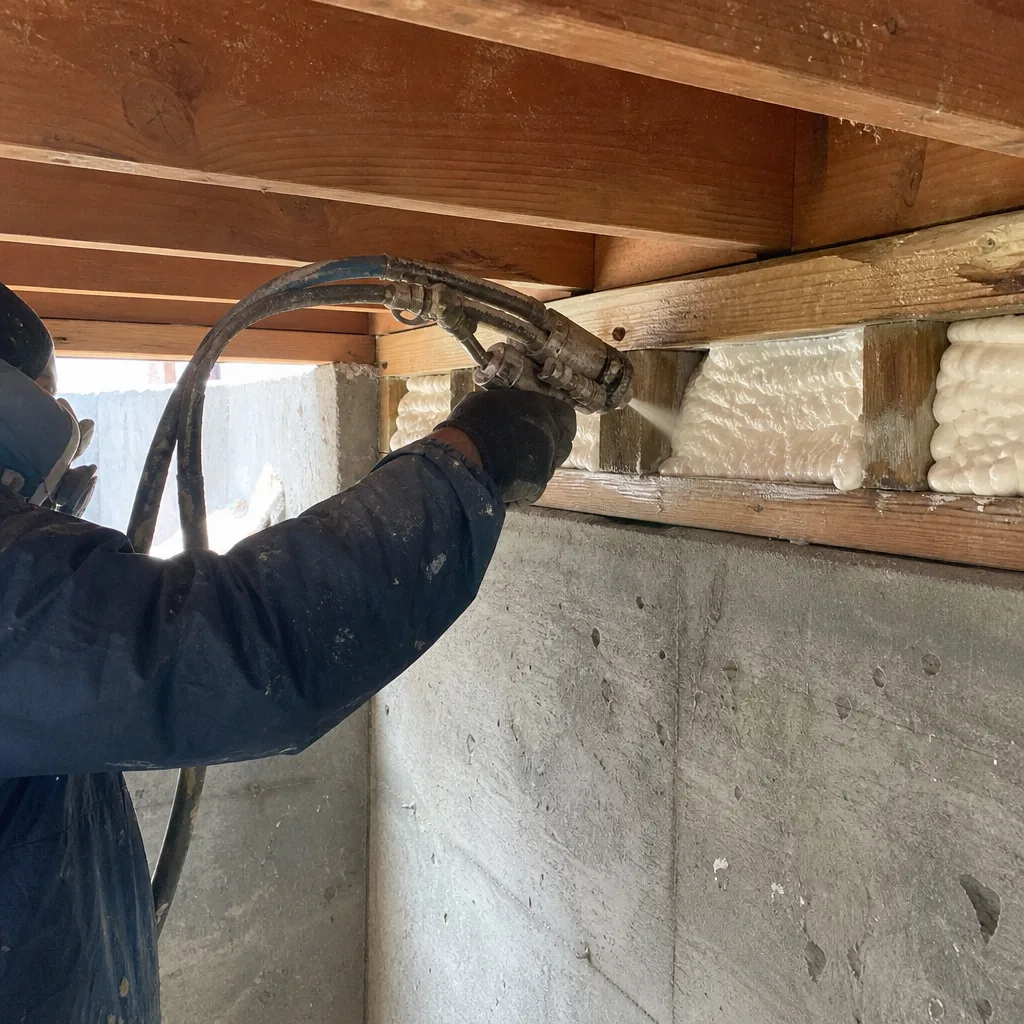
Garage Spray Foam Insulation in Topanga is one of our most-requested jobs, because so many canyon homes have converted garages that function as art studios, workshops, music rooms, or guest quarters. The framing is rarely standard. We see garages with exposed rafter tails, random 2×4 and 2×6 mixes, and cavities that no batt manufacturer ever planned for. Spray foam is the right call here because it expands to fill the actual void, sealing gaps that fiberglass would leave wide open.
A garage ceiling and wall foam job in Topanga runs $1,800 to $5,400 depending on square footage, cavity depth, and whether we’re working around existing electrical or plumbing. The work itself usually takes a day or two, with re-entry after a few hours of curing.
Ember Sealing and Air Infiltration
In Topanga, a garage isn’t just storage. It’s often the first line of vulnerability during Santa Ana wind events. Foam-sealed rim joists and ceiling penetrations reduce the pathways where embers can enter and where conditioned air leaks out. We focus on the perimeter: rim joists, wall-to-ceiling transitions, and any gap where framing meets the canyon grade.
When Closed-Cell Makes Sense in a Garage
If the garage is unvented or semi-conditioned, we lean toward closed-cell foam for the added structural rigidity and moisture resistance. Demilec’s closed-cell formulations hold up well in Topanga’s summer heat and occasional winter damp. If the garage is vented and the goal is comfort, Icynene open-cell is often the more economical spec.
Closed Cell Spray Foam Insulation in Topanga
Closed Cell Spray Foam Insulation in Topanga is the workhorse product for canyon homes that need ignition-resistant, moisture-resilient assemblies. It’s denser than open-cell, adds racking strength to irregular framing, and performs as an air barrier. For hand-built structures off Saddle Peak and the unpermitted cabins scattered through the 90290 corridor, closed-cell is frequently the only product that seals the way the structure demands. Expect $3.00 to $5.50 per board foot installed.
The reason we so often spec closed-cell in Topanga isn’t just R-value. It’s the way the foam locks framing together and seals ember-vulnerable penetrations. In a canyon where winter rain follows months of dry heat, the moisture-resistance of closed-cell also reduces the risk of hidden rot in non-standard wall assemblies.
Roof Deck and Rafter Bay Applications
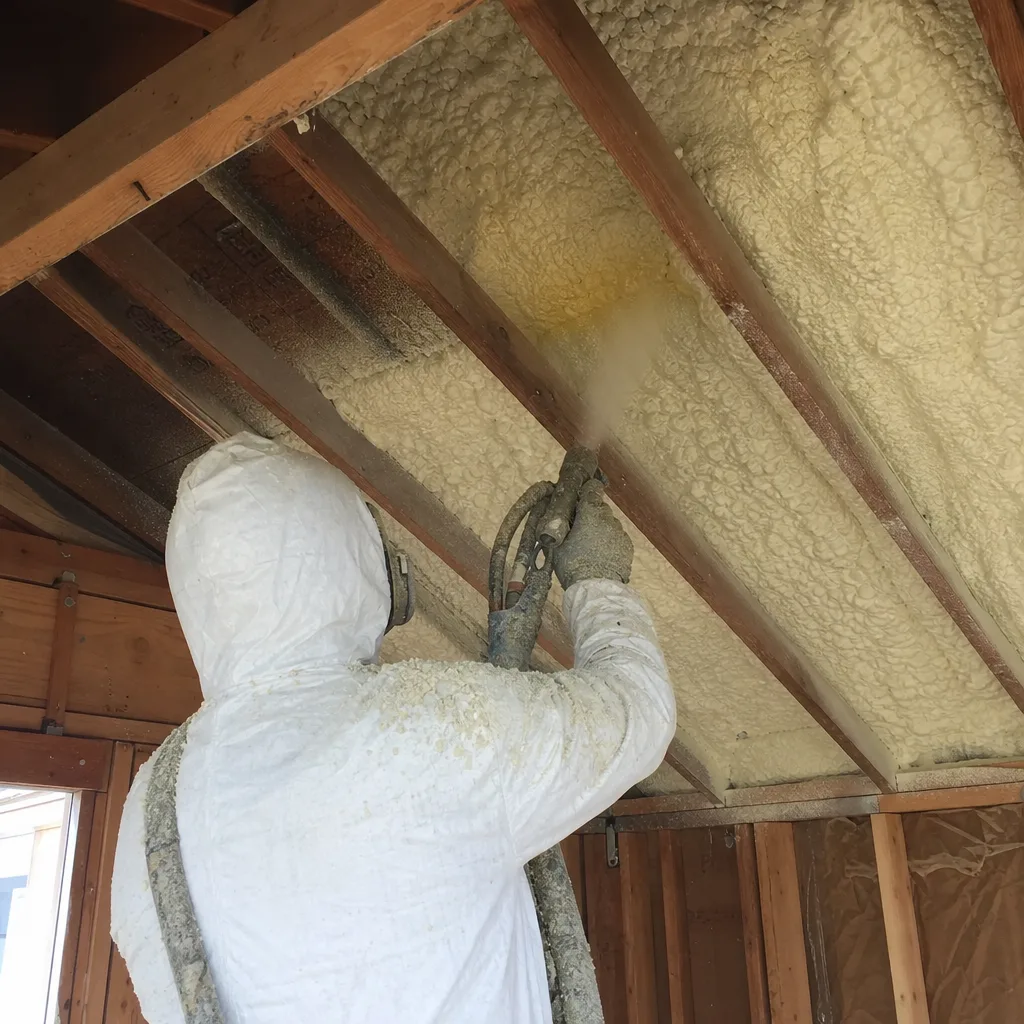
When roof rafters are exposed and irregular, closed-cell foam applied in lifts creates a continuous thermal and ignition-resistant layer. We don’t spray a single thick pass. We build up in controlled lifts so the foam cures properly and doesn’t overheat the substrate. This matters in Topanga because the dry summer heat accelerates exothermic reactions if we rush the application.
Structural Benefits for Older Canyon Framing
Closed-cell foam adds shear strength. For older Topanga cabins with undersized or non-standard framing, that’s a meaningful structural benefit beyond the insulation performance. The same foam that seals the thermal envelope also stiffens the walls and roof deck against high-wind events during fire season.
Trusted Brands We Service in Topanga
We carry multiple spray foam systems so the recommendation is never forced by inventory. On the premium spray foam side, we install Icynene and Demilec products. For hybrid assemblies, we pair spray foam with Rockwool mineral wool or GreenFiber cellulose where the design calls for a breathable, non-combustible infill. Our Topanga crews stock the materials needed for canyon jobs before they head up the hill, which means fewer supply runs back down to the Valley and less downtime on your project. We don’t push one brand. We spec the product that fits the framing, the fire-safety requirement, and the assembly’s moisture profile.
Common Spray Foam Insulation Problems We See in Topanga Homes
- Uneven cavity depths that defeat a single-pass spray. Owner-built framing rarely presents uniform cavities. Exposed rafters furred out to different depths mean a single spray pass leaves thin spots and voids. We spray in lifts and supplement with custom-cut Rockwool where the cavity is too irregular for foam alone.
- Moisture trapping in unvented, non-standard assemblies. Closed-cell foam applied too thick over a hand-built wall can lock in moisture that the canyon’s wet winters introduce. We check the assembly’s drying direction before recommending foam density, because rot in an unpermitted structure is expensive and often hidden until it’s severe.
- Ember-entry gaps at penetrations and transitions. Topanga’s WUI Chapter 7A environment means the enemy is ember intrusion, not just heat. Gaps around chimney chases, eave vents, and wall-to-roof transitions are where fires start. Foam sealing is only part of the answer; we also verify the detail work around those penetrations.
- Converted-garage and dome framing that standard foam jobs miss. Geodesic domes and converted garages have geometry that no batt product was designed for. Spray foam is the flexible answer, but only if the installer understands how those structures shed water and manage vapor. We spec from the actual framing, never from a generic checklist.
Pricing for Spray Foam Insulation in Topanga, CA
Spray foam pricing in Topanga tracks a little higher than Valley pricing, mostly because of access and site-visit time. You’ll see open-cell jobs run $2.50 to $4.00 per board foot, closed-cell at $3.00 to $5.50 per board foot. A rim joist sealing project in a Topanga crawlspace or garage typically lands between $1,200 and $3,200. A roof deck under the rafters on a 1,000-square-foot cabin falls between $4,000 and $8,500. What actually moves the number is cavity irregularity, whether we need to work from scaffolding or ladders, and whether the structure is permitted or requires material and method documentation for a retrofit. Our Spray Foam Insulation estimates in Topanga are free and site-based. Call (877) 265-5712 and Allen Decker will schedule the visit.
We Also Serve Cities Near Topanga
Beyond Topanga, our crews work regularly in Encino, Santa Monica, Northridge, and Sherman Oaks. The housing stock changes dramatically once you drop out of the canyon and into the flatlands. Tract homes with standard 16-inch on-center framing are a different job, and we adjust the spec accordingly. Whether you’re up on the ridge or down in the Valley, the material still has to match the structure.
Serving Topanga, CA — Our Local Coverage Area
We’re based in the Topanga area and know this community well. Use the map below to see our service coverage — if you’re nearby, we can almost certainly help.
FAQs About Spray Foam Insulation in Topanga
Because square footage doesn’t tell us how the structure is framed, and Topanga has more non-standard framing per square mile than any other market we serve. A site visit lets us measure actual cavity depths, check rafter spacing, confirm permit status, and see whether the assembly is vented or unvented. Without that, we’d be guessing, and guessing on a hand-built cabin means voids, moisture problems, or expensive rework. Call (877) 265-5712 to schedule a free site visit.
Yes, but only if the foam is part of a properly detailed assembly. Closed-cell foam sprayed in lifts can seal rafter bays and ember-vulnerable penetrations effectively. The Chapter 7A standard is about the entire assembly, including the exterior cladding and vent details, not just the insulation layer. We coordinate the foam spec with the ignition-resistant details the structure already has.
It can, if it’s applied too thickly over an assembly that can’t dry to one side. That’s why we don’t blanket-spec closed-cell. We check the wall or roof assembly’s drying direction, the presence of existing vapor control, and the framing type. If the assembly needs to dry inward, we may recommend open-cell or a hybrid with Rockwool instead.
We do, and those are among the most common Topanga jobs we take on. Converted garages and domes have geometry that standard batt insulation handles poorly. Spray foam’s expansion and air-sealing properties make it the practical choice. We’ll assess the existing framing and whether the conversion was done with any vapor or drainage considerations before we spec the foam.
It changes the process, but it’s not a dealbreaker. Unpermitted structures require more careful site documentation because there’s no permit file telling us how the framing was built. We photograph and measure before we spray, and we often recommend a permit-adjacent approach where the insulation work is documented to current code expectations, even if the rest of the structure isn’t. Our goal is simple: the insulation assembly should perform correctly regardless of the building’s legal history.
If you’re in Topanga and want a spray foam estimate based on an actual site visit, call North Tustin Insulation at (877) 265-5712. Allen Decker and our team will come up the hill, look at the framing, and tell you exactly what the job needs. No square-footage guesswork. No one-brand push. Just the right material for your canyon home.
Written by Allen Decker, Owner at North Tustin Insulation, serving Topanga and the surrounding canyon communities.