
Fast, Reliable Spray Foam Insulation Across West Covina
Spray foam insulation in West Covina typically runs $2.50 – $6.50 per board foot installed, depending on whether you’re sealing a rim joist, a garage ceiling, or an entire low-pitch roof deck. Most jobs in the 91790, 91791, and 91792 ZIP codes take one to two days once we’re on site. If your West Covina home was built between 1950 and 1975, chances are the attic is fighting way harder than it should against San Gabriel Valley heat. We’re North Tustin Insulation, and we’ve spent enough time in West Covina’s tract homes to know exactly what’s happening up there. Call (877) 265-5712 for a straight answer and a free estimate.
Why North Tustin Insulation Is West Covina’s Preferred Spray Foam Insulation Company
We carry eight insulation brands: Owens Corning and CertainTeed for fiberglass, Rockwool for mineral wool, GreenFiber for cellulose, and Icynene plus Demilec for spray foam, along with Johns Manville and Knauf. That matters in West Covina because a 1958 stucco tract home near South Hills needs a different foam than a 1980s infill build north of the 10 Freeway. We match the material to the home, not the other way around.
Our insulation-only focus means every estimate, every crew, and every conversation is about one trade. No roofing, no HVAC, no general remodeling. Just insulation performance in West Covina’s specific heat load. Allen Decker, our owner, has built the business around that single-minded approach.
When you call, you reach someone who knows the difference between open-cell and closed-cell foam, who can talk R-values without dumbing it down, and who won’t push a product just because it’s what’s on the truck. For West Covina homeowners tired of upstairs bedrooms that bake by 4 p.m., that clarity is the whole point.
Closed Cell Spray Foam Insulation in West Covina
Closed Cell Spray Foam Insulation is the heavy hitter for West Covina’s low-pitch, stucco-and-drywall tract homes. At roughly $3.50 – $6.50 per board foot installed, it delivers about R-6.5 to R-7 per inch, adds structural rigidity to old roof decks, and acts as a vapor barrier. If your attic hits 140°F in August, closed-cell is the material that actually stops that radiant heat from bleeding into the living space.
Roof Deck and Low-Pitch Applications
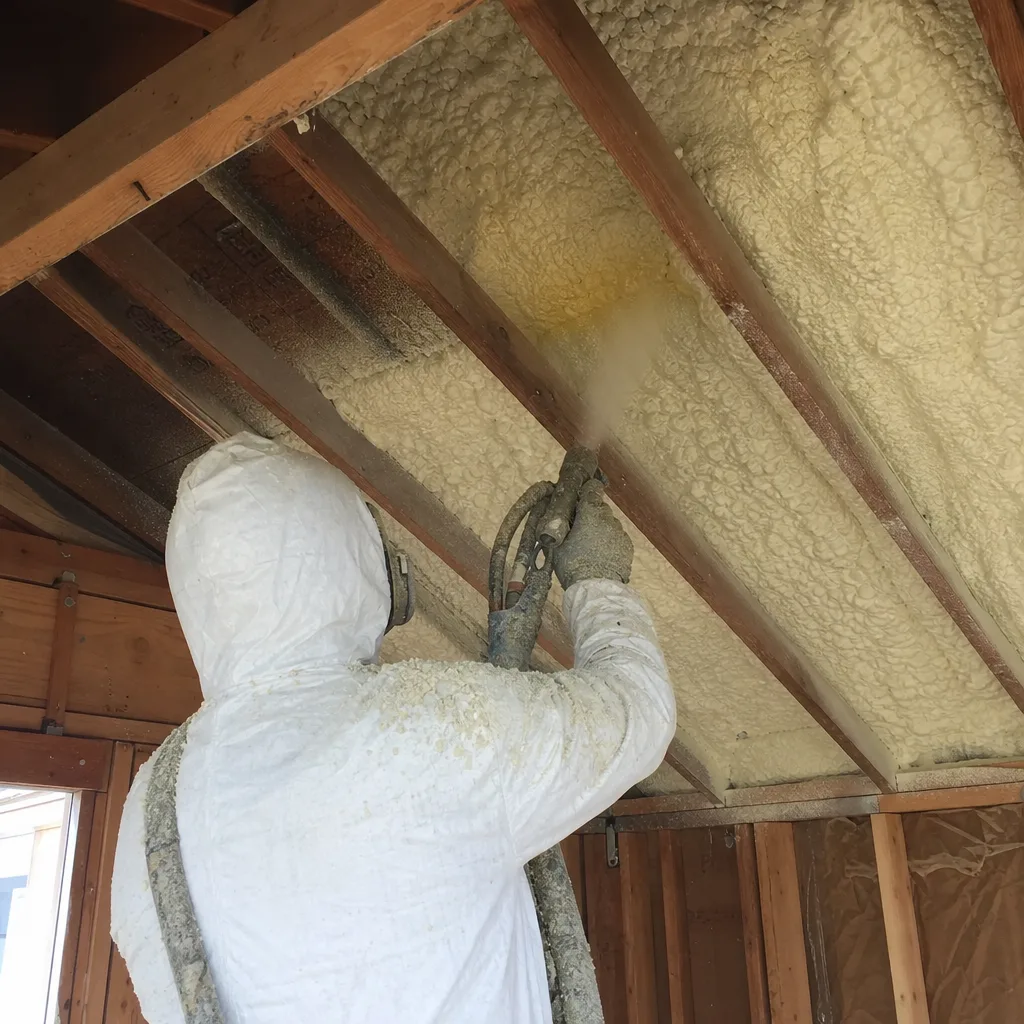
West Covina’s 1950s and 60s homes often have roof pitches too shallow for a comfortable attic walk. Closed-cell foam applied directly to the underside of the roof deck turns that tight, hot space into a conditioned buffer zone. It also seals the top-plate gaps that plague balloon-framed older builds.
When Closed-Cell Earns Its Cost
If you’re dealing with a converted garage, a storage attic that gets furnace-hot, or rooms that never cool evenly in summer, closed-cell is the answer. The upfront cost is higher than open-cell, but the air-sealing and moisture control do the heavy lifting in West Covina’s inland heat. We’ll be direct about whether it’s the right spend for your specific build.
Open Cell Spray Foam in West Covina
Open Cell Spray Foam runs lighter, typically $2.50 – $4.50 per board foot installed in West Covina. It expands aggressively, fills framing cavities and odd geometries fast, and delivers around R-3.5 to R-4 per inch. It’s a smart choice for interior walls, rim joists, and areas where you want serious air sealing without the higher price or rigidity of closed-cell.
Rim Joist Sealing
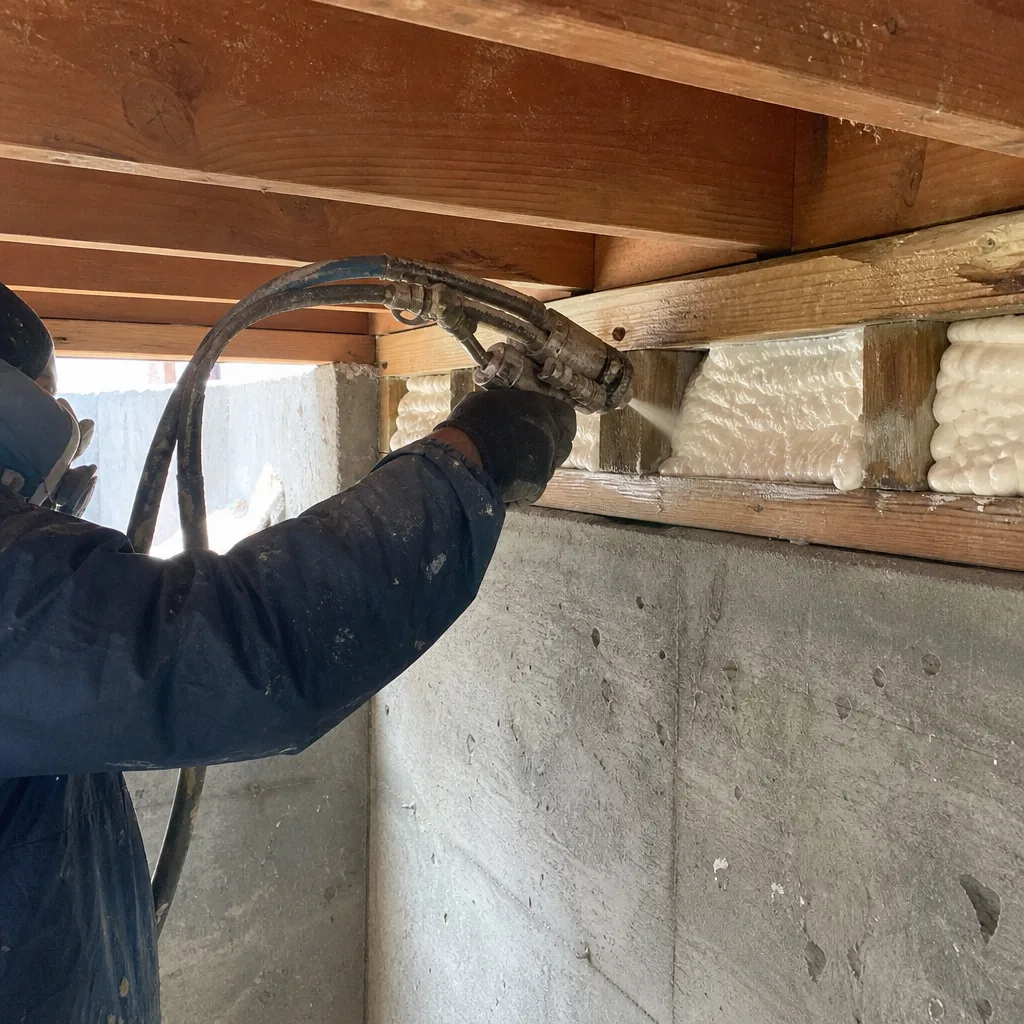
One of the most overlooked air leaks in West Covina’s wood-frame homes is the rim joist, the band where floor framing meets the foundation. Open-cell foam seals that perimeter in less than a day. It stops the stack effect that pulls hot attic air down through wall cavities and cold air up from crawl spaces.
Sound Control and Interior Comfort
Open-cell also deadens noise, which matters on busy streets like Azusa Avenue or Amar Road. If you’ve got a home office off a loud arterial or bedrooms that pick up freeway hum from the 10, open-cell in the walls helps. We’ll always tell you when it’s the better value over closed-cell.
Trusted Brands We Service in West Covina
We carry both Icynene and Demilec spray foam systems, two of the industry’s leading names for open- and closed-cell applications. That’s not a commodity install, it’s certified product knowledge. For West Covina homeowners who want to know exactly what’s going into their walls, having access to Icynene’s MD series and Demilec’s Heatlok line means we can match the foam to your roof pitch, your insulation goals, and your budget. Pair that with our fiberglass and cellulose lineup from Owens Corning, Johns Manville, Knauf, CertainTeed, Rockwool, and GreenFiber, and you get genuine choice, not a one-brand push. Call (877) 265-5712 to talk options.
Common Spray Foam Insulation Problems We See in West Covina Homes
- Compacted legacy insulation under new foam. Many West Covina attics still hold their original 1950s or 60s insulation, now settled to an inch or less. Spraying foam directly over it traps the dead material and skips the air-sealing step entirely.
- Rodent-disturbed fiberglass and top-plate gaps. Rats and mice tunnel through old batts in West Covina’s mature neighborhoods. If we don’t remove that mess and seal the top plates first, your new foam is just a lid on a leaky envelope.
- Blistering open-cell on low-pitch roofs. Applying open-cell too thick in one pass during a 100°F inland afternoon can cause poor adhesion and voids. We sequence the passes, especially in the hot months.
- Open-cell used where closed-cell belongs. On a West Covina low-pitch roof deck, open-cell can trap moisture and lose R-value over time in our intense sun. We see this from previous contractor work and it’s a common reason we’re called back to correct it.
Pricing for Spray Foam Insulation in West Covina, CA
Here are honest ranges for West Covina’s market. A rim joist sealing job typically runs $800 – $1,600. A garage ceiling in a standard tract home: $1,200 – $3,500 depending on square footage and whether it’s attached to living space. A full low-pitch roof deck with closed-cell foam on an 1,100-square-foot rancher: $5,500 – $12,000. Removal of old, rodent-contaminated insulation adds $1 – $3 per square foot, and that step is non-negotiable in most of the 91790s. Air-sealing top plates and penetrations usually lands between $500 and $1,500. Every estimate is free, specific to your home, and includes the brand name of the foam we’d use. Call (877) 265-5712 for exact numbers on your West Covina house.
We Also Serve Cities Near West Covina
Our crews cover West Covina and the surrounding San Gabriel Valley communities, including Valinda, South San Jose Hills, La Puente, and Irwindale. If you’re in one of those neighboring areas, the same Spray Foam Insulation expertise and multi-brand approach applies. We know these streets because we work them every week.
Serving West Covina, CA — Our Local Coverage Area
We’re based in the West Covina area and know this community well. Use the map below to see our service coverage — if you’re nearby, we can almost certainly help.
FAQs About Spray Foam Insulation in West Covina
No, and any contractor who says otherwise is cutting corners. In West Covina’s 1950s and 60s tract homes, decades of heat cycling plus rodent activity have compacted or contaminated most of that legacy material. It has to come out first. Then we air-seal the top plates and penetrations, and only after that do we apply foam. Skipping this step means you’re paying premium money to seal in a compromised envelope. Call (877) 265-5712 and we’ll inspect what’s actually up there before quoting anything.
Closed-cell. West Covina’s inland valley climate pushes attic temperatures past 140°F regularly in summer, and a low-pitch roof deck is exactly where closed-cell’s higher R-value per inch, vapor barrier properties, and structural rigidity earn their cost. Open-cell on a low-pitch deck in this heat can trap moisture and lose R-value over time. We’ve corrected more than a few of those installs. For rim joists and interior walls, open-cell is a fine, cost-effective choice.
In most cases, yes. A 1962 West Covina home almost certainly has R-11 or R-19 at best, and after 60-plus years, much of it is settled, dusty, or full of rodent tunnels. Adding spray foam on top of that without removal just hides the problem. The real value is in the air sealing, and closed-cell foam applied to the roof deck eliminates the radiant heat load entirely. You’ll feel the difference in every room that used to bake by late afternoon.
Differently, and in most West Covina homes, better. A radiant barrier reflects some of the sun’s heat but does nothing to stop hot air infiltration or air leakage through top plates and penetrations. Spray foam, especially closed-cell on the roof deck, seals those leaks and stops the heat at the source. In our inland heat, where August afternoons are brutal on low-pitch roofs, foam plus air-sealing is the higher-impact fix. A radiant barrier helps, but it’s not a substitute for an airtight envelope.
Three things. First, make sure the existing drywall or ceiling separates the space properly from living areas; converted garages often have poor air barriers. Second, check for rodent activity, which is common in West Covina’s older neighborhoods and must be addressed before foam goes in. Third, confirm the foam type matches the exposure. A converted garage with a roof deck that bakes in the sun needs closed-cell, not open-cell. We walk every West Covina customer through this before we touch the space. Call (877) 265-5712 for an assessment of your specific garage or attic.
The West Covina Retrofit Reality: Air Seal First, Foam Second
West Covina is a mid-century San Gabriel Valley tract-home city. Most of the housing went up in the postwar boom, before modern energy codes, and those original attics were built with R-11 to R-19 insulation at best. After decades of 90 to 100°F summer cycling, much of it in the 91790s is now settled to less than an inch, or has been pulled from the top plates by rodent tunnels. That’s the defining condition of insulation work in this city, and it’s why the air-sealing step matters more here than in coastal LA or basin communities where the heat load is milder.
We recently worked a 1958 single-story stucco tract home in the 91791 ZIP. The original attic insulation had compacted to almost nothing, and rodent tunnels had stripped it away from the top plates. Our crew removed the debris, sealed the top plates and every penetration, then applied closed-cell spray foam to the roof deck. That attic had been hitting 140°F-plus. After the job, the homeowners told us their back bedrooms, previously unusable in late afternoons, held temperature through the 100°F August stretch. That’s the difference between spraying foam and doing it right.
Here’s what generic pages skip but we can’t: Spray foam in West Covina only works long-term when it starts with debris removal and top-plate air sealing. Covering settled, pest-damaged insulation with fresh foam traps the same leaks underneath. The performance gain never materializes. In a city this hot, that’s a costly mistake. If you want the job done once, the sequence matters.
Written by Allen Decker, Owner at North Tustin Insulation, serving West Covina and the San Gabriel Valley with eight insulation brands and three installation methods.