
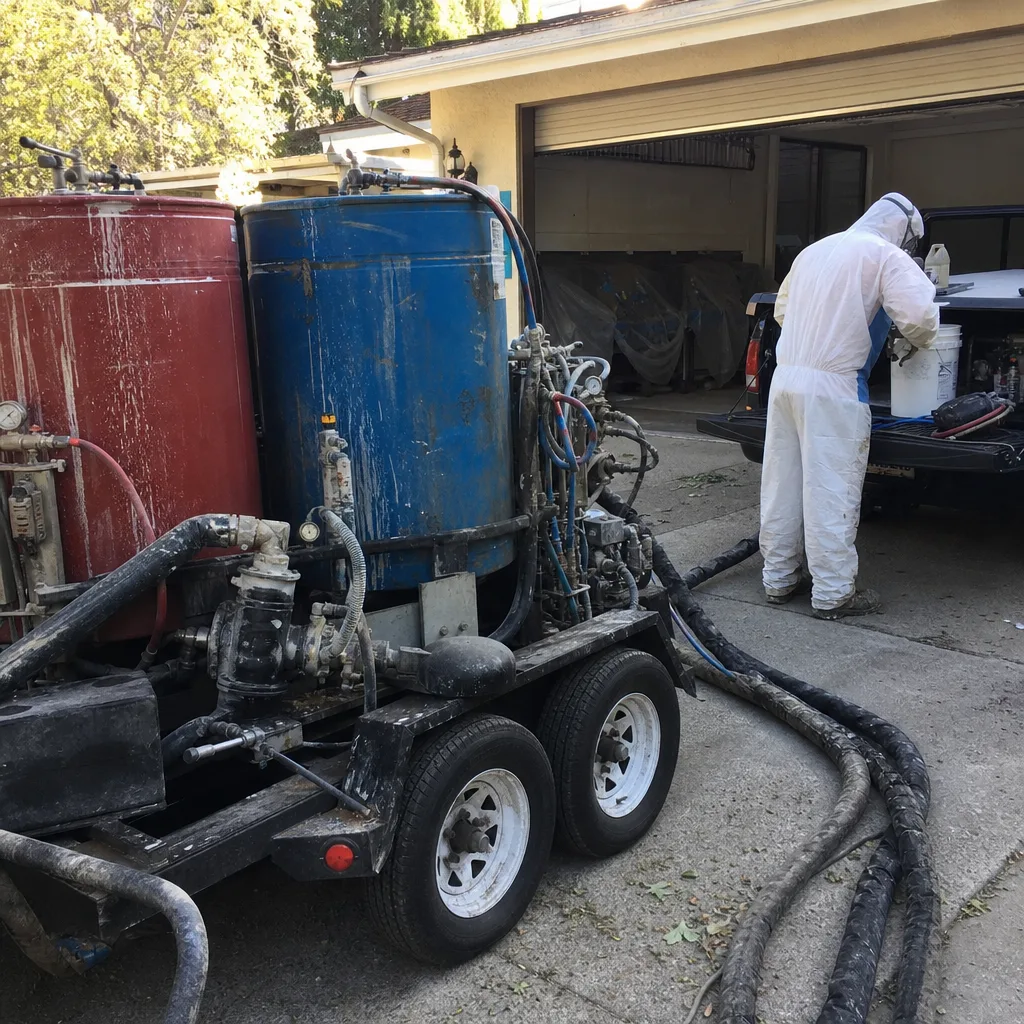
Fast, Reliable Spray Foam Insulation Across Long Beach
Closed-cell spray foam insulation in Long Beach typically costs $3.50 to $6.00 per board foot installed, with most whole-wall retrofit jobs running $5,000 to $14,000 depending on cavity depth and access. Most jobs in the 90802 and 90803 bungalow neighborhoods take two to four days from setup to final cleanup. We know those streets, those wall assemblies, and the way marine air works its way into old framing. Call (877) 265-5712 and we’ll give you an honest read on whether spray foam is the right call for your house, not just the most expensive one.
Long Beach homes fight a different battle than inland houses. The cold is rarely the problem. Damp air, salt spray, street noise, and code compliance are. We carry Demilec and Icynene closed-cell systems because they solve all four at once in a way open-cell and batt insulation cannot. Allen Decker runs every estimate personally. He’ll walk your crawlspace, check your wall cavities, and tell you exactly what he’d put in his own house.
Why North Tustin Insulation Is Long Beach’s Preferred Spray Foam Insulation Company
Long Beach homeowners call us because we show up already knowing what we’re going to find. A 1920s bungalow off Fourth Street has different wall cavities than a 1960s stucco tract home in Los Altos. A condo near the beach in 90803 has noise and moisture problems that a house in Carson never will. We’ve spray-foamed enough Long Beach walls, garages, and roof decks to know the difference by address.
Our Spray Foam Insulation team works in Long Beach weekly, often same-week for estimates and within seven to ten days for start dates. We carry eight national brands including Demilec, GreenFiber, and Owens Corning, so when closed-cell isn’t the right answer we’ll tell you what is, instead of forcing a product you don’t need. That’s the difference between an insulation specialist and a general contractor who took a foam course.
Customers in Belmont Shore, Rose Park, and the Zaferia District tell us the same thing: the estimate was specific, the crew showed up when they said, and the house finally stopped smelling like the inside of a boat. We don’t publish review counts, but we’re glad to provide references from past Long Beach jobs so you can hear it directly.
Closed Cell Spray Foam Insulation in Long Beach
Closed Cell Spray Foam Insulation in Long Beach is the material we recommend most often in the coastal zones because it’s the only product that combines a thermal barrier, an air seal, and a vapor barrier in one application. That matters in 90802, 90803, and 90804, where the marine layer pushes damp air against old plaster and drywall from May through August and sometimes longer. At roughly R-6.5 per inch, it also meets Title 24 cooling-climate performance requirements without eating up precious wall cavity depth in pre-war framing.
Vapor Control in Old Bungalow Walls
In Long Beach’s coastal bungalow blocks, the marine layer’s damp onshore air combines with the thick original wall cavities of pre-war cottages to make closed-cell spray foam the only code-compliant way to both insulate and create an interior vapor barrier without trapping moisture. Title 24’s cooling-climate rules here require low-perm assemblies that don’t exist ten miles inland. Open-cell foam lets vapor through, which is fine in Signal Hill or Lakewood, but in a 1926 Belmont Shore cottage it can turn the back of your drywall into a mold farm.
A typical closed-cell retrofit for a 900-square-foot bungalow wall set in Long Beach runs $4,500 to $8,500. That includes removing old siding or drywall, spraying the cavities, and reassembly. It is not the cheapest option. It is the one that actually works here.
Rim Joist and Crawlspace Sealing
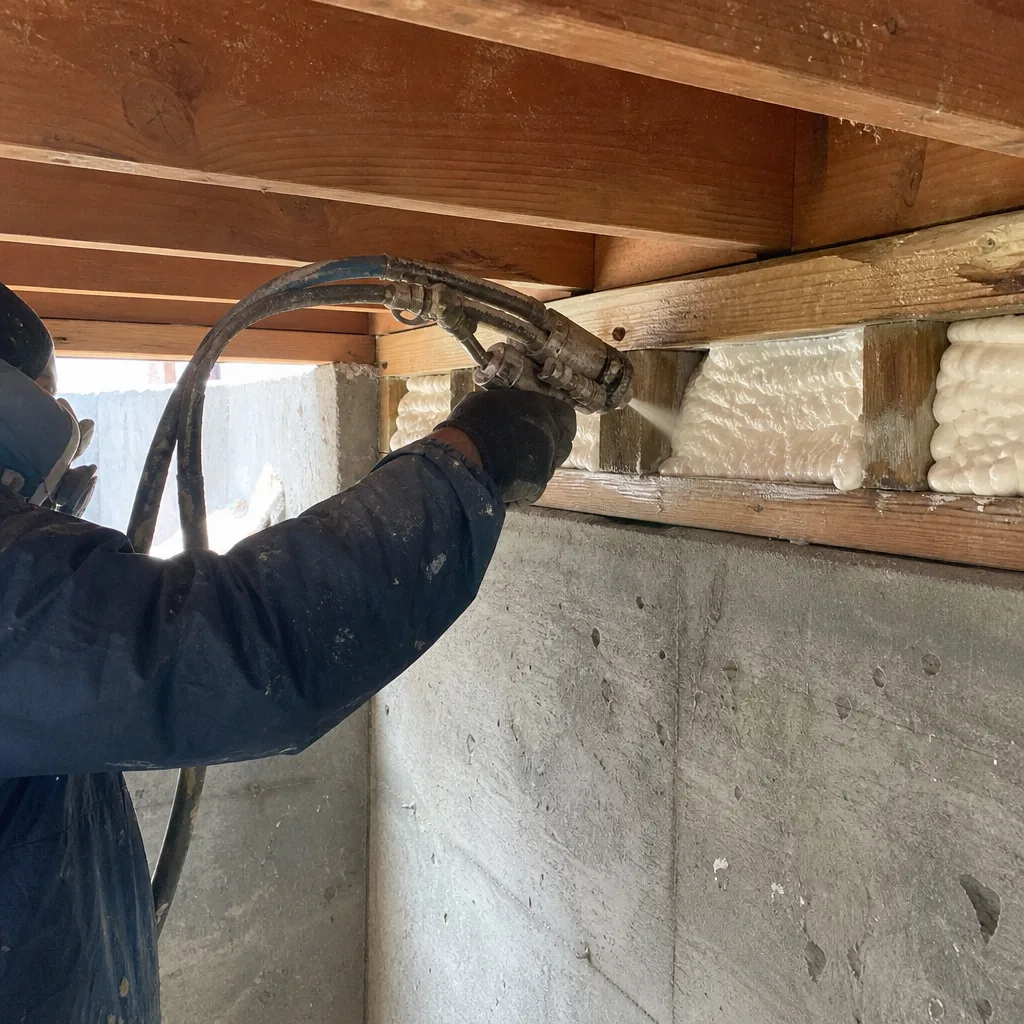
Many Long Beach homes from the 1920s through the 1950s sit over unconditioned crawlspaces that breathe marine air year-round. We see rim joists rotted from years of fog drip and salt-laden humidity. Closed-cell foam at the rim joist, usually 2 inches, stops the air exchange and creates a moisture break that a fiberglass batt never will. Plan on $1,200 to $2,800 for a full rim joist seal on a typical Long Beach home, depending on access and crawlspace height.
Open Cell Spray Foam in Long Beach
Open Cell Spray Foam in Long Beach has its place, mostly in interior wall cavities of homes in 90805, 90806, and 90808 where air sealing and sound control matter more than vapor management. At about R-3.7 per inch, it’s half the insulating value of closed-cell, but it’s roughly 40% less per board foot and it expands more aggressively to fill odd cavities you’d never get a batt into. For interior partition walls, second-floor floors, and garage ceilings, it’s often the right tool.
We do not recommend open-cell foam in exterior walls of the beach zones, and we’ll explain why in plain English if you ask. Damp air passes through it. In a pre-war bungalow wall that already lacks a functioning vapor barrier, that’s how a $6,000 insulation job becomes a $12,000 mold remediation.
Sound Control for Busy Beach Blocks
Belmont Shore and the Peninsula have some of the densest residential blocks in Long Beach. Bars, shops, and foot traffic along Second Street run late. Open-cell foam in interior walls and between floors absorbs and breaks up sound waves as well as any product we install. We’ve done full interior retrofits in 90803 where the homeowner’s goal wasn’t energy savings at all, just quieter bedrooms. For a 1,200-square-foot single-story house, an interior open-cell sound package usually runs $3,000 to $6,500.
Garage Ceilings and Under-Roof Decks
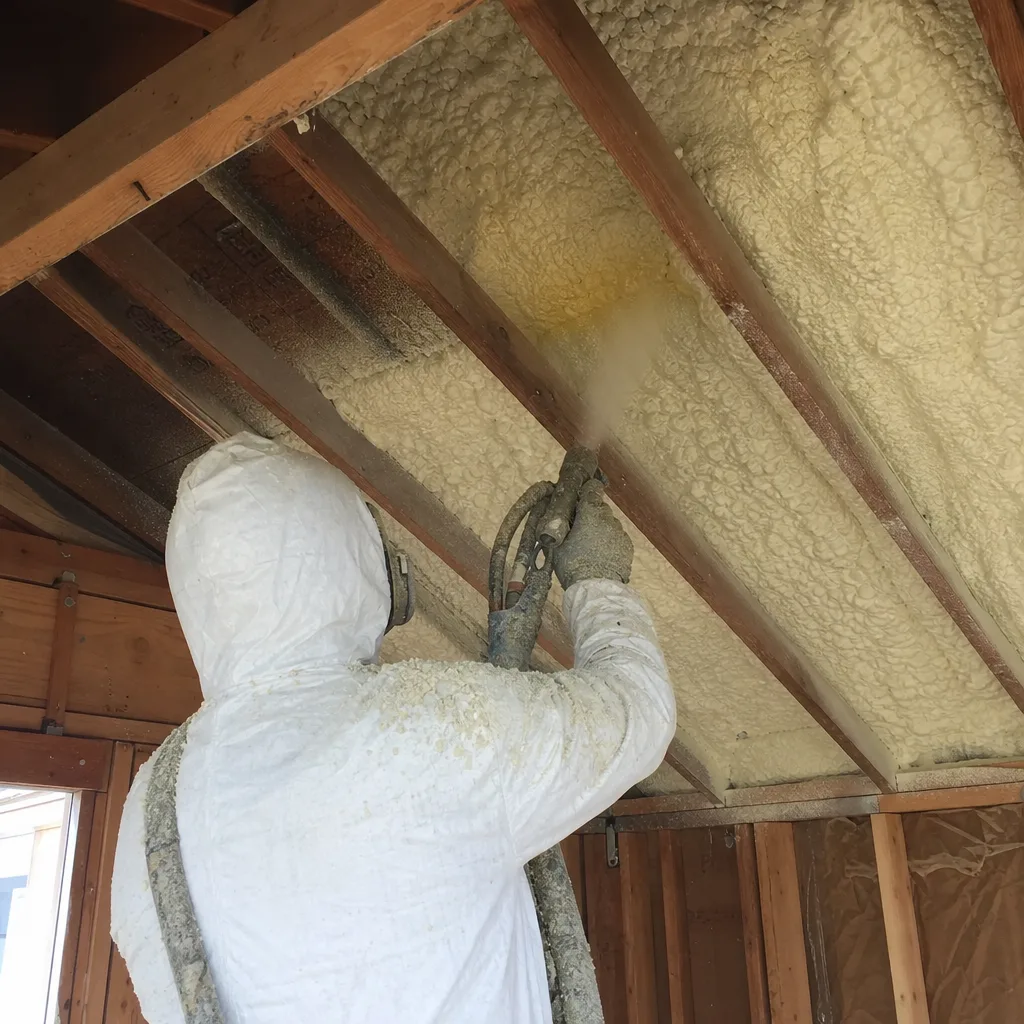
Long Beach garages are unconditioned, humid, and often built tight against the alley or the neighbor’s garage. Open-cell foam on the garage ceiling and under the roof deck reduces the heat that pours into the house through shared wall cavities. But the fasteners and hardware in those garages are rusting from salt air, so we inspect the substrate before we spray. Foam applied over corroded fasteners will delaminate within a few seasons. A typical two-car garage ceiling in Long Beach runs $1,800 to $3,200.
Trusted Brands We Service in Long Beach
We install Demilec open-cell and closed-cell systems, Icynene closed-cell, and we maintain working relationships with GreenFiber and Owens Corning for jobs where foam isn’t the right answer. Carrying multiple brands means we can match the product to the wall assembly, not the other way around. For Long Beach customers, we keep a local stock of common foam thicknesses and substrates, so we aren’t waiting on a shipment from a distributor when your job is scheduled. That shortens turnaround on repairs and pre-spray prep work. GreenFiber blown-in cellulose also shows up often in Long Beach attics, especially in 90808 tract homes where the original insulation is thin and the homeowner wants a lower-cost upgrade than full foam.
Common Spray Foam Insulation Problems We See in Long Beach Homes
- Marine-layer moisture trapped behind open-cell foam in pre-war bungalow walls. We see this monthly in 90802 and 90803, where someone sprayed open-cell into exterior cavities without addressing the missing vapor barrier. The foam gets damp, the drywall grows mold, and the whole job needs to come back out. This is why we’re specific about closed-cell in coastal zones.
- Salt-air corrosion of fasteners and hardware in unconditioned garages. Long Beach air is corrosive. Substrates that look fine from the surface are often rusted at the fastener points. Foam sprayed over corroded metal loses adhesion within a few years. We inspect and treat or replace substrates before we spray.
- Title 24 cooling-climate compliance failures. Spray foam thickness and R-value must meet the low-perm assembly requirements for Long Beach’s climate zone. Undershooting the R-value because the bid was low doesn’t just fail inspection; it leaves the assembly prone to condensation at the interior face. We spec to code, not to a sale price.
- Failed vapor barriers in 1920s and 1930s homes. Original vapor barriers in pre-war Long Beach houses are often tar paper or nothing at all. Once they fail, condensation forms on the back of exterior drywall and the musty smell starts. Closed-cell foam is the fix because it becomes the vapor barrier, permanently.
Pricing for Spray Foam Insulation in Long Beach, CA
Closed-cell spray foam in Long Beach runs $3.50 to $6.00 per board foot installed. Open-cell runs $1.80 to $3.20 per board foot. For a typical wall retrofit on a 1,000-square-foot beach bungalow in 90803, a closed-cell wall job lands between $5,000 and $9,000. A rim joist seal runs $1,200 to $2,800. A garage ceiling runs $1,800 to $3,200. An interior open-cell sound package for a single-story house runs $3,000 to $6,500.
What moves the final number: wall cavity depth, access to the crawlspace or attic, whether old insulation needs removal, and whether drywall or siding needs to be pulled and replaced. If your 1950s stucco tract home in 90808 has original fiberglass batts, we’ll need to remove them before we spray. That’s an extra line item, and we’ll show it to you up front. Call (877) 265-5712 for a free estimate. It’s specific, written, and good for 30 days.
We Also Serve Cities Near Long Beach
Our crews work throughout the Long Beach area, including Signal Hill, Lakewood, Carson, and West Carson. If you’re a few blocks over the city line, the marine air, housing stock, and Title 24 requirements are the same or close to it. We’re already out that way weekly. You can also read more about the broader service area on our Spray Foam Insulation in Long Beach page.
Serving Long Beach, CA — Our Local Coverage Area
We’re based in the Long Beach area and know this community well. Use the map below to see our service coverage — if you’re nearby, we can almost certainly help.
FAQs About Spray Foam Insulation in Long Beach
Yes, closed-cell spray foam eliminates the musty smell in most Long Beach bungalows because it cuts off the air and vapor flow that feeds mold and mildew inside wall cavities. The damp air stops moving through the wall, condensation stops forming on the back of the drywall, and the smell fades within days of the foam curing. Open-cell foam will not do this in exterior walls. Call (877) 265-5712 and we’ll confirm what’s behind your walls before recommending anything.
Yes, spray foam reduces street noise in Belmont Shore and other dense Long Beach neighborhoods, especially open-cell foam in interior walls and between floors. It fills every gap and cavity, which breaks up sound transmission far better than fiberglass batts. Closed-cell on exterior walls also helps, but the real noise reduction comes from interior treatments. For a full answer, call us and we’ll talk through your specific layout.
Closed-cell foam is dense, acts as a vapor barrier, and is the right choice for exterior walls near the ocean. Open-cell foam is softer, lets vapor through, and belongs in interior walls and ceilings where sound control is the goal. In Long Beach coastal zones, using open-cell in an exterior wall is the most common mistake we get called to fix. Expect to pay about twice as much per board foot for closed-cell.
Title 24’s cooling-climate requirements for Long Beach mean exterior wall assemblies must meet specific R-values and low-perm performance standards that closed-cell foam satisfies easily and open-cell foam often cannot without additional vapor-retarding layers. If your job is permitted, the inspector will check the foam type and thickness against the climate zone. We spec to code on every job. For a free code review of your walls, call (877) 265-5712.
Yes, old fiberglass batts and any existing loose-fill need to come out of the wall cavities before spray foam goes in, especially in 1950s and 1960s stucco tract homes in 90805 and 90808. Leaving old insulation in place prevents the foam from adhering to the sheathing and creates thermal gaps that defeat the purpose. Removal adds to the total cost, and we’ll show you exactly how much. Estimates are free. Call (877) 265-5712 to schedule a look.
Get a Straight Answer About Your Long Beach Home
If you’re reading this because your walls smell like a damp basement or your bedroom faces Second Street, give us a call. Allen Decker will walk your property, check the cavities, and tell you whether closed-cell, open-cell, or no spray foam at all is the right answer for your Long Beach house. No pressure, no one-size-fits-all pitch. Call (877) 265-5712 for a free estimate.
Written by Allen Decker, Owner at North Tustin Insulation, serving Long Beach and surrounding coastal communities.