
Last updated October 31, 2026
Insulation Warning Signs: A North Tustin Homeowner’s Reference Guide
Here’s something most North Tustin homeowners don’t realize until it costs them real money: your insulation doesn’t fail with a bang. It fails quietly, through a $40 spike in a summer utility bill, a bedroom that never quite cools to the thermostat setting, or a musty smell in a hallway closet that backs to an exterior wall. By the time most people notice, the problem has typically been running for two or three years. This guide connects the symptoms you actually feel and see in a North Tustin home to the specific insulation failure behind them, so you can address the root cause instead of guessing. For more guides & resources on keeping your home efficient, explore our blog. We’re going to walk through temperature differentials, attic visual clues, outlet cold-spot testing, and the sound transmission changes that signal wall cavity insulation is no longer doing its job.
Quick Answer
The most common insulation warning signs in North Tustin homes are uneven room temperatures (a 4°F or greater variance between rooms on the same floor), summer utility bills that climb year-over-year without a corresponding change in usage, cold drafts near electrical outlets on exterior walls, and visible attic degradation such as compacted fiberglass batts, pest tunneling in cellulose, or spray foam pulling away from roof decking. Any two of these signs appearing together strongly indicates an insulation performance problem rather than an HVAC issue. The fastest way to confirm is a free attic inspection that checks depth, coverage, and material condition.
Table of Contents
- Room-by-Room Temperature Differentials: What’s Normal and What’s Not
- Visual Attic Warning Signs Specific to Southern California
- Wall Insulation Failure: The Outlet Cold-Spot Test
- Sound Transmission as a Secondary Insulation Indicator
- How to Distinguish an HVAC Problem from an Insulation Failure
- Moisture and Odor Signals that Point to Insulation Compromise
- Reading Your Utility Bill for Insulation Failure Patterns
- Common Mistakes to Avoid
- When to Call a Professional
- Frequently Asked Questions
- The Bottom Line
Room-by-Room Temperature Differentials: What’s Normal and What’s Not
Every North Tustin home has some temperature variation between rooms. The question is how much variation is acceptable, and at what point the differential stops being an HVAC balancing issue and becomes an insulation failure signal.
In a properly insulated single-story home, you should expect no more than 2-3°F difference between rooms on the same floor with the HVAC running. That’s normal, and it’s usually caused by solar orientation (west-facing rooms always run warmer in the afternoon) or duct length differences from the air handler. On a 95°F North Tustin day, a west-facing bedroom might sit at 76°F while an east-facing kitchen holds 74°F. That’s within normal range.
But here’s the threshold we use in our own assessments: if any room consistently runs 4°F or more hotter or colder than the rest of the house, start looking for insulation gaps. A 6-8°F differential, especially in an upstairs bedroom or a room directly under an unconditioned attic, almost always points to degraded or missing attic insulation above that specific room, not an HVAC problem.
Zone-by-zone thresholds for North Tustin homes
- Rooms directly under attic space: More than 4°F variance from the rest of the home signals thin or compacted attic insulation. In our experience with North Tustin attics, the most common culprit is original fiberglass batts compressed to half their rated R-value by decades of foot traffic and storage.
- Rooms over a garage: Floor surface temperature more than 5-7°F different from interior floors indicates missing or inadequate insulation in the garage ceiling cavity. This is extremely common in North Tustin homes built before 2000.
- Rooms with exterior walls facing south or west: Wall surface temperature more than 8°F different from an interior wall in the same room suggests wall cavity insulation has settled or was never installed correctly.
- Hallways and bathrooms on exterior walls: More than 3°F variance warrants checking for gaps around plumbing penetrations and exhaust fan housings, common North Tustin retrofit issues.
Here’s the actionable takeaway: if your master bedroom runs 6-8°F hotter than your living room on a 95°F day, that’s not an HVAC problem. It’s almost certainly a radiant gain issue from degraded or absent attic insulation directly above that room. Radiant heat transfer through a poorly insulated ceiling on a hot day can add thousands of BTUs to a single room. Your air conditioner can’t outrun the sun when the ceiling is essentially acting as a radiant panel.
One more note on what we see in North Tustin specifically: the marine layer and coastal influence means many homes were built with minimal attic insulation because builders assumed the mild climate would make it unnecessary. But when we get heat waves, the same coastal microclimate brings higher humidity, and the combination of attic heat plus trapped moisture accelerates insulation degradation in ways builders never accounted for.
Visual Attic Warning Signs Specific to Southern California
Most North Tustin homeowners step into their attic once every few years at most. But the attic reveals insulation problems faster than any other part of the home, if you know what to look for. Following an Attic Insulation Maintenance Checklist for North Tustin Homeowners can help you catch these issues early. Here’s what we find during our inspections across North Tustin.
1. UV-degraded kraft facing on fiberglass batts
Kraft-faced fiberglass batts have a paper facing designed to act as a vapor retarder on the warm-in-winter side of the insulation. Southern California’s high UV exposure and the intense heat in confined attic spaces causes that paper facing to become brittle, yellowish, and eventually crumbly. When you see kraft facing that looks scorched, faded, or disintegrating to the touch, the batt’s structural integrity is gone. The fiberglass may still look fluffy, but without an intact facing, it has lost its air-sealing capability and may be losing effectiveness through moisture intrusion.
2. Pest tunneling through blown-in cellulose
Rodents love cellulose. In North Tustin, we routinely find rat and mouse tunnels through blown-in GreenFiber and other cellulose products, especially in attics that haven’t been inspected in years. These tunnels create air channels that let conditioned air escape directly into the attic. The visible sign is uneven cellulose depth: areas flattened to near-zero depth, with raised “runways” where animals traveled. If you see droppings, disturbed material, or areas where you can clearly see the ceiling joists through the insulation, you have both a pest problem and an insulation performance problem that need to be addressed together.
3. Spray foam delamination from roof decking
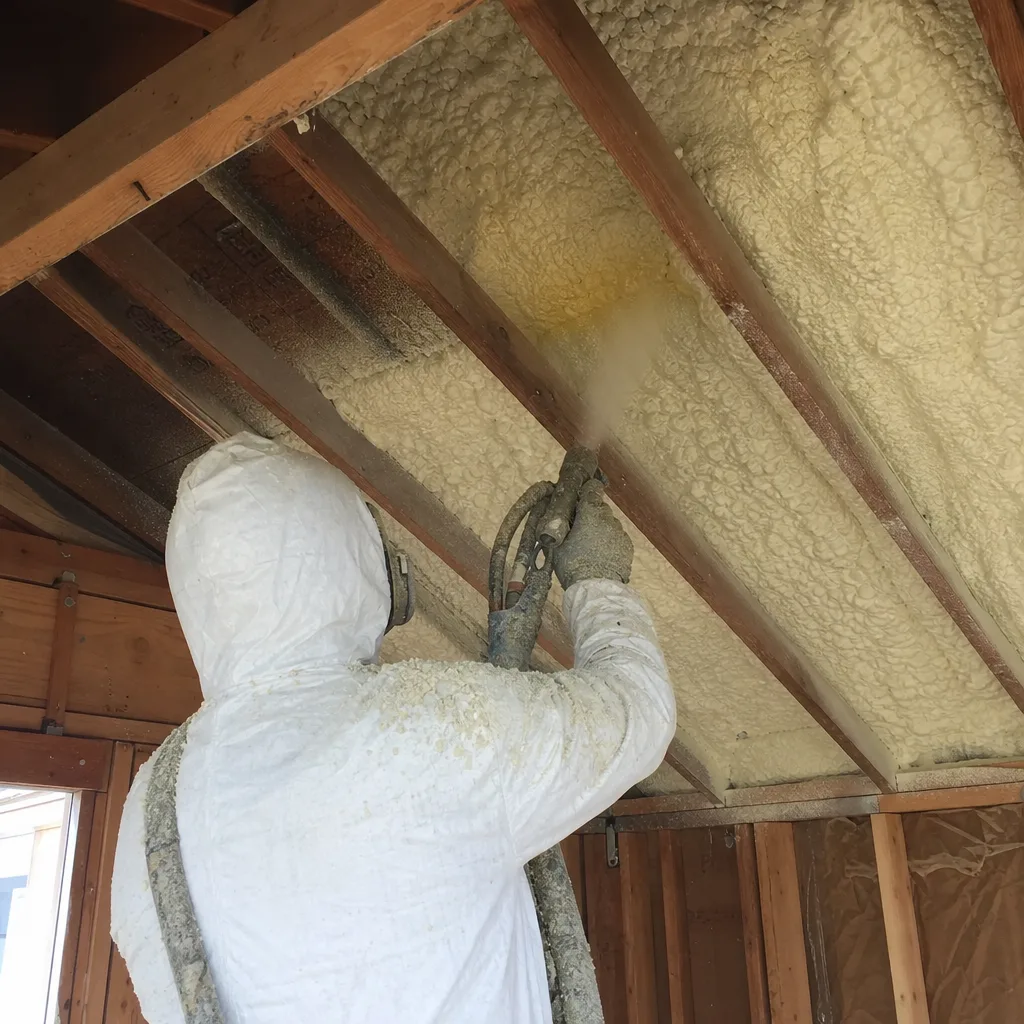
Closed-cell spray foam like Icynene and Demilec products is chemically bonded to the roof decking or wall surface during installation. When applied correctly, it does not separate. But over time, extreme attic heat cycling (North Tustin attics routinely hit 140-160°F in August) can cause delamination if the original substrate was dusty, if there was any moisture during application, or if the foam was installed at the wrong thickness for the temperature conditions. Look for foam that has pulled away from the plywood or OSB decking, forming visible gaps or ridges. Also watch for any areas where the foam appears chalky, discolored, or has a popcorn-like texture. These are chemical degradation signs that warrant professional assessment. Our Attic Insulation Troubleshooting: Common Problems and How to Fix Them covers additional warning signs to watch for.
4. Compacted fiberglass batts under roof valleys and mechanical runs
Anywhere an HVAC tech, electrician, cable installer, or plumber has worked in your attic, the insulation beneath their path is compressed. Compressed fiberglass loses R-value roughly in proportion to the compression: a 12-inch batt compressed to 6 inches has lost about half its insulating capability. In older North Tustin homes where attic mechanical equipment has been serviced multiple times, we commonly find entire runs of compressed batts across the attic floor.
5. Dark staining at the insulation surface
If the top surface of your attic insulation shows dark gray or black staining in patches, that’s air movement. Attic air sneaks through gaps around light fixtures, ceiling fans, and partition walls, and as it passes through insulation, it deposits dust and fiber particles. Those dark patches are visual evidence of the “stack effect” actively stealing conditioned air from your home. The insulation is also acting as an air filter, which is not its job, and the dirt reduces its performance.
If you see any combination of these five signs, it’s worth scheduling a professional inspection to determine how much R-value has actually been lost and whether repair or replacement makes more sense. Our North Tustin Insulation home page covers what a full assessment includes.
Wall Insulation Failure: The Outlet Cold-Spot Test
Wall cavity insulation is the hardest to inspect because it’s sealed inside the wall. But older North Tustin homes with original fiberglass batts in the walls often show insulation failure through a specific, repeatable symptom: cold spots around electrical outlets on exterior walls.
Here’s the mechanism. Fiberglass batt insulation in walls works by trapping air in tiny pockets between glass fibers. Over 30-40 years, three things happen to original 1970s and 1980s batts in North Tustin walls: gravity slowly pulls the fibers downward (settling), the binder that holds the batt shape degrades in the warm climate, and any moisture from leaks or condensation further compresses the material. The result is a void at the top of the wall cavity, often the top 6-12 inches.
An electrical outlet on an exterior wall is a penetration through the drywall into the wall cavity. The gap around the outlet box gives you a tiny window into what’s happening inside the cavity.
How to test for wall cavity insulation gaps
- Pick a cold-ish morning or evening. The test works best when the temperature difference between inside and outside is noticeable. A North Tustin winter morning at 45°F outside with 68°F inside is ideal.
- Remove the outlet cover. Turn off the circuit breaker for that outlet first. Use a flathead screwdriver to remove the cover plate. This exposes the small gap between the drywall and the electrical box.
- Feel for air movement. Hold the back of your hand near the gap between the drywall and the outlet box. If you feel cold air moving, the wall cavity is depressurized or has air channels from gaps at the top or bottom of the cavity.
- Check the wall surface temperature around the outlet. An infrared thermometer works best. Point it at the wall 6 inches above or beside the outlet, then at an interior wall in the same room. If the exterior wall is more than 5°F colder than the interior wall, the cavity insulation has likely settled or failed.
- Repeat on the windward side of the house. Test outlets on exterior walls facing different directions. The wall that faces the prevailing wind or the side with the most afternoon sun exposure will show the biggest differential.
In our inspections across North Tustin, we find that homes built between 1970 and 1990 with original fiberglass batts often show settled insulation in wall cavities, particularly on south and west faces where thermal cycling is most extreme. This is also the era when wall insulation practices were less rigorous: batts were often cut short around outlets, wires, and plumbing, leaving gaps that were never addressed.
One thing to be clear about: the outlet cold-spot test is a diagnostic signal, not a definitive diagnosis. A cold spot could also indicate air infiltration from a cracked exterior, missing sheathing, or an oversized hole around the outlet box. But if you find consistent cold spots across multiple outlets on the same exterior wall, the pattern strongly suggests wall cavity insulation failure.
Sound Transmission as a Secondary Insulation Indicator
One of the least discussed signs of insulation failure is the change in how your home sounds. Insulation doesn’t just manage heat; it also absorbs sound. When wall cavity insulation degrades or settles, exterior noise becomes noticeably louder inside the home. For North Tustin homeowners, this typically shows up first as increased traffic noise from major roads, louder neighbor activity, or more audible aircraft noise from John Wayne Airport flight paths.
The mechanism is straightforward. Fiberglass and cellulose insulation function as acoustic absorbers by converting sound energy into small amounts of heat through fiber vibration. When insulation settles, compresses, or develops gaps, the sound transmission path through the wall opens up. A wall cavity with a 6-inch void at the top becomes a direct sound conduit.
Mineral wool products like Rockwool are especially effective as acoustic insulators because they’re denser than fiberglass. When we install Rockwool in wall cavities for North Tustin clients who specifically want sound control, the before-and-after difference is usually dramatic, often a noticeable reduction in perceived traffic noise within the first day.
How to evaluate sound transmission changes
- Baseline comparison: If you’ve lived in your home for more than 3 years, you know what “normal” street noise sounds like. When that baseline shifts upward without an obvious external change (new road surface, more traffic, a neighbor’s new HVAC unit), wall insulation may be the culprit.
- Room-specific pattern: Insulation failure creates localized sound leaks. If one bedroom is noticeably louder than the others, especially a bedroom on an exterior wall facing a street, that points to wall cavity or attic insulation gaps above that specific room.
- Low-frequency vs. high-frequency: Degraded insulation tends to let in more low-frequency noise first: truck rumble, airplane noise, bass from music. High-frequency sounds like birdsong or distant conversation are less affected early in the failure curve.
- Attic insulation loss and rain noise: If rain on your roof sounds dramatically louder than it used to, that’s a sign of attic insulation loss. Adequate attic insulation acts as a sound barrier between the roof decking and the living space. When it’s depleted, rain sounds transfer almost directly through the ceiling.
Sound transmission alone is rarely the primary reason to replace insulation, but combined with temperature differentials and elevated utility bills, it completes a clear diagnostic picture. And for those who work from home in North Tustin, the noise factor can be the difference between a functional home office and a constant distraction.
We’ve written more about how different insulation materials perform for specific needs in our guide to Attic Insulation in East La Mirada, which covers material selection criteria and R-value requirements.
How to Distinguish an HVAC Problem from an Insulation Failure
Before calling any contractor, North Tustin homeowners want to avoid the expensive mistake of addressing the wrong problem. Here’s the framework we recommend for separating HVAC performance issues from insulation failures. Both can cause high bills and uneven temperatures, but the patterns are different.
Pattern 1: The bill spike happens when?
An HVAC problem, like a failing compressor or a refrigerant leak, causes the system to work harder and run longer. The utility bill spikes suddenly, often within one billing cycle, and stays elevated. An insulation failure causes a gradual, year-over-year utility bill increase that tracks with outdoor temperature: the bill is higher in summer and winter, but you may not notice it because it’s been creeping up 5-7% per year.
Pattern 2: Does the temperature follow the thermostat?
Set your thermostat to 74°F on a hot afternoon. Walk through the house 30 minutes later. If some rooms are at 74°F and others are at 80°F, that’s an insulation or air distribution problem, not a system capacity problem. A properly sized and functioning HVAC system should bring every room close to the setpoint. Temperature variance between rooms points to heat gain in specific zones, which in turn points to insulation gaps above or around those rooms.
Pattern 3: Does the system cycle normally?
A refrigerant leak or failing compressor causes short cycling (the system turns on and off every few minutes) or continuous running without reaching temperature. If your system runs for long periods but the house doesn’t cool, that could be either a system problem or a heat load problem. The tell: if the system is blowing cold air (check the temperature at a vent, should be 15-20°F below room temperature) and still can’t cool the house, the heat load exceeds system capacity. More insulation reduces the heat load and often resolves the issue without touching the HVAC.
Pattern 4: Are the vents pushing enough air?
Weak airflow from vents strongly suggests duct problems, filter issues, or a failing blower motor. Strong airflow with cold air that still doesn’t maintain temperature means the home is gaining heat faster than the system can remove it. In North Tustin, a home with adequate attic insulation (R-38 or better for most existing homes) and sealed air leaks rarely has this problem even on peak summer days.
Pattern 5: Time of day when the problem peaks
HVAC mechanical problems tend to worsen over the entire day as the system runs longer and longer. Insulation-related heat gain peaks in mid-afternoon when the sun is directly on the roof and walls, then somewhat declines in evening. If your comfort problem peaks between 2:00 PM and 6:00 PM, look at the attic insulation first.
Using these patterns, you can often make a strong initial diagnosis before calling anyone. And when we do get called to a North Tustin home for what was suspected as an HVAC problem, the actual finding is insulation failure in roughly a third of those cases, based on what our inspection reveals in the attic and exterior walls.
If you’re still unsure after going through these patterns, call us. We can inspect the insulation condition and tell you definitively whether the heat load problem is in the envelope or the mechanical system. Many North Tustin homeowners get an insulation assessment before spending thousands on HVAC repair.
Moisture and Odor Signals that Point to Insulation Compromise
Insulation and moisture are linked in ways most homeowners don’t realize until a smell or stain forces the issue. In North Tustin, the marine layer and higher coastal humidity mean that insulation in attics and walls is exposed to moisture more often than in drier inland communities. Our guide on Seasonal Insulation Care for North Tustin: Year-Round Homeowner’s Guide explains how to protect your insulation through every season. When insulation gets wet or stays damp, it loses R-value (water conducts heat far better than air) and creates the conditions for mold, mildew, and the musty odors that homeowners notice first.
Musty smell in a closet that backs to an exterior wall
This is a classic North Tustin insulation failure signal. Closets on exterior walls have limited air circulation, and if wall cavity insulation has become damp (from a slow leak, from condensation, or from wicking through stucco), the closet acts as a sealed chamber where the odor concentrates. When you open the closet door and get a whiff of mustiness, the insulation in that wall cavity is usually involved.
Visible condensation on windows in the morning
Condensation on interior windows in the morning, especially on the lower corners, indicates high interior humidity. In North Tustin homes, that humidity often comes from two sources: a bathroom exhaust fan that vents into the attic instead of outside (which also destroys nearby insulation), or missing vapor retarder on fiberglass batts that should be blocking moisture migration.
Insulation stains in the attic after rain
After a rain event, check your attic for wet spots, water stains on the ceiling drywall, or damp insulation. If you see wet fiberglass batts or saturated cellulose, the insulation has absorbed water and needs evaluation. Wet insulation that dries out does not restore its R-value; fiberglass loses its loft, and cellulose compacts and mattes down.
How moisture degrades different insulation types
- Fiberglass (Owens Corning, CertainTeed, Knauf, Johns Manville): Moisture reduces loft and R-value. Wet fiberglass also loses its ability to block air movement. Once it dries, it never fully fluffs back up.
- Cellulose (GreenFiber): Cellulose absorbs moisture readily and holds it. Wet cellulose compacts, creating gaps and voids. It can also encourage mold if moisture persists.
- Spray foam (Icynene, Demilec): Closed-cell spray foam is moisture-resistant and generally does not absorb water. However, open-cell foam can absorb water if there’s a leak, and even closed-cell foam can delaminate from the substrate if water gets between the foam and the decking.
- Mineral wool (Rockwool): Rockwool is naturally hydrophobic, meaning it sheds water. It retains integrity even if it gets damp. It’s the most moisture-resistant fibrous insulation in the standard lineup.
If you find moisture in or around insulation, address the moisture source first. Adding new insulation over a water source that hasn’t been fixed is throwing money away.
Reading Your Utility Bill for Insulation Failure Patterns
Your utility bill is a diagnostic tool. Most North Tustin homeowners look at the total and the amount due, but the patterns inside the bill tell you a lot about insulation condition.
Step 1: Get 24 months of billing data
Southern California Edison and SoCalGas both allow you to download historical usage data. Pull two years of monthly usage in kilowatt-hours (for cooling) and therms (for heating), if you have gas heat. This data is free and easily accessible from your online account.
Step 2: Compare summer usage year-over-year
Look at July, August, and September usage for the current year versus the same months last year and two years ago. Adjust for obvious variables: if last summer was milder, usage should be lower; if you added a family member or started working from home, usage should rise accordingly. But if you see a steady increase in summer kWh without any lifestyle change, that increase is most likely heat gain through a degrading building envelope: attic insulation, wall insulation, or air sealing.
Step 3: Look at the “base load”
Your base load is the electricity you use every month regardless of season: refrigerator, lighting, electronics. That number should be relatively flat year-round. Summer cooling spikes above the base load represent the heat gain your HVAC system is fighting. As insulation degrades, the summer spike grows.
Step 4: Watch for the “shoulder season” signal
North Tustin has mild shoulder seasons (April-May and October-November) when we run neither heat nor AC. If your utility bill during these months is creeping upward, that’s less likely to be an insulation issue and more likely to be an appliance or electronics change. Insulation failure shows up primarily in extreme weather months.
Step 5: Calculate cost per degree-day
Degree-days are a measure of how much cooling or heating a home needs based on outdoor temperature. If you divide cooling kWh by cooling degree-days for each summer month, you get a normalized figure that accounts for weather. If that number has risen year-over-year, the home is using more energy per unit of outdoor heat, which points squarely at insulation and air sealing.
We’ve seen North Tustin homes where attic insulation had degraded from R-38 to roughly R-11 as measured, and the summer bill impact was $60-80 per month. Reinsulating the attic often pays for itself within 3-5 years in energy savings alone, not counting the comfort improvement.
Common Mistakes to Avoid
- Adding insulation over failed insulation without checking the existing layer. Putting new blown-in fiberglass over compressed, water-stained, or pest-damaged batts does not fix the performance problem. The new material compounds the issue, and the degraded layer continues to fail. Inspect first, then decide.
- Treating the symptom, not the source, when it comes to drafty rooms. Weatherstripping doors and windows helps with air infiltration, but it won’t address a wall cavity void or an uninsulated attic hatch. You’ll spend money on caulk and still have cold spots.
- Assuming the original builder insulation is still performing. North Tustin homes built in the 1980s and earlier were frequently insulated to R-19 in the attic when today’s recommendation is R-38 or higher. Even if the original material hasn’t degraded, it was never adequate for current energy costs and comfort standards.
- Sealing the attic without first addressing ventilation. An attic that’s been air-sealed but not properly ventilated creates moisture problems. North Tustin’s coastal humidity means condensation in a sealed, poorly ventilated attic can damage insulation and roof decking.
- Ignoring the attic access hatch. The pull-down stair or hatch to the attic is often uninsulated or has a failed seal. A 22-square-foot hatch with no insulation is equivalent to a hole in the ceiling of that size. This is one of the most common, and most fixable, insulation gaps we find in North Tustin homes.
- Buying insulation by price per square foot. The cheapest material installed without regard for the specific attic conditions (moisture profile, pest pressure, accessibility, ductwork layout) will underperform. Material selection matters. Different attics have different requirements; the right choice prevents rework.
- Running the AC cooler to compensate for insulation loss. Setting the thermostat to 71°F when the home gains too much heat to hold 75°F is treating the symptom with higher electricity bills. The fix is in the attic and walls, not the thermostat.
When to Call a Professional
Some insulation warning signs are worth watching; others warrant an immediate call. Call a professional insulation contractor if you see any of the following: visible water staining on ceiling surfaces or attic insulation, evidence of rodent activity in the attic, dark staining at insulation surfaces indicating air movement, room temperature differentials of 4°F or more that persist across seasons, utility bills that have risen 15% or more year-over-year without a corresponding change in your usage patterns, or spray foam that has visibly separated from the roof decking.
Also call if you’re planning an HVAC replacement: adding insulation before or during an HVAC upgrade maximises the value of both. North Tustin Insulation offers free estimates in North Tustin. Call (877) 265-5712 to schedule an attic inspection and insulation assessment.
Frequently Asked Questions
The first signs of insulation failure are usually uneven room temperatures (a 4°F or greater variance between rooms on the same floor), a gradual increase in utility bills year-over-year without increased usage, and drafts near windows, outlets, or baseboards on exterior walls. In North Tustin attics, visual signs include compacted fiberglass, dark staining at the insulation surface, and pest tunnels through blown-in cellulose.
Attic insulation inspection in North Tustin is typically free as part of an insulation estimate. North Tustin Insulation includes a full attic assessment with every estimate: we measure existing insulation depth, check for air leaks, inspect for moisture or pest damage, and evaluate ventilation. Call (877) 265-5712 to schedule.
You can add new insulation over old insulation only if the existing layer is dry, uncompressed, and free of pest damage or mold. Compressed or water-damaged insulation should be removed first, because it has lost its thermal performance and can trap problems beneath the new layer. A professional inspection tells you whether your existing insulation is a suitable base.
Spray foam insulation from quality manufacturers like Icynene and Demilec generally performs for the life of the home when properly installed, but it can delaminate from the substrate if installation conditions were poor, if there was moisture during application, or if the surface wasn’t properly prepared. Visible separation between the foam and the roof decking or wall surface is a failure sign that warrants professional assessment.
The most reliable home test for settled wall insulation is the outlet cold-spot method: remove an outlet cover on an exterior wall (with the breaker off) and feel for cold air movement, then compare the wall surface temperature to an interior wall. A consistent 5°F or greater difference across multiple outlets on the same wall strongly suggests cavity insulation has settled or failed.
A sudden, single-month spike in your electric bill likely points to an HVAC problem. A gradual increase in summer bills year-over-year, without a change in usage habits, points to insulation degradation or air leaks. If your HVAC is blowing cold air (15-20°F below room temperature at the vent) but the home still won’t hold temperature, the heat load is exceeding the system’s capacity, and insulation is usually involved. Call (877) 265-5712 for a free assessment that can pinpoint the source.
The Bottom Line
Insulation failure in North Tustin homes almost never announces itself directly. It hides inside temperature differentials, utility bill trends, musty closet odors, and attic visual clues that most homeowners only notice when someone points them out. The good news is that every warning sign in this guide is detectable with a systematic walkthrough and a trip into the attic. Once you know your home’s baseline and the signs of deviation, you can catch insulation problems early enough to fix them before they turn into five-figure energy waste and comfort problems. North Tustin Insulation offers Spray Foam Insulation in East La Mirada, Blown In Insulation in East La Mirada, and full attic insulation services in North Tustin. Call us at (877) 265-5712 for a free estimate and an honest assessment of what your insulation is actually doing.
Written by the team at North Tustin Insulation, serving North Tustin since 2011.