Last updated October 31, 2026
DIY vs Professional Insulation: The North Tustin Homeowner’s Decision Guide
Renting a blow-in machine from Home Depot is legal, costs about $200 a day, and works fine for topping off an open attic. But here’s what the rental counter won’t tell you: if you’re trying to hit a Title 24 R-38 verified rating for a permit closure or a home sale, DIY blown-in won’t get you a signed HERS report. The inspector doesn’t care how many bags you emptied. They care about installed density, settled thickness, and a third-party verification number. This guide walks through exactly which insulation jobs a capable North Tustin homeowner can realistically tackle, which ones require a licensed professional, and where the hidden costs and code traps actually live. For more guides & resources on home insulation, see our blog. We’re not here to talk you out of DIY across the board. We’re here to tell you where DIY stops making sense in Southern California specifically.
Quick Answer
DIY insulation makes sense for one narrow job in North Tustin: replacing or topping off fiberglass batts in an accessible, open attic with no existing moisture problems and no permit requirement. Everything else, especially spray foam, air sealing, and any Title 24 compliance work, needs a professional. The deciding factors are rarely skill. They’re code documentation, equipment costs, material chemistry, and what a botched job costs to fix.
Table of Contents
- The Job-by-Job Breakdown: What’s Actually DIYable in North Tustin
- Why California Code Changes the DIY Math
- Hidden DIY Costs North Tustin Homeowners Underestimate
- Moisture Mistakes: The Dry Climate Trap
- Using Professional Installation Strategically
- Material Match: Why Brand Matters More Than You Think
- Common Mistakes to Avoid
- When to Call a Professional
- Frequently Asked Questions
- The Bottom Line
The Job-by-Job Breakdown: What’s Actually DIYable in North Tustin
Insulation isn’t one job. It’s five distinct jobs wearing the same name. Grouping them all as “insulation” is how homeowners end up renting the wrong equipment, buying the wrong material, and discovering halfway through a Saturday that their attic doesn’t match any YouTube tutorial. Each job below is evaluated on its own terms, because the DIY answer changes completely depending on which one you’re facing.
Job 1: Batt Replacement in an Open Attic
DIY feasibility: High. This is the one job where DIY genuinely makes sense for a capable homeowner. If your North Tustin attic already has fiberglass batts that are compressed, matted, or thinned out from years of heat cycling, and the framing bays are accessible, laying new batts is straightforward. Cut to size with a utility knife, wear long sleeves and a respirator, and don’t compress the fiberglass. Compressed batts lose R-value fast because insulation works by trapping air, and squeezing the material removes the air pockets that do the actual insulating.
The catch: batts only make sense when the attic is open and mostly empty. If you’ve got storage decking nailed over half the floor joists, or the attic is a tight crawlspace with ductwork everywhere, batt replacement gets complicated quickly. And if the existing insulation shows signs of moisture staining, stop and figure out the moisture source before covering it back up.
Job 2: Blown-In Top-Off Over Existing Insulation
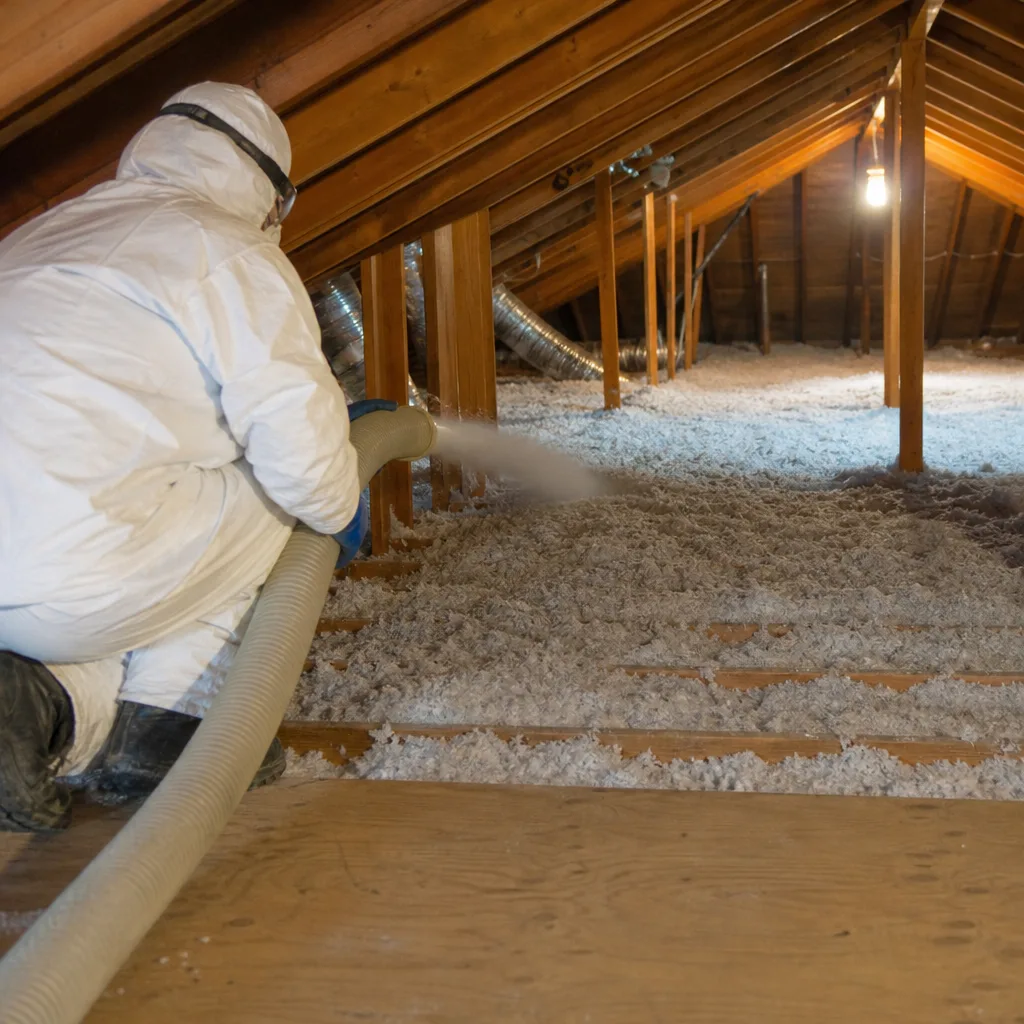
DIY feasibility: Moderate, with a HERS caveat. Topping off an existing blown-in layer with more cellulose or fiberglass is the classic “rent the machine and go” project. The machine from Home Depot works. The material is cheap. For a pure energy-savings play with no permit involved, it’s a reasonable weekend project.
But here’s the North Tustin-specific problem: if this top-off is part of a bigger renovation with a permit, or you’re planning to sell the house within a few years, Title 24 requires a HERS rater to verify installed R-value. A HERS rater isn’t going to sign off on a homeowner’s work without documentation that includes installed density measurements and coverage verification. You can’t document what you didn’t measure. This is covered in depth in the California code section below.
Job 3: Air Sealing
DIY feasibility: Low, and getting it wrong is expensive. Air sealing is the unglamorous, invisible work that matters more than insulation thickness in a lot of North Tustin homes. The gaps around recessed lights, plumbing penetrations, top plates, and the attic access hatch leak conditioned air all year. In an inland Orange County climate where summer attic temperatures routinely pass 120°F, those gaps pull hot air down into the living space and push cooled air out.
The reason air sealing is professional territory: doing it correctly requires identifying every leak, understanding which sealant goes where (fire-rated caulk around flues? specific clearance around can lights? vapor considerations in bathrooms?), and not accidentally creating a negative-pressure situation that pulls combustion gases from a gas water heater or furnace. North Tustin has a lot of older single-story and split-level homes with gas appliances in interior closets. Improperly sealed attics plus negative pressure equals backdrafting risk. That’s not a comfort issue. That’s a carbon monoxide issue.
Job 4: Spray Foam
DIY feasibility: Effectively zero. Two-part spray polyurethane foam is not a consumer product. The chemistry requires precise temperature control, proper ratio mixing at the gun, and application thickness that doesn’t exceed what the substrate can handle. Off-ratio foam won’t cure properly, can off-gas, and often has to be completely removed and redone. The spray foam kits sold at home improvement stores are meant for sealing small gaps and cracks, not for insulating a North Tustin attic or crawlspace. Full spray foam installation means pro-level rigs, respirators beyond what a dust mask provides, and applicator training. In California, specific certification and compliance requirements apply to professional spray foam work. This isn’t a question of whether you’re handy. It’s a question of chemistry and code.
Job 5: Wall Cavity Injection for Existing Homes
DIY feasibility: None. If your North Tustin home was built before the late 1970s, there’s a good chance the exterior walls have empty cavities or settled fiberglass from a bygone era. Fixing this means drilling holes into the exterior or interior walls and injecting dense-pack cellulose or injection foam. This requires specialized equipment, understanding of framing patterns, and knowing how to avoid over-pressurizing cavities so the drywall doesn’t blow out. The tools alone cost more than hiring it done.
Why California Code Changes the DIY Math
If North Tustin were in a state without a robust energy code, more insulation jobs would be DIYable. But California’s Title 24 Part 6 sets specific minimum R-values for climate zones, and North Tustin sits in a climate zone that requires R-38 in attics for most residential projects. More importantly, Title 24 compliance isn’t honored by good intentions. It’s verified by HERS raters who perform field inspections and sign documents that go into your permit file and your home’s resale disclosure.
Here’s what that means in practice:
- Permit-pull projects require verified R-value. If your insulation work is part of a remodel, addition, or any pull with a city permit, the final inspection typically includes HERS verification of installed attic insulation. A DIY job with no documentation won’t pass.
- HERS raters need installation data. A rater doesn’t just eyeball the attic and say “looks like R-38.” They check installed depth, settled R-value, and sometimes density. Professional insulation contractors document every step and provide the paperwork that makes the rater’s job quick and clean.
- Spray foam installations require compliance documentation. Spray polyurethane foam in California involves EPA RRP compliance and, in many cases, applicator certification for the specific system being installed. The compliance burden sits on the contractor, not the homeowner. That’s a transfer of liability worth paying for.
- Home resale increasingly demands energy disclosures. Buyers in North Tustin are asking about attic insulation condition more than they did ten years ago. Any insulation work you do now becomes part of the disclosure conversation. Professional installation with documentation reads differently than a weekend project with no records.
The point isn’t that DIY insulation is “against code.” Adding a few batts on top of old insulation with no permit involved is perfectly fine. The point is that the moment a permit or compliance verification enters the picture, the professional’s documentation becomes the product you’re actually buying.
Hidden DIY Costs North Tustin Homeowners Underestimate
The math you do in your head on a Saturday morning, sitting at the kitchen table with an energy bill in one hand and a Home Depot receipt in the other, usually looks something like this: machine rental $200, twelve bags of cellulose $180, one Saturday gone. Total: under $400. For a fuller picture, see our Insulation Cost Breakdown: The North Tustin Homeowner’s Reference for 2026. The math you learn later, when you’re halfway up a ladder in July and the attic is 130°F, looks different.
Equipment rental isn’t just the machine. Blow-in machines require extension cords rated for the amperage, hoses long enough to reach from the driveway to the attic, and someone feeding the hopper while someone else works the hose. You need two people minimum. If your helper bails, the machine rental clock keeps ticking.
Material waste from inexperience is real. First-time cellulose installers routinely over-blow or under-blow bays. Over-blow wastes material. Under-blow means you’re back at the store buying more bags. Both eat into the projected savings.
Disposal fees hit harder than expected. If you’re removing old insulation, especially old fiberglass that’s been in an attic for 40 years, you can’t just bag it and put it in the weekly trash. Orange County disposal facilities charge by volume, and an attic’s worth of old insulation fills a surprising number of contractor bags. That’s an extra $100 to $200 most DIY math forgets entirely.
Fixing installation errors costs more than the original job. Here’s the number nobody puts on the spreadsheet: if you miss an air leak, under-insulate a zone, or install a vapor retarder on the wrong side of a wall assembly in a North Tustin home and moisture accumulates. Remediating that after drywall goes up means demo, mold treatment, re-insulation, and re-drywall. That’s thousands of dollars chasing an error that a professional crew wouldn’t have made.
Your time has a value. A professional crew knocks out an attic insulation job in a day or two. A DIY blown-in job, with rental pickup and return, setup, cleanup, and the inevitable second trip back to the store, eats three to five days of your free time. If that time is billable, the DIY project just doubled in cost.
Moisture Mistakes: The Dry Climate Trap
North Tustin gets about 14 inches of rain annually. Compare that to Portland’s 43 or Seattle’s 37, and it’s easy to convince yourself that moisture management doesn’t matter here. That assumption is exactly what makes moisture mistakes in dry climates so dangerous. They sit undetected for years because the environment dries them out before the visible signs appear. Then one wet winter, or one HVAC condensate line failure, and the problem blooms.
The most common dry-climate moisture mistake is installing a vapor retarder on the wrong side of the assembly. In a heating-dominated climate, the vapor retarder goes on the warm side. In a cooling-dominated climate like Southern California, the rules are different, and interior vapor barriers can trap moisture inside wall cavities where air conditioning creates condensation potential. Get this wrong and you’ve essentially built a slow mold incubator inside your walls.
The second common mistake is insulating over bathroom exhaust fan ducts without checking the ducting first. If the exhaust fan duct is leaky, disconnected, or venting into the attic instead of through the roof, adding insulation on top just locks moisture in with the framing. In a dry climate, wet framing takes longer to show staining. By the time you notice the drywall discoloration, the rot and mold have had years to work.
The third issue is spray foam done wrong. Closed-cell spray foam is an air and moisture barrier. Properly installed, that’s excellent. If someone applies it without understanding the dew point calculations or the roof assembly specifics, condensation can form on the wrong side of the foam and rot out your roof sheathing from underneath. This is a known failure mode in Southern California homes with unvented attic conversions gone wrong. The roof doesn’t leak from weather. It rots from the inside.
Using Professional Installation Strategically
You don’t have to hire a professional for every square inch of insulation work. Smart North Tustin homeowners split jobs. They do what’s genuinely simple themselves and hire out what carries disproportionate risk or cost. The key is knowing which zones deliver the most performance-per-dollar when professionally done.
Hire out: air sealing. This is the highest-leverage professional service on the list. Air sealing fixes cost somewhere in the $400 to $900 range in North Tustin for a typical attic, and they often cut energy bills more than adding insulation thickness. The equipment is cheap (caulk, foam, a few specialized materials), but the knowledge of where to seal and what not to seal is where the value lives.
Hire out: any spray foam work. The equipment cost alone eliminates DIY here. Beyond that, the compliance documentation and liability transfer make professional installation the only rational choice. Our team carries both Icynene and Demilec spray foam systems, which means we select the product based on the specific application rather than whichever single brand we happen to stock. That matters for open-cell versus closed-cell decisions in Southern California roof assemblies.
Consider hiring out: blown-in installation with permit involvement. If the job is big enough that a permit is being pulled, just have the professional do the whole thing. The HERS verification process is smoother when the installer handles documentation from the start.
Do it yourself: batt replacement in a simple, open attic with no moisture signs and no permit. This is the one job where your savings are genuine and the risk profile is manageable. Buy good material. We recommend CertainTeed fiberglass batts for this kind of work because they hold their thickness well and cut clean. Rockwool mineral wool is another strong choice for its non-combustible properties and stability, especially if you’re installing around can lights or other heat sources.
Material Match: Why Brand Matters More Than You Think
Insulation brands aren’t like tool brands where the difference is mostly tote-bag aesthetics. Product quality varies measurably, and the wrong material for a specific North Tustin attic can underperform even when installed perfectly. This is where the multi-brand approach earns its keep.
Fiberglass batts from Owens Corning and CertainTeed dominate residential attics for good reason: they’re economical, predictable, and easy to work with. But fiberglass loses some effectiveness in high-temperature attic conditions because air moves through it more readily than through denser materials. For a North Tustin attic that bakes in summer heat, that’s relevant.
Cellulose from GreenFiber is recycled paper treated with fire retardant, and it fills cavities more completely than batts, which reduces air movement. It’s a solid blown-in choice for older homes with irregular framing. The recycled content matters to a lot of North Tustin homeowners who want sustainability without a performance compromise.
Rockwool mineral wool is heavier and denser than fiberglass, cuts cleanly, and won’t burn. It’s the premium batt choice for areas around heat sources like recessed cans and furnace flues. It also provides better sound control, which matters if you live near the 55 or under a flight path.
Spray foam is a different animal entirely. Open-cell foam (like Demilec’s open-cell products) is lighter, less expensive, and works as an air barrier but not a complete moisture barrier. Closed-cell foam (like certain Icynene systems) is denser, more expensive, and creates both an air and moisture barrier. The decision between them depends on roof assembly specifics, appliance venting, and the moisture profile of your specific North Tustin home. Our team carries both Icynene and Demilec spray foam systems specifically so we’re not forced to recommend open-cell because that’s all we have, or closed-cell because that’s easier for us to install. We match the material to your home, not the other way around.
The broader principle: a contractor with one brand relationship will always find a way to make that brand fit your house, whether it’s the right material or not. A contractor with eight brand relationships across four material categories makes recommendations based on the house. That distinction matters more in North Tustin, where homes range from 1960s single-story ranch styles with vented attics to newer builds with different assemblies entirely. No single insulation product handles all of those well.
Common Mistakes to Avoid
- Compressing insulation to fit a tight cavity. Insulation works by trapping air, and compression kills the R-value. If you’re squeezing a batt to fit around a duct or an electrical box, you’re undoing its effectiveness. Cut the batt, don’t crush it.
- Ignoring the attic access hatch. The hatch or pull-down ladder access is typically the single biggest air leak in a North Tustin attic. Insulating the floor and ignoring the hatch is like sealing every window but leaving the front door open six inches.
- Covering recessed lights with insulation without checking ratings. Older can light fixtures aren’t rated for insulation contact. Covering them with batts or blown-in material creates a fire hazard. If the fixtures are old, replace them with IC-rated ones or leave proper clearance.
- Skipping the respirator for fiberglass work. Fiberglass particles irritate skin and lungs. A dust mask is not sufficient for a full day of attic batts. Long sleeves, a real respirator, and a rinse-off shower afterward are the minimum.
- Assuming new insulation over old is always fine. If the old insulation is wet, compacted, rodent-infested, or loaded with decades of dust, putting new material on top is a waste of money. The old layer won’t perform, and moisture problems compound.
- Using one material for everything because it’s familiar. Batts in open attics make sense. Batts in hard-to-reach soffits or around complex framing do not. Matching material to application matters.
When to Call a Professional
Call a professional if your insulation project involves a permit, a HERS verification, spray foam of any kind, air sealing around gas appliances, or any situation where the attic shows signs of moisture. Call if you’ve started a DIY job and found something unexpected, like old vermiculite (which may contain asbestos), animal droppings, or framing damage. Call if the project is in a hard-to-access zone, like a low-slope roof attic or a crawlspace. North Tustin Insulation offers free estimates in North Tustin. Call (877) 265-5712 and we’ll tell you honestly whether your job is worth hiring out or whether you should grab that Home Depot machine and go for it. That’s the kind of straight answer this guide is built on.
Frequently Asked Questions
For batt replacement in a simple, open attic with no permit requirement and no moisture issues, DIY attic insulation can save you labor costs and produce real value. For blow-in insulation that needs HERS verification, or any spray foam or air sealing work, professional installation is the only cost-effective choice. Call (877) 265-5712 for a free estimate and we’ll tell you which path makes sense for your specific attic.
Professional attic insulation in North Tustin ranges from roughly $1,200 for a small top-off to $4,000+ for full removal, air sealing, and R-38 blown-in installation, depending on attic size and accessibility. Spray foam runs higher. The best way to get an accurate number is a free on-site estimate: call (877) 265-5712.
No. Two-part spray foam requires commercial-grade equipment, chemical handling training, and California compliance documentation that homeowner-grade kits cannot provide. A botched spray foam job can fail to cure, off-gas, or trap moisture against roof sheathing. Professional installation is the only realistic option for spray foam work.
California Title 24 requires R-38 in attic floors for most residential projects in North Tustin’s climate zone. R-38 translates to roughly 10 to 14 inches of blown-in fiberglass or cellulose, depending on the material’s settled density. If your attic has less than that, you’re under the current standard.
Most North Tustin attic insulation jobs, including air sealing and blow-in installation, are completed in one day by a professional crew. Batt replacement in large attics can run to a second day. Spray foam takes longer depending on the area and foam type.
Topping off existing insulation that’s still in decent shape is almost always cheaper than removing and replacing. But if the existing insulation is wet, compressed, or rodent-contaminated, replacement is the better long-term investment. Call (877) 265-5712 for a free attic inspection and we’ll tell you which way makes sense for your home.
The Bottom Line
DIY insulation has exactly one lane in North Tustin: fiberglass batt replacement in an open, dry, accessible attic with no permit on the table. Everything else, from blown-in work that requires HERS documentation to air sealing to spray foam, belongs with a professional crew. The reasons are code compliance, equipment costs, material chemistry, and the risk of a hidden moisture problem that a dry climate keeps invisible for years. If you’re not sure whether your job falls in the DIY lane, get a free estimate and some straight answers first. North Tustin Insulation carries eight brands across fiberglass, mineral wool, cellulose, and spray foam, which means our recommendation comes from your home’s needs, not from whatever product we happen to stock. Call (877) 265-5712 for a free, no-pressure estimate in North Tustin.
Written by the team at North Tustin Insulation, serving North Tustin since 2011.