Last updated October 31, 2026
Insulation Emergency Preparedness Guide for North Tustin Homes
Most North Tustin homeowners think about insulation exactly twice: when the July electric bill arrives and when a room feels stuffy in August. That’s a missed opportunity with real consequences. The same attic insulation that trims your cooling costs also determines how many hours your home stays habitable when the power fails during a heat wave, how much wildfire smoke seeps into your living room, and whether your walls hold up to Santa Ana wind pressure. This guide explains the emergency-resilience side of insulation, written specifically for North Tustin’s climate, terrain, and building stock, and complements our Seasonal Insulation Care for North Tustin: Year-Round Homeowner’s Guide. By the time you finish, you’ll know which materials buy you the most time when things go wrong, and what to inspect after the next extreme weather event.
Quick Answer
Insulation is emergency infrastructure, not just an energy efficiency product. During a North Tustin power outage in peak summer heat, well-insulated homes with air-sealed attics stay below 85°F for 6 to 10 hours longer than under-insulated homes, depending on material type and installation quality. The right insulation also slows wildfire smoke infiltration by up to 70% when combined with proper air sealing. For North Tustin homes, the most resilience per dollar comes from dense-packed cellulose or mineral wool in the attic, plus air-sealing around all ceiling penetrations. If your insulation is 15 years old, settled, or installed before 2000, it’s likely providing less than half the emergency protection of a properly installed modern system.
Table of Contents
- Thermal Lag: How Insulation Buys You Time During a Power Outage
- Wildfire Smoke Infiltration and PM2.5: What Insulation Does
- Fire-Resistant Insulation Materials for Wildfire-Adjacent Homes
- Santa Ana Wind Events and Whole-House Pressure Dynamics
- Emergency Performance of Specific Materials: Rockwool, Cellulose, Spray Foam
- Post-Event Inspection Checklist: Heat, Wind, and Smoke
- Common Mistakes to Avoid
- When to Call a Professional
- Frequently Asked Questions
- The Bottom Line
Thermal Lag: How Insulation Buys You Time During a Power Outage
During the 2020 heat dome events, poorly insulated Southern California homes hit interior temperatures above 90°F within four hours of losing power. Homes with air-sealed attics and R-38 or better insulation took more than eight hours to reach that same threshold. That’s the difference between riding out an outage comfortably and evacuating to a cooling center. In North Tustin, where summer highs routinely hit the mid-90s and heat waves push past 100°F, this four-hour gap is genuinely meaningful.
Thermal lag is the term for how long a building assembly delays heat transfer. Insulation doesn’t stop heat, it slows it. The more thermal mass and higher the R-value, the longer the delay. Here’s how common materials in North Tustin attics perform during a 105°F day with no air conditioning:
- Fiberglass batts, R-19 (common in pre-1990 homes): Interior temperature rises above 88°F in roughly 3 hours. Minimal lag, significant heat gain through the ceiling.
- Fiberglass batts, R-38: Approximately 5 to 6 hours before interior hits 88°F. Better, but still loses the fight by late afternoon.
- Blown-in cellulose, R-38: 7 to 8 hours. Cellulose is denser than fiberglass, packs tighter around framing, and resists convective air movement within the insulation layer itself.
- Rockwool mineral wool, R-38: 8 hours or more. Mineral wool has higher density and exceptional resistance to radiant heat transfer, which matters when the roof deck is scorching.
- Closed-cell spray foam, R-38 equivalent: 10+ hours. Icynene and Demilec closed-cell formulations air-seal as they insulate, eliminating the convective bypass that undermines batt-and-blown installations.
These numbers matter more than most North Tustin homeowners realize. Your attic can reach 140°F on a hot day. Without adequate insulation, that heat radiates down through your ceiling all night, long after outdoor temperatures drop. With adequate thermal lag, your home releases stored heat gradually rather than absorbing it continuously. That’s why two identical floor plans on the same North Tustin street can have vastly different indoor temperatures during an outage.
For a deeper look at how attic insulation performs in this climate, see our guide on Attic Insulation in East La Mirada, where we cover the same heat dynamics in a comparable Southern California microclimate.
Wildfire Smoke Infiltration and PM2.5: What Insulation Does
When the Silverado or Bond fires push smoke into North Tustin, the air inside your home matters as much as the air outside. PM2.5 particles are 2.5 microns or smaller, small enough to slip through the tiniest cracks around ceiling boxes, recessed lights, attic hatches, and electrical penetrations. A leaky attic insulation assembly doesn’t just waste energy; it acts as a conduit that draws smoky air into your living spaces.
Here’s the mechanism. Your home operates under pressure differentials. When your HVAC system runs, or when wind pushes against one side of your house, or when temperature differences create stack effect, air moves through every available leak. A typical pre-2000 North Tustin home has enough combined attic bypass openings to equal a 2-square-foot hole in the ceiling. During a wildfire smoke event, that’s a 2-square-foot pathway for PM2.5, carbon monoxide, and volatile organic compounds to enter your bedrooms.
When we talk about insulation in an emergency context, we’re really talking about insulation plus air sealing. The two are inseparable for smoke resilience:
- Dense-packed cellulose (GreenFiber) fills irregular cavities completely, physically blocking airflow through wall and ceiling penetrations when properly installed to the correct density of 3.5 pounds per cubic foot.
- Open-cell spray foam (Icynene, Demilec) expands to create an air-impermeable seal at the attic floor level, effectively eliminating the bypass pathways that draw smoke downward.
- Closed-cell spray foam does everything open-cell does but also provides a vapor retarder and structural rigidity. The premium choice for wildfire-smoke protection.
- Custom-cut fiberglass batts (Owens Corning, CertainTeed, Johns Manville) perform poorly against smoke infiltration unless paired with deliberate air sealing at every penetration point, something most installations from 20 years ago skipped entirely.
In our experience working in North Tustin homes, the single biggest smoke entry point is the recessed light. Non-IC-rated fixtures from the 1980s and 1990s sit directly in the attic insulation, leaving a gap that smoke finds within minutes. Sealing these with rated covers, and insulating around them properly, does more for smoke resilience than most homeowners realize.
Fire-Resistant Insulation Materials for Wildfire-Adjacent Homes
North Tustin sits in a wildland-urban interface zone, which means fire resilience should factor into every material decision, including insulation. Not all insulation responds to fire the same way, and the differences are significant enough to matter during an ember attack or structure fire.
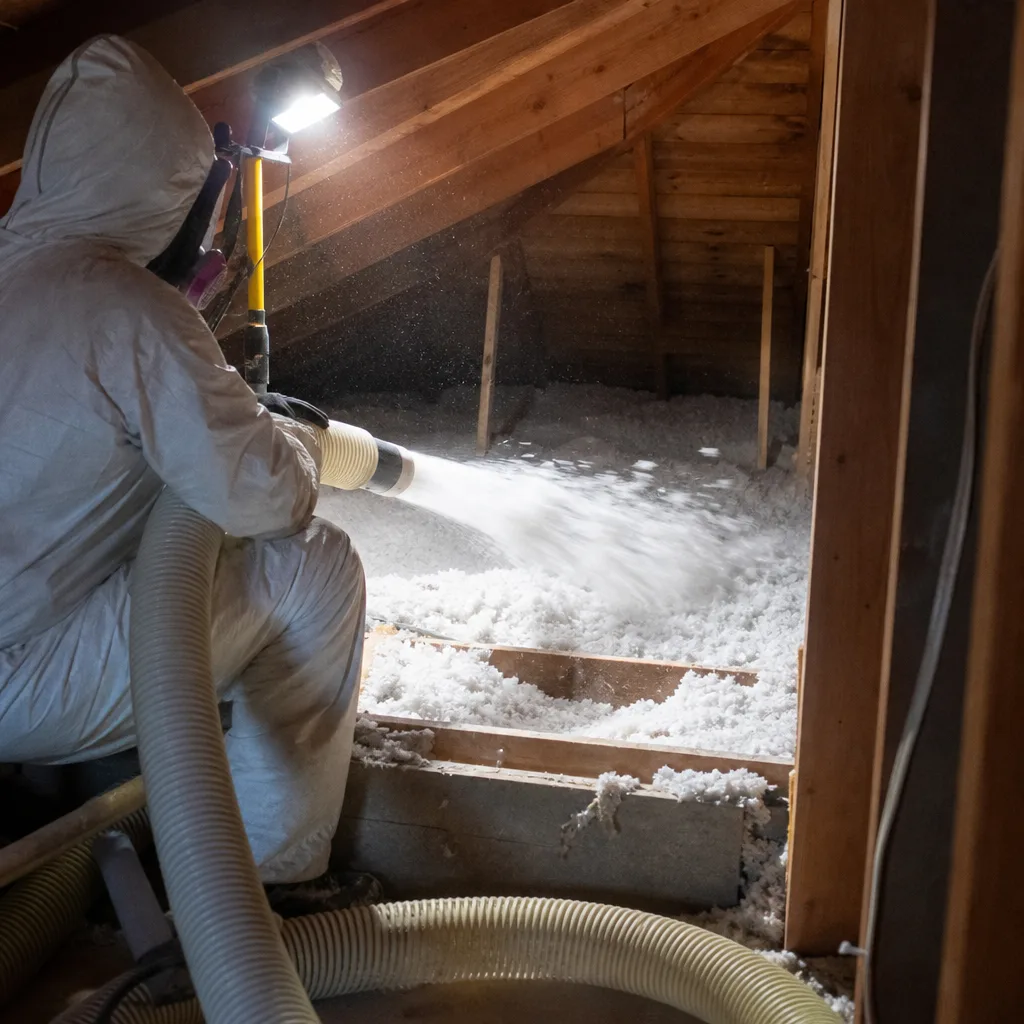
Rockwool mineral wool is non-combustible. It’s made from volcanic basalt rock and recycled slag, and it withstands temperatures above 2,000°F without burning, melting, or producing toxic smoke. In a wall cavity or attic assembly, Rockwool acts as a fire spread barrier, slowing flame propagation from one room to the next. For North Tustin homeowners prioritizing fire safety, this is the material we most frequently recommend for exterior walls and attic perimeters.
Cellulose (GreenFiber) is chemically treated with borate compounds that provide flame resistance. Treated cellulose chars rather than flames when exposed to fire, and its dense-packed installation leaves no oxygen pockets for fire to travel through. It’s not non-combustible like mineral wool, but it’s a substantial step up from untreated fiberglass in fire performance.
Fiberglass (Owens Corning, CertainTeed, Knauf, Johns Manville) is inherently non-combustible, but the paper or foil facing on batts is not. Most North Tustin attics have faced batts, and the facing is the vulnerable point. In a fire, the kraft paper burns away, leaving the glass fibers exposed. The fibers themselves won’t burn, but they also won’t stop fire the way dense-packed cellulose or mineral wool will.
Spray foam (Icynene, Demilec) requires ignition barriers. Both open-cell and closed-cell spray foam are combustible and must be covered by a thermal or ignition barrier, usually 1/2-inch gypsum board, when installed in living spaces. This doesn’t make spray foam unsafe; it’s standard building code. But it’s a relevant distinction in wildfire-adjacent areas. Closed-cell spray foam has better fire performance than open-cell when exposed, but neither is a fireblock by itself.
For a deeper comparison of how spray foam compares to other methods in this region, read our guide on Spray Foam Insulation in East La Mirada.
Santa Ana Wind Events and Whole-House Pressure Dynamics
Santa Ana winds don’t just knock down fences and dry out vegetation. They turn your house into a pressure vessel, and a leaky insulation assembly amplifies every problem that comes with it. Wind blowing at 40 to 60 mph against one side of your North Tustin home creates positive pressure on the windward side and negative pressure on the leeward side. The result is air being pulled through every crack on the windward side and sucked out through every crack on the leeward side, in a constant loop.
This pressure differential has three emergency-relevant consequences:
- Smoke and particulate draw: During a wind-driven fire, the leeward side of your home acts like an exhaust vent. As air rushes out the downwind side, replacement air gets drawn in from the upwind side. If that replacement air is full of smoke or embers, your home becomes an unintended filter, concentrating particulates inside.
- Rapid heat loss or gain: The same pressure loop strips conditioned air from your home within minutes. During a winter Santa Ana event, a leaky attic can pull heated air out of your living space faster than your furnace can replace it. During a hot, dry Santa Ana in October, the reverse happens.
- Ember intrusion: Wind-blown embers don’t need an open window. They can be drawn through soffit vents, gable vents, and attic gaps, landing in dry insulation or structural framing. In North Tustin, homes built before 1970 often have open-eave construction with minimal ember screening.
A properly air-sealed insulation assembly reduces the overall leakage area of your home, which reduces the pressure differentials that drive these problems. Think of it this way: the smaller the hole, the harder the wind has to work to move air through it. Dense-packed insulation and spray foam both contribute meaningfully here. Batt insulation alone, without deliberate sealing at every penetration, contributes almost nothing.
For homeowners exploring blown-in insulation as a retrofit solution, our guide on Blown In Insulation in East La Mirada walks through what the process looks like in similar Southern California homes.
Emergency Performance of Specific Materials: A Head-to-Head Comparison
We carry eight insulation brands across four material categories, and we recommend different materials for different homes based on construction type, budget, existing insulation, and the homeowner’s specific resilience priorities. Here’s how the materials we most commonly install in North Tustin compare specifically on emergency performance metrics:
| Material | Thermal Lag (105°F day, no AC) | Smoke Infiltration Resistance | Fire Performance | Best For |
|---|---|---|---|---|
| GreenFiber Cellulose, dense-packed R-38 | 7-8 hours | High, when dense-packed and paired with air sealing | Flame retardant treated, chars without flaming | Attic retrofits, irregular cavities, smoke-prone areas |
| Rockwool Mineral Wool, R-38 | 8+ hours | High, density blocks convective pathways | Non-combustible, exceeds 2,000°F tolerance | Wildfire-adjacent homes, fire-priority situations |
| Icynene Open-Cell Spray Foam, R-38 equivalent | 8-9 hours | Excellent, air-impermeable seal at attic floor | Combustible, requires ignition barrier | Attics with complex geometry, structural air sealing |
| Demilec Closed-Cell Spray Foam, R-38 equivalent | 10+ hours | Excellent, air-impermeable plus vapor control | Combustible, requires ignition barrier | Highest resilience priority, both heat and smoke |
| CertainTeed or Owens Corning Fiberglass Batts, R-38 | 5-6 hours | Low without dedicated air sealing at every penetration | Non-combustible fibers, combustible facing | Budget-driven projects, open attic floors |
One thing we emphasize to every North Tustin homeowner: the R-value on the bag is only one part of the story. An R-38 fiberglass batt installed with gaps, compression, and no air sealing will deliver less than half its rated performance. An R-38 dense-packed cellulose installation with sealed penetrations will outperform it dramatically, especially in emergency scenarios where air movement matters as much as thermal resistance.
We carry both Icynene and Demilec for a reason. Icynene open-cell is the right call for most standard attic deck and roofline applications where noise reduction and air sealing are the primary goals. Demilec closed-cell is the stronger choice when the homeowner wants maximum thermal lag, moisture control, or structural reinforcement in addition to air sealing. The fact that we’re authorized to install both means the recommendation you get is driven by your home’s actual conditions, not by which product line we happen to stock.
This material-matching philosophy is the core of what we do. You can see it explained more fully on the North Tustin Insulation home page, where we walk through why carrying eight brands across four categories produces better outcomes than a one-material approach.
Post-Event Inspection Checklist: What to Check After Heat, Wind, and Smoke
After any extreme weather event in North Tustin, your insulation system deserves a quick inspection; see our Insulation Warning Signs: A North Tustin Homeowner’s Reference Guide for what to watch for. Most homeowners skip this, and the result is undiagnosed damage that compounds with every subsequent event. Here are the three checklists we recommend:
After a Heat Event (100°F+ for 3+ days)
- Check your ceiling surface temperatures. On a hot afternoon after the heat breaks, place your hand flat on your ceiling. If it feels warm, your attic insulation is underperforming. North Tustin attics sitting at 130°F will radiate heat through insufficient insulation within hours.
- Look for attic staining. Dark streaks on your attic insulation near roof penetrations indicate moisture from condensation events, a sign your insulation has been compromised by humidity cycling.
- Check for settled insulation. Blown-in cellulose and fiberglass settle over time. If your attic insulation depth is below the top of your ceiling joists, you’ve lost meaningful R-value. North Tustin homes that haven’t been re-insulated since the 1990s are typically running at R-19 to R-25 actual performance, regardless of what the original spec was.
After a Santa Ana Wind Event
- Inspect soffit vents. High winds can dislodge or damage soffit vent covers. A missing vent cover turns your attic into a wind tunnel, which degrades insulation performance and invites pests.
- Check for wind-blown debris in the attic. Open your attic hatch and look for leaves, dirt, or dust accumulation near gable vents or eaves. Debris in the attic is a sign that wind-driven air is entering freely, which means your insulation assembly isn’t sealed properly.
- Listen for air movement. On a windy day, stand in your attic. If you can hear wind moving through the space, your air sealing is inadequate. A properly sealed attic should be quiet even during a Santa Ana event.
After a Wildfire Smoke Event
- Smell your attic. Smoke odor lingering in your attic days after the outdoor air clears is a sign that PM2.5 and VOCs have adsorbed into your insulation material. Fiberglass is particularly prone to odor retention. Cellulose and mineral wool fare better.
- Check your HVAC filter. If your filter is discolored after a smoke event, that’s expected. If it’s deeply saturated with particulate matter, your return air is drawing smoke from somewhere inside the envelope, which points to attic bypass leakage.
- Inspect for soot streaks around ceiling penetrations. Soot marks around recessed lights, ceiling fans, or attic access hatches are concrete evidence of smoke being pulled through those bypasses. These are exactly the leaks that a professional air-sealing job addresses.
None of these inspections require specialized equipment, and all of them take less than 20 minutes. But each one can tell you whether your insulation is still doing its job, or whether it’s been quietly failing since the last weather event.
Common Mistakes to Avoid
- Assuming R-value is the only number that matters. Installation quality, density, and air sealing determine at least half of real-world performance. A poorly installed R-38 system often performs worse than a properly installed R-30 system, especially in emergency conditions where air movement is the enemy.
- Ignoring the attic hatch. The attic access is one of the largest single bypass points in a North Tustin home. An uninsulated, unsealed hatch can account for 10-15% of total attic leakage, which directly translates to faster heat gain during an outage and faster smoke infiltration during a fire event.
- Installing batt insulation over existing blown-in without addressing air sealing first. Layering new insulation over old doesn’t fix the bypasses that are drawing heat and smoke into your living space. The air sealing must come first, or you’re burying problems under new material.
- Thinking spray foam is automatically the best choice for every situation. Spray foam is excellent, but it’s not always the right fit. In some North Tustin attics with existing ventilation systems, dense-packed cellulose or mineral wool provides comparable emergency performance at a better cost-to-benefit ratio. We carry Icynene and Demilec because they’re outstanding products, but we’ll tell you when they’re not the right call for your house.
- Ignoring wall insulation entirely. Attic insulation gets most of the attention because heat rises, but during a Santa Ana wind event, your walls are the primary leakage surface. Under-insulated walls mean wind-driven air is moving through your living space, carrying heat, smoke, and dust with it.
- Delaying action until the next emergency. Every heat wave, every wildfire season, every Santa Ana event in North Tustin exposes the same vulnerabilities. The homes that fare best are the ones whose insulation was upgraded before the event, not after. By the time smoke is visible on the horizon, the time for a retrofit has passed.
When to Call a Professional
Some insulation issues are visible from the living room. Most are not. Call a professional if you notice any of these in your North Tustin home: rooms that heat up differently during afternoon heat, a persistent smoke smell in your attic or closets after wildfire season, ceiling stains that suggest moisture cycling, or utility bills that keep climbing despite no change in usage. If your home was built before 2000 and hasn’t been re-insulated, you’re almost certainly under-protected by Insulation Permits, Codes & Inspections in CA: What You Need to Know. If you’ve had three or more of the symptoms described in this guide, your insulation is past due for a professional assessment. North Tustin Insulation offers free estimates in North Tustin, call (877) 265-5712 to schedule an inspection.
Frequently Asked Questions
For North Tustin’s climate, we recommend a minimum of R-38 in the attic, which matches current California energy code, and R-15 to R-21 in exterior walls. For emergency resilience specifically, the density and air-sealing quality matter more than the R-value alone. Dense-packed cellulose or a spray foam system at R-38, properly air-sealed, will outperform fiberglass batts at the same R-value by a wide margin during a power outage or smoke event.
Yes, but only when the insulation acts as an air barrier, not just a thermal barrier. Dense-packed cellulose and spray foam both reduce the bypass pathways that smoke uses to move from your attic into your living space. Fiberglass batts alone, without careful air sealing at every penetration, will do almost nothing to stop smoke infiltration. If you’re in a wildfire-adjacent part of North Tustin, the air-sealing component of your insulation project is the most important part for smoke defense.
Rockwool mineral wool is the strongest choice for wildfire-adjacent homes. It’s non-combustible, withstands extreme temperatures without burning or smoking, and provides genuine fire spread resistance within wall and attic assemblies. For the attic specifically, dense-packed cellulose from GreenFiber is a strong second choice due to its borate flame-retardant treatment and its ability to completely fill cavities and eliminate oxygen pathways for fire to travel through.
Fiberglass batts can last 20 to 30 years if they stay dry and undisturbed, but their performance degrades sooner if they’ve been compressed, water-damaged, or exposed to rodent activity. Blown-in cellulose typically delivers 15 to 20 years of reliable performance in North Tustin attics. Spray foam, when properly installed, is effectively permanent but should still be inspected after major weather events. Most homes in North Tustin that were insulated before 2000 are due for a full assessment, regardless of material type.
Not necessarily. Smoke odor in insulation can sometimes be mitigated with ventilation and time, but deeply saturated material, especially fiberglass, may retain odor and adsorbed VOCs indefinitely. The determining factor is the concentration and duration of exposure. If your attic still smells smoky several weeks after the outdoor air cleared, the insulation likely needs replacement. We can assess this during a free estimate and tell you honestly whether replacement is necessary or whether your existing material can be saved.
For a typical 1,800 to 2,500 square foot North Tustin home, upgrading attic insulation to R-38 with proper air sealing typically ranges from $3,500 to $7,500 for blown-in cellulose or mineral wool. Spray foam systems run higher, generally $8,000 to $15,000 depending on the foam type and application area. Wall insulation retrofits are typically more variable due to access limitations. Call (877) 265-5712 for an exact quote, estimates are free and we’ll give you a straight answer on what your specific home needs, not a one-size-fits-all number.
The Bottom Line
Insulation is the only home system that protects you from three separate emergencies at once: heat waves, wildfire smoke, and wind-driven pressure events. The same attic retrofit that cuts your summer electric bill by 20 to 30% also buys you an extra four to six hours of livable indoor temperature during a power outage, and blocks a meaningful fraction of PM2.5 smoke infiltration during fire season. In North Tustin, where all three threats arrive on a reliable schedule, that’s not a luxury. Most homes here are under-insulated relative to what the climate demands, and the fix is straightforward: dense-pack the attic, seal every penetration, and match the material to the specific risk profile of the house. If you’re not sure where your home stands, explore our more guides & resources or schedule an inspection—the best time to find out is before the next heat wave, not during it.
Written by the team at North Tustin Insulation, serving North Tustin since 2011.