
Last updated October 31, 2026
The Complete Attic Insulation Guide for North Tustin Homeowners
North Tustin sits in one of Southern California’s hotter inland microclimates, yet most attic insulation guides are written for climates where heating is the primary concern. That mismatch leads homeowners here to under-insulate against radiant heat and overspend on the wrong products. This Complete Guide to Insulation in North Tustin is built specifically for the area’s thermal reality: cooling degree days dominate, the roof deck bakes under August sun, and the difference between a comfortable home and a hotbox often comes down to what’s above your ceiling. You’ll learn what actually works in this climate, what’s a waste of money, and how to sequence an attic upgrade so every dollar performs.
Quick Answer
The right attic insulation for a North Tustin home starts with air sealing, then meeting or exceeding California Climate Zone 8’s R-38 minimum, and choosing a material based on your attic type: blown-in cellulose or fiberglass for vented attics with existing insulation, spray foam for unvented attics or homes with HVAC equipment in the attic, and a radiant barrier if you have a dark roof and an asphalt shingle roof deck. Most older North Tustin homes fall short of R-38 and can cut cooling costs 15-25% with a properly sealed and insulated attic.
Table of Contents
- Why North Tustin’s Climate Demands a Different Insulation Strategy
- What R-38 Means and Why California Requires It
- The Radiant Heat Problem: Why Your Roof Deck Is the Real Enemy
- Material-by-Material Breakdown for North Tustin Homes
- Air Sealing First: The Step Most Homeowners Skip
- How to Sequence an Attic Upgrade (and Why Order Matters)
- Vented vs. Unvented Attics in North Tustin
- Common Mistakes to Avoid
- When to Call a Professional
- Frequently Asked Questions
- The Bottom Line
Why North Tustin’s Climate Demands a Different Insulation Strategy
North Tustin runs hotter than coastal Orange County by a meaningful margin. On a typical July afternoon, the difference between North Tustin and Newport Beach can be 15 to 20 degrees. That heat doesn’t just sit outside; it radiates through the roof deck into the attic space, and from there it conducts through the ceiling into your living areas. Most national insulation guides assume the problem is keeping warm air in during winter. In North Tustin, the problem is the reverse: keeping radiant heat out during a cooling season that can stretch from May through October.
Here’s what that means practically. A dark asphalt shingle roof absorbs solar energy all day. By mid-afternoon, the underside of the roof sheathing can reach 140 to 160 degrees. That heat transfers into the attic air and down through whatever insulation sits on the attic floor. Standard fiberglass batts slow conductive heat transfer, but they do little to stop radiant heat from warming the attic air itself. A ventilated attic with only R-19 or R-30 insulation becomes an oven that keeps cooking your living space long after the sun goes down.
In our experience across North Tustin homes, we see the same pattern: rooms on the second floor run 5 to 8 degrees warmer than rooms below, air conditioners cycle nonstop in late afternoon, and homeowners assume they need a bigger AC unit. Often the real fix is in the attic. Insulation is not a one-size-fits-all product. North Tustin Insulation home resources and the guide below will help you see why.
North Tustin’s semi-arid climate also means low humidity and mild winters. That changes the calculation on moisture control. In humid climates, vapor barriers matter a great deal. In North Tustin, vapor drive is far less of a concern than radiant heat, air leakage, and attic ventilation. Many generic guides overemphasize vapor barriers because they’re written for the Southeast or Midwest. Here, that overemphasis can lead homeowners to install a vapor barrier that does nothing useful and sometimes traps moisture where the roof deck meets insulation.
What matters in North Tustin: air sealing to stop conditioned air from leaking into the attic, enough insulation to hit R-38 or better across the entire attic floor, and a material choice that matches whether your attic is vented or unvented. If your attic has ductwork running through it, that adds another layer of urgency. Ducts in a 130-degree attic lose a significant portion of the cooled air passing through them before that air ever reaches a room. A well-insulated attic keeps those ducts cooler and your AC working less.
What R-38 Means and Why California Requires It
R-value measures thermal resistance: how well a material blocks heat from moving through it. The higher the R-value, the more resistance. California’s Title 24 building code assigns every region a climate zone from 1 to 16. North Tustin falls in Climate Zone 8, which is classified as hot and dry. For attics in Zone 8, the code minimum is R-38. If you’re adding insulation to an existing home in North Tustin, that’s your target when the attic has been partially insulated, or R-30 if you’re topping off existing insulation that already rates R-30 or higher on average.
Why R-38 specifically? Title 24 models are built around cost-effectiveness. Below R-38 in Zone 8, the energy lost through the attic costs a homeowner more over the life of the insulation than the additional material would cost to install. In simpler terms: skimping below R-38 doesn’t save money, it just shifts the cost to your utility bill every month.
Here’s the part many North Tustin homeowners don’t realize. Homes built before California’s 1978 energy code update often have zero attic insulation or something nominal like R-11. Homes built in the 1980s and 1990s commonly have R-19 to R-30. A 1990s North Tustin tract home with R-19 in the attic is at half the current code minimum. That home is paying more every single summer month to cool rooms that should be holding temperature.
The R-38 requirement also matters for resale disclosure. California law requires sellers to disclose attic insulation levels and whether the home meets current standards. Buying or selling a North Tustin home with sub-R-38 insulation means negotiations over a “fix” that could have been handled for a few thousand dollars.
A quick guide to what different R-values actually look like on an attic floor:
- R-11 to R-19: Common in pre-1980 homes. Barely slows the transfer of the day’s heat into living space. Cooling bills run highest in these homes.
- R-30: Found in many 1980s-1990s builds. A step in the right direction, but still below Zone 8 code.
- R-38: California’s Zone 8 minimum for attics. Achievable with about 12-14 inches of blown fiberglass or cellulose, or roughly 10-12 inches of rock wool.
- R-49 to R-60: The range where diminishing returns typically begin in North Tustin’s climate. Going beyond R-49 sometimes makes sense for homes with dark roofs and poor ventilation, but it’s not automatically better.
The point is not “more is always better.” The point is that R-38 is the floor, not the ceiling, for North Tustin attics. And most homes in this area are sitting below that floor right now.
The Radiant Heat Problem: Why Your Roof Deck Is the Real Enemy
Conductive heat transfer is what most people picture when they think about insulation: hot air on one side, cool air on the other, and insulation in the middle slowing the movement. Radiant heat is different. Radiant heat travels as infrared energy, not through air but through space. The sun heats your roof deck, the roof deck radiates that heat downward into the attic, and your attic floor insulation (if it’s even doing its job) only addresses the conductive portion of the problem.
In North Tustin, radiant heat is the dominant attic problem from June through September, and it’s significant even in spring and fall. A dark asphalt shingle roof absorbs somewhere between 80 and 90 percent of the solar energy that hits it, depending on color and age. Lighter roofs reflect more; older, darker, weathered roofs absorb more. That absorbed energy turns into heat at the roof deck, and the underside of that deck emits infrared radiation directly into the attic space.
A radiant barrier changes this equation completely. Installed under the rafters, a radiant barrier is a reflective surface (typically aluminum foil) that bounces infrared energy back toward the roof deck instead of letting it radiate down into the attic. It does not add meaningful R-value. It addresses an entirely different heat transfer mechanism. In a North Tustin attic, a properly installed radiant barrier can lower attic air temperatures by 20 to 30 degrees on a hot afternoon. That’s a bigger comfort win than adding another R-10 of insulation in many homes.
Here’s the interaction many homeowners don’t understand: adding a radiant barrier changes which insulation material makes the most sense on the floor. In an attic that already has a radiant barrier installed under the rafters, the floor insulation has a much easier job. The attic air stays cooler, so the floor insulation doesn’t have to fight as hard. In that scenario, blown-in fiberglass or cellulose at R-38 often performs as well as a much higher R-value would without the barrier. Conversely, in an attic without a radiant barrier, the floor insulation is fighting a losing battle against an overheated attic, and a denser material like cellulose starts to look more attractive because its higher density makes it better at slowing the conductive heat transfer from a superheated attic.
This is exactly why we match the material to the home, not the other way around. A Johns Manville fiberglass batt and an Owens Corning blown-in fiberglass blanket both have the same nominal R-value per inch, but they perform differently in a North Tustin attic with a dark roof, no radiant barrier, and 140-degree attic air. The material matters, and the reason it matters is radiant heat.
Material-by-Material Breakdown for North Tustin Homes
There are four main insulation categories available to North Tustin homeowners: fiberglass batts, blown-in fiberglass, blown-in cellulose, and spray foam. Each has a legitimate role in this climate, but each also has a clear set of conditions where it’s the right call and conditions where it’s a mismatched product.
Fiberglass Batts (Owens Corning, Johns Manville, Knauf)
Fiberglass batts are the most common insulation in American homes and the most commonly misapplied. In a new-construction open attic without obstructions, batts are fast and inexpensive. The problem in existing North Tustin homes is that batts in an attic floor rarely fit perfectly around wiring, plumbing vents, crossing framing, and uneven joist spacing. Even a 2 percent gap in batt coverage reduces effective R-value by a substantial margin because air moves through any uninsulated channel. In a vented attic with clean joist bays and no existing insulation, Owens Corning or Johns Manville batts at R-38 can work. In a real-world attic with decades of accumulated obstacles, blown-in options almost always win.
Blown-In Fiberglass (Owens Corning AttiCat, Johns Manville Climate Pro)
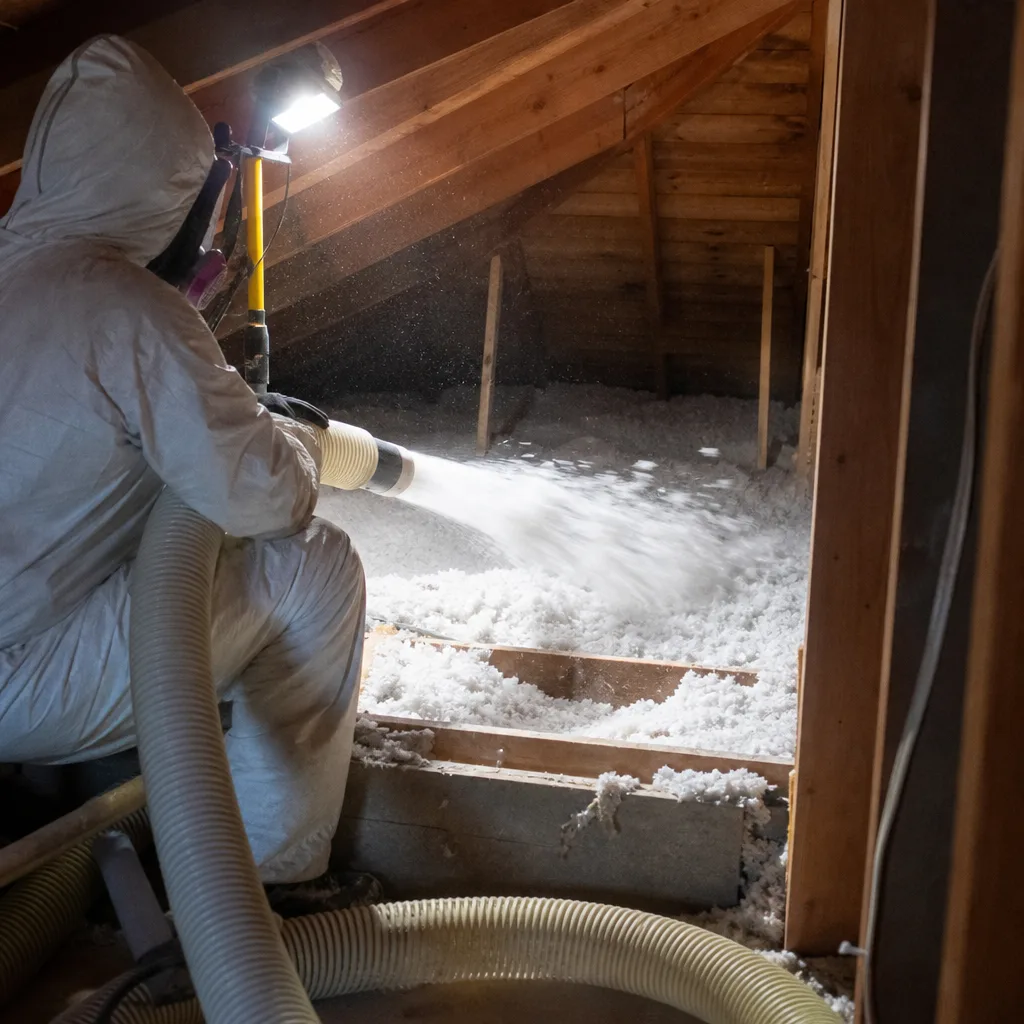
Blown-in fiberglass solves the coverage problem that makes batts underperform. A machine blows loose fiberglass across the attic floor, filling irregular gaps, corners, and hard-to-reach areas without cutting. The material can be applied to any depth, so hitting R-38 or R-49 is just a matter of how much you blow. Blown fiberglass is lighter than cellulose, which matters on ceiling drywall that’s already carrying weight. It resists moisture and doesn’t settle as much as it once did, though some settling is normal. In a North Tustin vented attic, blown-in fiberglass is a solid mid-range option.
Blown-In Cellulose (GreenFiber)
Cellulose is made from recycled paper treated with fire retardants. It’s denser than fiberglass, which gives it better performance against air movement and better thermal performance in a hot attic, where the temperature difference between the attic air and the living space is extreme. GreenFiber cellulose is a strong choice in North Tustin for two reasons. First, it’s an eco-friendly option for homeowners who don’t want to compromise on performance while cutting recycled material into their build. Second, its density makes it unusually good at stopping the kind of conductive heat transfer that hot-air-driven attics create. In an unvented attic without a radiant barrier, cellulose at R-38 tends to outperform equally rated fiberglass because it slows air and heat movement through the material itself.
Spray Foam (Demilec, Icynene)
Spray foam is a different animal entirely. Applied to the underside of the roof deck rather than the attic floor, spray foam turns the attic into a conditioned space. Open-cell foam (like Icynene) is lighter, less expensive, and air-seals while it insulates. Closed-cell foam (available in the Demilec lineup) is denser, adds structural strength, and creates a moisture barrier. In North Tustin, spray foam makes the most sense when your HVAC equipment or ductwork already lives in the attic. Cooling ducts running through 130-degree attic air loses a meaningful percentage of conditioned air before it reaches a register. Moving the thermal boundary to the roof deck with Demilec closed-cell or Icynene open-cell foam brings that ductwork inside the conditioned envelope. That can cut cooling costs dramatically, even before accounting for the air-sealing benefits of foam.
Here’s a quick material decision table for North Tustin attics:
- Vented attic, good existing insulation, no radiant barrier: Top off with blown-in cellulose (GreenFiber) or blown fiberglass to R-38+.
- Vented attic, uneven or missing insulation, dark roof: Full coverage with blown-in cellulose at R-38 to R-49, plus a radiant barrier under the rafters.
- Vented attic, clean open joist bays, tight budget: Owens Corning or Johns Manville fiberglass batts at R-38, with careful air sealing beforehand.
- Unvented attic, HVAC in attic, serious heat problems: Demilec closed-cell or Icynene open-cell spray foam at the roof deck, sized to achieve the code-required roof deck R-value for Zone 8 when combined with existing insulation.
The decision isn’t theoretical. We carry eight brands across all these categories precisely so the recommendation follows the home’s needs, not the brand we happen to stock. Blown In Insulation in East La Mirada follows the same principle: material matched to attic, not the other way around.
Air Sealing First: The Step Most Homeowners Skip
Air sealing is the least glamorous and most important attic upgrade you can make. Here’s the physics: your air conditioner cools the air inside your house. That cooled air wants to rise, because it’s denser than the hot air in your attic. Every hole, gap, crack, and penetration in your ceiling is a chimney for conditioned air to escape into the attic. The result is a house that leaks cold air all summer and pulls hot attic air in through every opening in the building envelope.
Insulation slows heat transfer, but insulation does not stop air movement. A fiberglass batt over a hole in the ceiling does almost nothing. Air flows right through the batt, carrying heat with it. Air sealing closes those holes first, so the insulation can do its job.
In North Tustin tract homes, the same penetration points show up again and again. We’ve seen them in hundreds of attics:
- Recessed lights: Older can lights are vented, meaning they allow attic air to flow directly into the room below. They need to be sealed or replaced with IC-rated, airtight fixtures before insulation goes in.
- Top plates: The horizontal framing where walls meet the attic is rarely sealed in older homes. Gaps run the entire perimeter of the house.
- HVAC boots and registers: Where ductwork passes through the ceiling, the gap around the boot is often an eighth of an inch or more, and there are typically a dozen or more of them.
- Plumbing vents and electrical penetrations: Every pipe and wire that passes into the attic creates a channel. Foam or caulk closes each one in minutes.
- Attic access hatches and pull-down stairs: A poorly sealed attic hatch can leak more than a window. Weatherstripping and an insulated cover solve most of the problem.
The order is non-negotiable: air seal first, then insulate. Doing it the other way means burying the problems you should have fixed, and the insulation can’t reach its rated performance. We see North Tustin homes where someone blew R-38 over unsealed can lights and the homeowners can’t figure out why the upstairs is still hot. The answer is always the same: the air leaks are still there, they’re just hidden.
How to Sequence an Attic Upgrade (and Why Order Matters)
The biggest mistake in attic work is treating insulation as a standalone purchase. It isn’t. An attic is a system, and each part affects the others. Getting the sequence right means every step builds on the last. Getting it wrong means paying for work twice.
Here’s the sequence we recommend for North Tustin homes:
- Inspect the attic thoroughly. Check for existing insulation depth, type, and condition. Look for water stains, rodent activity, mold, and wiring issues. If there’s a roof leak or moisture problem, it needs to be fixed before anything else happens. Insulation over an active leak hides the problem and ruins the new material.
- Air seal all penetrations. Recessed lights, top plates, plumbing vents, electrical boxes, HVAC boots, and the attic hatch. This is a half-day job for a professional and the highest ROI step in the entire project.
- Evaluate and address ductwork. If your ducts run through the attic, check for disconnected joints, crushed flex duct, missing mastic, and lack of duct insulation. Leaky ducts in a hot attic can waste 20-30 percent of your cooled air. Sealing and insulating ducts before you bury them in insulation is critical, because accessing them afterward is much harder.
- Choose the insulation system. Decide between a vented floor-insulation approach (blown-in cellulose, blown fiberglass, or batts) and an unvented roof-deck approach (spray foam). This decision should follow from the attic conditions, the age and condition of the roof, and where the HVAC lives.
- Add a radiant barrier if appropriate. In a vented attic with a dark roof, a radiant barrier under the rafters is one of the highest-impact upgrades you can make in North Tustin. It should be installed before or alongside the floor insulation, not after.
- Install the insulation to R-38 or higher. Whether blown or sprayed, the final layer goes in only after everything above it is done. The material should be applied evenly, to the right depth, with baffles in place at soffit vents so attic ventilation keeps working.
Rebate and incentive programs also care about this order. Many utility and state programs require proof of air sealing or duct sealing as a prerequisite for insulation rebates. Skipping steps doesn’t just hurt performance; it can cost you the rebate. For more on how spray foam fits into an attic upgrade, see Spray Foam Insulation in East La Mirada.
Vented vs. Unvented Attics in North Tustin
Traditional attics are vented. Soffit vents at the eaves let outside air in, and ridge or gable vents let hot air out. The goal is to keep attic air temperature close to outside air temperature and prevent moisture buildup. In California’s climate, vented attics work well as long as they’re adequately insulated and air-sealed at the floor level.
Unvented attics are a different architecture. The roof deck itself becomes the insulated surface, usually with spray foam. The attic becomes a conditioned space, like a room that happens to be above your ceiling. In North Tustin, unvented attics make sense when:
- HVAC equipment and ductwork live in the attic, and you’re losing cooled air to the hot attic environment.
- The attic is used for storage or has been partially finished.
- The roof is complex, with many hips, valleys, or cathedral ceilings that make floor insulation inconsistent.
- You want the air-sealing benefits of spray foam (which are substantial; foam is an air barrier at about one inch thick, while fiberglass and cellulose are not air barriers at any thickness).
Unvented attics are not automatically better. They require careful moisture management, especially at the roof deck. Closed-cell foam from the Demilec stable handles this role well because its low permeability blocks moisture from reaching the sheathing. Open-cell Icynene foam allows moisture to pass, which is fine in North Tustin’s dry climate but needs a properly maintained roof.
The vented-versus-unvented decision is one place where a one-material contractor will steer you wrong. A fiberglass-only contractor will always tell you to vent. A spray-foam-only contractor will always tell you to unvent. North Tustin’s answer genuinely depends on the house. We install both systems and recommend based on what’s in your attic right now.
For readers closer to the county line, the same material logic applies in Attic Insulation in East La Mirada: hot inland air, dark roofs, and older homes with sub-code insulation.
Common Mistakes to Avoid
- Adding insulation without air sealing first. This is the number one mistake in North Tustin attics. Unsealed penetrations let conditioned air escape regardless of how much insulation sits on the floor. The insulation gets blamed, but the leaks are the problem.
- Blocking soffit vents with insulation. Baffles must be installed at every soffit vent before blown insulation goes in. Blocking the soffits turns a vented attic into an accidentally unvented one, which traps heat and moisture.
- Assuming R-19 or R-30 is “good enough.” It isn’t. Code minimum in Climate Zone 8 is R-38, and many North Tustin homes are below that. Below code means you’re paying for the gap every month on your energy bill.
- Buying insulation by brand name without thinking about material type. Owens Corning, Johns Manville, and Knauf all make excellent fiberglass products. But fiberglass isn’t always the right category for a given attic. The brand matters less than the material system.
- Skipping duct work because it’s not “insulation.” Leaky ducts in a hot attic waste cooled air before it reaches a room. Insulating the attic floor while leaving ducts leaking is like fixing one hole in a bucket.
- Installing a radiant barrier on top of the floor insulation. Radiant barriers need an air gap to work. They belong under the rafters facing the roof deck, not lying flat on the attic floor where dust settles and the reflective surface stops working.
- Waiting until summer to schedule the work. Attic work in North Tustin is busiest from May through September. The crews are booked, and the attic itself is 130 degrees while the work happens. If you’re planning an attic upgrade, the mild months from October through April are a better window.
When to Call a Professional
Most attic insulation projects in North Tustin are not DIY jobs. Blown-in insulation requires specialized equipment and a second person feeding the hopper. Spray foam requires certified installers, proper PPE, and an understanding of building envelope physics. Even batt installation in an existing attic means working in 120-degree heat, navigating joists, and avoiding wiring and recessed lighting. Air sealing requires identifying every penetration point, including ones hidden behind old insulation.
Call a professional when you see uneven room temperatures, cooling bills that spike every summer, insulation that’s settled below the tops of the joists, or visible gaps around can lights and duct boots. See our more guides & resources for additional help. Also call if you’re buying or selling a North Tustin home and need a documented insulation level for disclosure. North Tustin Insulation offers free estimates in North Tustin. Call (877) 265-5712.
Frequently Asked Questions
California Climate Zone 8 requires R-38 for attic insulation. That’s the code minimum for new construction and the target for existing homes. Homes below R-38 are leaking cooling dollars every month.
Blown-in insulation for a typical North Tustin attic run runs roughly $2,000 to $5,000 depending on square footage, existing insulation depth, and whether air sealing is included. Spray foam runs higher, typically $5,000 to $12,000 for an unvented attic roof deck. Call (877) 265-5712 for a free, specific estimate.
Cellulose is denser and performs better against heat transfer from a hot attic; fiberglass is lighter and easier to remove if you ever need access. In most vented North Tustin attics, blown-in cellulose at R-38 or R-49 is a strong choice, especially with a radiant barrier above it.
Yes, but only when installed correctly under the rafters with an air gap and a clean reflective surface. A properly installed radiant barrier can lower attic air temperatures by 20 to 30 degrees in North Tustin’s summer heat, which reduces the load on your floor insulation.
Spray foam is worth it when HVAC equipment or ductwork lives in the attic, when the attic is used for storage, or when you’re converting the attic to conditioned space. It’s an expensive solution for a simple vented attic that could be air-sealed and blown to R-38 for much less.
Most blown-in insulation projects are completed in a single day, including air sealing. Spray foam projects typically run one to two days depending on the roof area and foam type. Call (877) 265-5712 to check current scheduling availability.
The Bottom Line
North Tustin’s attic insulation needs are driven by cooling, not heating. R-38 is the floor, not the target. Radiant heat from a sun-baked roof deck is the dominant problem, and it changes the material calculus. Air sealing comes first, always. Ductwork comes second. Material choice comes third, and it should follow your attic’s actual conditions rather than a contractor’s inventory list. The right system in the right order will cut your cooling bills, even out room temperatures, and make the second floor livable in August. If you’re in North Tustin and want an honest recommendation, call (877) 265-5712 for a free estimate.
Written by the team at North Tustin Insulation, serving North Tustin since 2011.
Request a Free Estimate in North Tustin
Tell us what you need — North Tustin Insulation responds fast. No obligation.