
Fast, Reliable Spray Foam Insulation Across Desert Edge
Spray foam insulation in Desert Edge typically runs $3.50 to $7.80 per square foot for open-cell and $5.10 to $9.40 for closed-cell, and our crews make the drive out to 92240 most weeks. The real variable here isn’t the product so much as the house: a 1970s single-story with uninsulated garage walls and brittle attic batting needs a different plan than a newer manufactured home with decent fiberglass that’s just underperforming. Allen Decker has built our spray foam team around one trade, carrying both Icynene and Demilec systems, because Desert Edge’s temperature swings expose weak installs fast. Call (877) 265-5712 and describe what you’re feeling in your home. We’ll tell you straight what’s needed and what isn’t.
Why North Tustin Insulation Is Desert Edge’s Preferred Spray Foam Insulation Company
Desert Edge sits high enough that insulation has to work in two directions every single day. Your attic bakes past 150°F in July, then the mercury drops near freezing on January nights. That’s not a normal environment for cheap fiberglass, and it’s why our crews don’t show up pushing one product. We carry eight brands across fiberglass, mineral wool, cellulose, and spray foam, but when the job is sealing a sun-baked west wall or a quonset-style workshop, Icynene and Demilec open-cell and closed-cell foams are usually the right move. Our reputation in Desert Edge comes from straight recommendations, not whatever’s loaded in the truck.
We regularly hear from homeowners here who’ve had two or three other quotes that didn’t mention air sealing at all. That’s the whole point of spray foam in this climate. Sealing the envelope matters as much as the R-value. Our technicians know to check the rim joists on manufactured homes and the garage wall cavities on detached workshops, because that’s where Desert Edge heat sneaks in before your AC even gets a chance. We’re an insulation-only operation, which means every estimate we write for Desert Edge is concentrated on moving air, heat gain, and heat loss. Nothing else. Our Spray Foam Insulation team carries certified expertise in open- and closed-cell applications, so you’re not getting a roofer who insulates on the side.
Call volume from Desert Edge tends to spike July through September, when the thermal envelope is visibly failing. We plan our routes to serve Desert Edge within the same week in most cases. If your attic feels like a sauna and your AC hasn’t shut off all afternoon, we’d rather come look before you spend money replacing equipment you may not need to replace.
Open Cell Spray Foam in Desert Edge
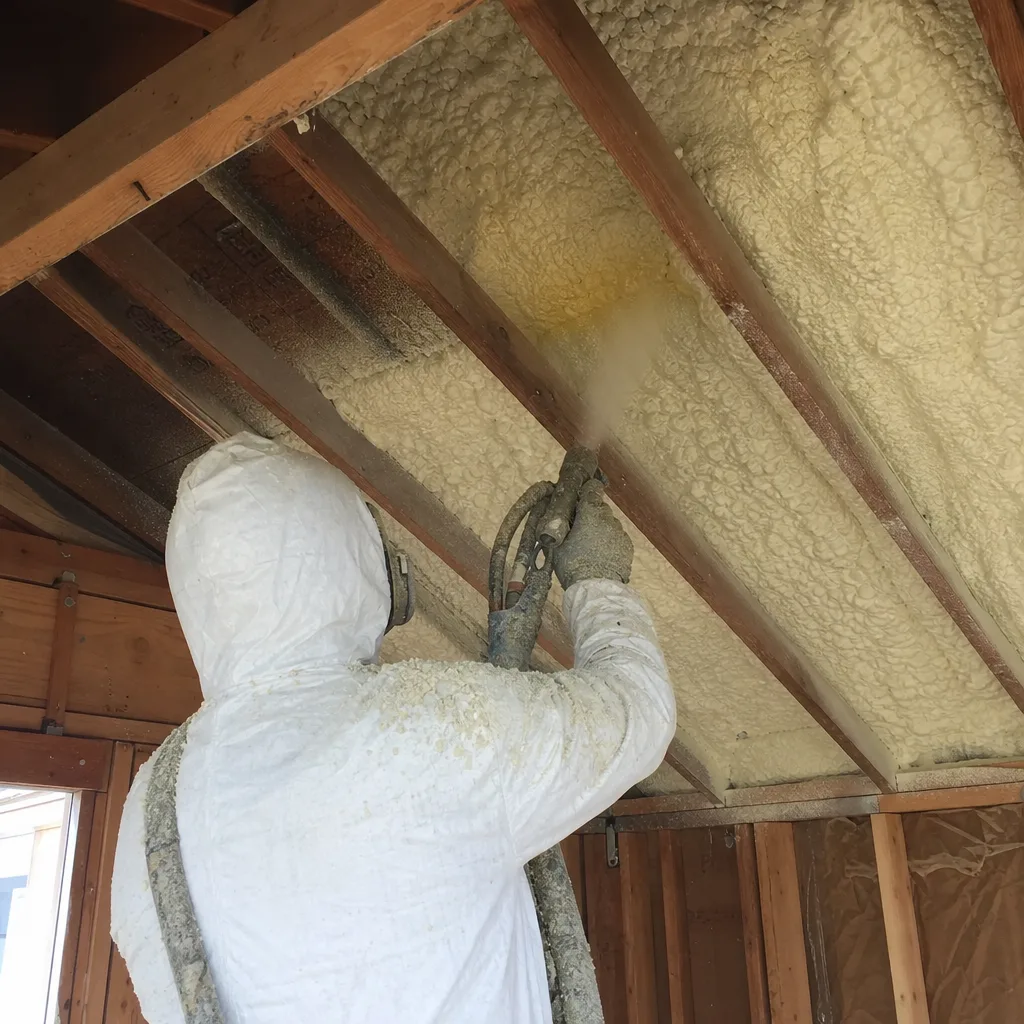
Open cell spray foam works as an air barrier and a sound damper, and in Desert Edge it earns its keep as the flexible layer that hangs on through the desert’s 40-degree daily temperature swings. The material cures into a semi-rigid, open-porous structure that expands over 100 times its liquid volume, filling crooked 2×4 cavities in older ranch-style walls and the irregular joist bays of 1970s manufactured homes. In Desert Edge, attic open cell applications on the underside of the roof deck are common because they keep the attic semi-conditioned and slow that brutal summer heat from radiating down through the ceiling. Typical open cell spray foam for a Desert Edge attic or exterior wall runs $3.50 to $7.80 per square foot installed, depending on depth and access.
Where Open Cell Shines in Desert Edge Homes
Homes here with detached workshops and outbuildings present odd geometries: sloped roof lines, exposed ceiling joists, and cavities that fiberglass batts never properly filled. Open cell foam expands into those spaces and creates a continuous air seal. We see it perform especially well on interior garage walls shared with living space, where the temperature difference between the garage slab and the house interior is severe in both summer and winter.
Rodent and Air-Seal Realities
Open cell foam does not stop rodents. No spray foam does. Homes on the open desert fringe of Desert Edge routinely deal with pack rats and mice, and they’ll chew through open cell if they have a reason to. The correct sequence is sealing with hardware cloth or rodent-proof backing where needed, then applying foam over the barrier. We’ve corrected installs in Desert Edge where crews simply sprayed foam into rim joist cavities and the rodents tunneled through within a season. The foam still air-seals, but the defense needs to happen first. That’s a local detail generic spray foam guides skip entirely.
Spray Foam Insulation Contractors in Desert Edge
Spray foam insulation contractors who actually know high-desert building science are harder to find than the lower valley’s crews, and Desert Edge homeowners tell us they’ve waited weeks to get someone out who even returned their call. As an insulation-only contractor, we keep our focus narrow. No roofing, no HVAC upselling. When you call North Tustin Insulation, the person who answers talks insulation, and the crew that arrives installs insulation. Spray foam work in Desert Edge typically runs $2,200 to $6,800 for a standard attic or rim joist project, with full attic encapsulation on larger homes reaching higher. Closed-cell roof deck applications, which we’ll cover shortly, run toward the upper end because of the material density and curing requirements in high heat.
Rim Joist and Garage Ceiling Work
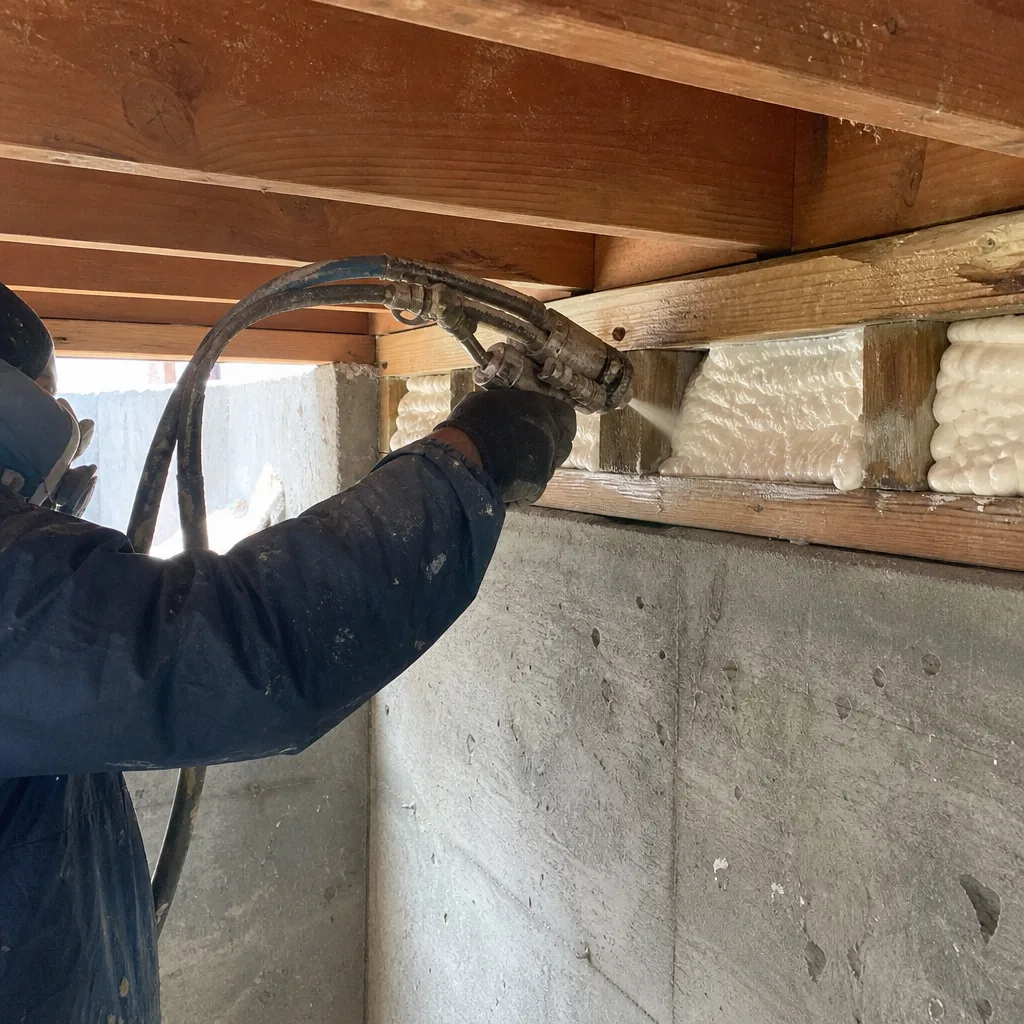
Rim joists in Desert Edge are the overlooked heat pathway, especially in manufactured housing and mid-century construction where the floor assembly sits exposed underneath. Closed-cell foam injected into rim joist cavities stops air movement and adds structural rigidity. Garage ceiling spray foam is another common request here when the homeowner spends time in the garage and wants to keep it under 90°F during a heat spell. Both are straightforward jobs that transform comfort, and both require a contractor who understands that Desert Edge’s daily thermal expansion stresses the bond line between foam and substrate.
The One-Trip Standard
Desert Edge is a drive. Whether you’re off Dillon Road or tucked back on a dirt road near the foothills, you don’t want a contractor showing up without the right materials. Our crews stage trucks before heading out so a single visit covers assessment, prep, application, and cleanup. Allen Decker runs the estimates personally for most Desert Edge jobs, and he won’t send a crew out until he knows what they’re walking into. That’s how you avoid three return trips and a mess. For rural properties with long service drives and heavy-duty garage doors, the one-trip standard is the difference between a clean install and a long-running headache.
Trusted Brands We Service in Desert Edge
We do not sell one brand. We carry Icynene and Demilec for spray foam, and both systems have open-cell and closed-cell formulations suited to Desert Edge’s heat and thermal cycling. Icynene’s open-cell foam handles large cathedral-style ceilings in ranch homes well, and Demilec’s closed-cell foam brings higher R-value per inch for tight spaces like rim joists and metal building panels. We also stock GreenFiber cellulose and Owens Corning fiberglass for hybrid jobs where spray foam targets the air seal and a less expensive material fills the bulk. Parts and warranty know-how for these brands are things we handle in-house, and for Desert Edge customers that means no chasing down a manufacturer’s rep just to get a straight answer.
Common Spray Foam Insulation Problems We See in Desert Edge Homes
- Foam delamination on west-facing roof slopes. Desert Edge’s intense afternoon sun bakes the roof deck, and if radiant barrier sheathing is present, the foam can separate from it after several summers of thermal cycling. We inspect for adhesion loss before recommending any attic encapsulation.
- Air gaps around heavy-duty garage doors on detached workshops. A warped roll-up door from years of high-desert sun creates gaps spray foam alone can’t close. The foam needs proper backing and a door adjustment in the same visit, or you’ve just foamed a leak.
- Rodent damage in rim joist and crawl space applications. The open desert fringe of Desert Edge has constant rodent pressure. Exposed spray foam gets tunneled through if the exclusion work isn’t done first, and we’ve seen this on properties near the washes and open scrub.
- Compacted, heat-degraded attic insulation under roof decks. Original blown fiberglass in 1960s and 1970s homes here often measures at half its labeled R-value after fifty years of 150°F attic temperatures. Spray foam applied over or in place of that layer changes the physics entirely.
Pricing for Spray Foam Insulation in Desert Edge, CA
Open-cell spray foam in Desert Edge runs $3.50 to $7.80 per square foot installed. Closed-cell runs $5.10 to $9.40 per square foot. A rim joist job on a manufactured home usually lands between $1,800 and $3,200. A full attic encapsulation on a 1,200-square-foot ranch house might run $4,500 to $7,000. Access matters: vaulted ceilings, tight attic clearances, and detached structures with long hose pulls all add labor. Material depth required for code or comfort targets also moves the number. Estimates are free, and we give you the square-foot breakdown before any work begins. Call (877) 265-5712 for an exact quote on your Desert Edge home.
We Also Serve Cities Near Desert Edge
Our crews work up and down the high desert and into the valley. We regularly serve Desert Edge households plus Garnet, Desert Hot Springs, Morongo Valley, and Palm Springs. Same material standards, same one-trip approach, same straight answers. If you’re on the edge of two service areas, call us and we’ll tell you the truth about scheduling.
Serving Desert Edge, CA — Our Local Coverage Area
We’re based in the Desert Edge area and know this community well. Use the map below to see our service coverage — if you’re nearby, we can almost certainly help.
FAQs About Spray Foam Insulation in Desert Edge
A 40-degree-plus daily swing means foam expands during the afternoon and contracts at night, every single day. Over several years, that thermal cycling stresses the bond between foam and the substrate. In Desert Edge, open-cell foam fares better on wood substrates than closed-cell because it flexes with the structure. Closed-cell foam is stiffer and can pull away from metal or radiant barrier sheathing under repeated stress. We choose the chemistry based on what your roof deck, wall cavity, and exposure actually demand. Call (877) 265-5712 and we’ll walk you through the difference for your specific home.
Spray foam seals the wall cavities and the gap around the door frame, but it cannot seal the moving seam of a heavy-duty roll-up door that has warped from heat. The door itself needs to be adjusted, or the foam will simply sit next to a gap. We run both in the same visit on Desert Edge properties, because a workshop with a sealed wall and a leaky door still loses your cool air by noon. We see this on detached structures throughout the 92240 area.
West-facing roof slopes in Desert Edge take direct UV and solar gain every afternoon, and when insulation is applied to the underside of the roof deck, the deck material itself heats dramatically. Radiant barrier sheathing compounds the problem because its surface isn’t a stable bond for foam. After just a few summers, adhesion loss is common. We test existing foam on west-facing slopes before adding anything, and if the substrate is compromised, we say so instead of spraying another layer on top. Call us for an honest assessment.
No spray foam, open-cell or closed-cell, stops rodents by itself. Pack rats and mice on Desert Edge’s desert fringe will chew through cured foam if they want to. The effective order is exclusion first: hardware cloth, steel wool, and sealing obvious entry points, then foam over the top for air sealing. We’ve seen too many Desert Edge attics where well-meaning installs got tunneled through within a season. The fix is knowing the right sequence, and it’s part of our standard approach here.
Manufactured homes in Desert Edge respond extremely well to spray foam at the rim joist and belly board, because those assemblies are notorious for air movement. The floor deck sits above open air, and the belly board often leaks around utility penetrations. Closed-cell foam applied to the rim joist area stops that stack effect and cuts dust intrusion too, which matters on dirt-road properties. Open-cell foam in the exterior walls of older manufactured homes is also a strong upgrade when the existing batt insulation has slumped or compressed. For an exact quote on your manufactured home, call (877) 265-5712.
Written by Allen Decker, Owner at North Tustin Insulation, serving Desert Edge and the surrounding high desert with insulation-specific expertise.