Last updated October 31, 2026
Choosing the Right Insulation Brand: A Buyer’s Guide for North Tustin
Owens Corning and Johns Manville both sell fiberglass batts. They do not perform identically, and the difference is not marketing. Binder chemistry, fiber length, density, and facing type shift how a batt holds its R-value over a decade of Southern California heat cycling, and whether it contributes to indoor air quality problems or stays inert. Most North Tustin homeowners never compare these details. They accept whatever brand the contractor stocks. This guide exists so you don’t have to. We’ll walk through what actually distinguishes the major brands across fiberglass, mineral wool, cellulose, and spray foam, and give you the criteria to evaluate a product spec sheet instead of just a logo. North Tustin homes face specific thermal conditions: hot attic summers, cool damp winters, and a housing stock heavy on 1960s and 1970s construction where original insulation is either thin or settled. Brand choice matters more here than a spec-sheet glance suggests.
Quick Answer
The right insulation brand for your North Tustin home depends on the cavity, the climate exposure, and your indoor air quality priorities; see our Complete Attic Insulation Guide for North Tustin Homeowners for deeper cavity-by-cavity analysis. For most attics, Owens Corning or Johns Manville fiberglass batts offer the best balance of cost and install simplicity. For fire-prone hillside zones or sound control between rooms, Rockwool mineral wool is worth the premium. For irregular cavities and air-sealing, Icynene or Demilec spray foam outperform batts by a wide margin. GreenFiber cellulose is the strongest value in the blown-in category, especially for retrofit attics in older North Tustin homes.
Table of Contents
- Fiberglass Brand Comparison: Owens Corning vs. Johns Manville vs. CertainTeed
- Mineral Wool: Why Rockwool Stands Alone (and Where It’s Worth the Cost)
- Cellulose: GreenFiber and What the Bag Label Won’t Tell You
- Spray Foam: Icynene vs. Demilec and Why Brand Matters More Here
- Warranty Transferability: Which Brands Follow the Home
- CARB Compliance and Low-VOC Certifications by Brand
- How to Verify Your Contractor Installed the Brand They Quoted
- Common Mistakes to Avoid
- When to Call a Professional
- Frequently Asked Questions
Fiberglass Brand Comparison: Owens Corning vs. Johns Manville vs. CertainTeed
Fiberglass batt insulation is the default for most North Tustin attics and walls, and three manufacturers dominate the residential market here. They do not make the same product. Owens Corning’s EcoTouch line uses a formaldehyde-free binder and a fiber geometry designed to reduce airborne particulates during install. Johns Manville’s Formaldehyde-Free Kraft line competes directly on the same claim, but the batt density and friction-fit characteristics differ: JM batts are slightly stiffer, which matters if you’re fitting irregular joist bays in an older North Tustin home where spacing is not consistent. CertainTeed’s InsulSafe batt line targets the same code-minimum R-19 to R-38 range but uses a softer binder that some contractors prefer for attic kneewalls because it compresses less when stuffed around framing.
What should a homeowner actually weigh between these three? R-value per dollar is nearly identical. The differentiators are practical: how clean the install is, how long the batt holds its shape, and what documentation comes with the bag. Owens Corning and CertainTeed both provide clearly labeled batch numbers that are easy to photograph. Johns Manville’s packaging is more compact, which matters if you have a tight attic access hatch.
In North Tustin specifically, our recommendation leans on attic geometry and sun exposure. Homes in the older tracts near Cowan Heights and Lemon Heights often have shallow rafter bays where a stiffer batt like Johns Manville resists slumping better. Homes in the flatter sections of North Tustin with deep attics and standard 16-inch framing do fine with any of the three. The decision should follow the home, not the brand preference of the crew.
Mineral Wool: Why Rockwool Stands Alone (and Where It’s Worth the Cost)
Rockwool is the mineral wool brand most North Tustin homeowners encounter, and it occupies a category almost by itself. The product is made from spun basalt rock and recycled slag, with no organic binders. That translates to three concrete performance differences versus fiberglass: it is non-combustible, it is hydrophobic, and it has substantially higher density, which means better sound attenuation. Rockwool batts hold their shape without stapling and friction-fit tightly enough that installers do not need wire supports in most attic applications.
The cost difference is real. Rockwool batts run 30 to 50 percent more than comparable fiberglass per square foot. Whether that premium is justified depends on where you live in North Tustin. Hillside homes in the wildland-urban interface zone, where fire hardening is a documented concern, benefit from the non-combustible rating in a way flatland homes do not. Homes along major roads like Newport Avenue or Foothill Boulevard get a measurable noise reduction from Rockwool in exterior walls. A 1960s ranch with single-pane windows and a standard attic is fine with fiberglass.
CertainTeed also offers a mineral wool product in some markets, but availability in Orange County has historically been inconsistent. Rockwool is the dependable specification in North Tustin, and it is what we stock when a homeowner specifically asks for mineral wool.
Cellulose: GreenFiber and What the Bag Label Won’t Tell You
GreenFiber is the cellulose brand most often specified in North Tustin for blown-in attic retrofits. The product is 85 percent recycled paper fiber treated with borate-based fire retardant and pest deterrent. The label tells you that. What the label does not tell you is that blown-in cellulose settles. The settled density calculation matters more than the installed depth, and installers who do not account for this leave attics under-insulated within a few years.
GreenFiber’s product is consistent bag to bag, which matters in blown-in applications because density drives both R-value and air-infiltration resistance. A cellulose blanket at 3.5 pounds per cubic foot is a different performance product than one at 2.8 pounds per cubic foot, even if both measure 12 inches deep. Brand consistency is the reason we specify GreenFiber rather than generic cellulose. The batch-to-batch fiber size and borate concentration do not drift.
For North Tustin attics with odd framing, low slope, or existing wiring and duct runs that make batt installation awkward, GreenFiber blown-in is often the right call. It also performs well in the city’s older homes where the attic floor is irregular and a continuous air-permeable blanket outperforms gapped batts. The recycled content is a real sustainability feature, not marketing, and we mention that because some North Tustin homeowners ask.
Spray Foam: Icynene vs. Demilec and Why Brand Matters More Here
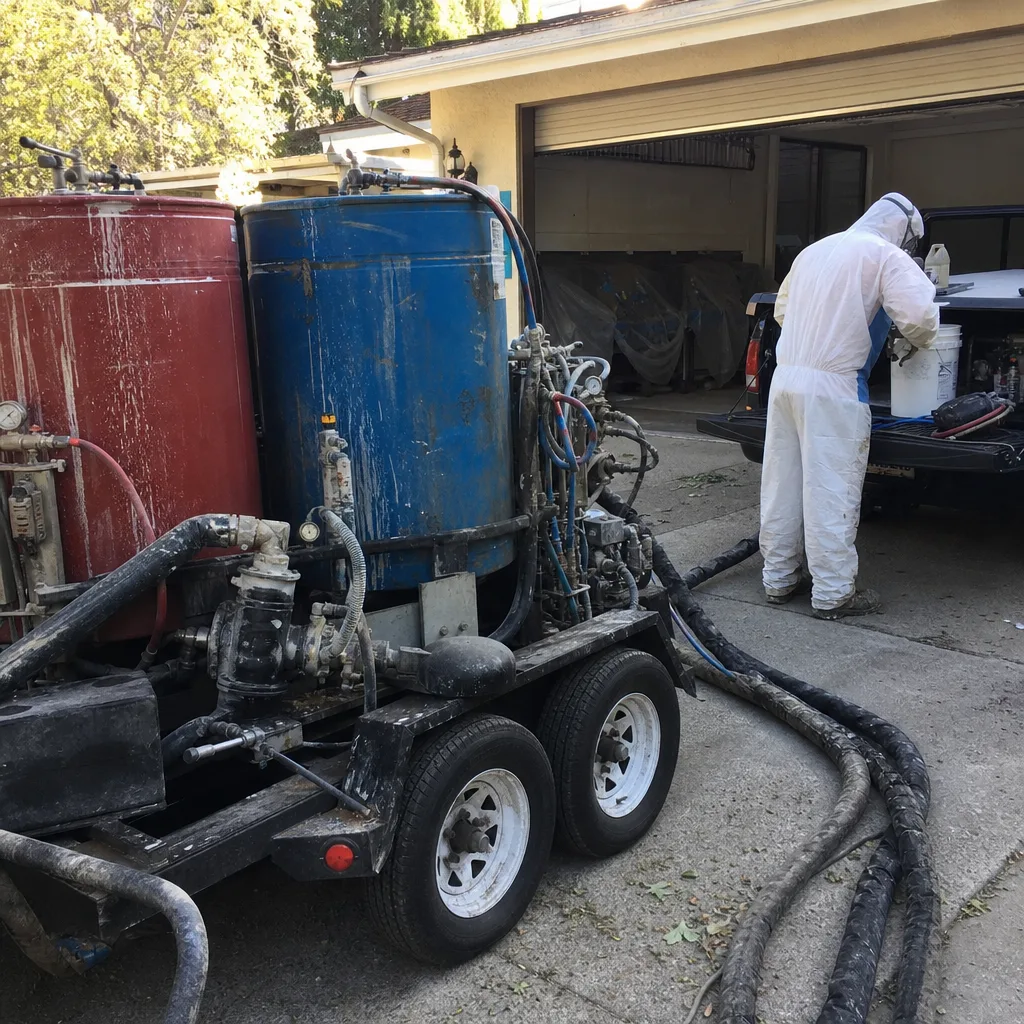
Spray foam is where brand choice carries the most weight, because the product is manufactured on-site. A fiberglass batt leaves the factory and arrives at your home as a finished product. Spray foam is two liquids that get mixed in a heated hose at the moment of installation. The cured foam’s R-value, density, and off-gassing duration depend on the chemical formulation and the mix ratio. That is why brand matters more for spray foam than for any other insulation category.
Icynene and Demilec are both premium two-component spray foam systems, but they target different applications. Icynene’s open-cell product (Classic Max) is a low-density, water-blown foam that expands aggressively and fills irregular cavities. It is air-impermeable at typical attic depths and does a strong job of sealing the thermal boundary in North Tustin attics with complicated geometry. Demilec’s product line includes both open-cell and closed-cell formulations, with the closed-cell foam (Heatlok HFO) using a hydrofluoroolefin blowing agent that has a significantly lower global warming potential than older HFC-blown foams. That HFO blowing agent distinction is not marketing. It affects both the environmental impact and the long-term R-value stability of the cured foam.
Why warn against off-brand foam? Generic two-component kits sold at big-box stores have inconsistent mix ratios across the spray window, especially as the canisters cool. The result is foam that cures at lower density, delivers less effective R-value than the label implies, and can off-gas for weeks. We have seen North Tustin homeowners buy these kits for small attic repairs and end up calling us to remove and redo the work. Icynene and Demilec both require certified installers and calibrated equipment, and that certification exists for a reason. For any spray foam job in a North Tustin home, the brand spec and the installer certification are the same decision.
Warranty Transferability: Which Brands Follow the Home
Insulation warranties are less straightforward than they appear. The question homeowners should ask is not whether a warranty exists, but whether it transfers to a new owner and what documentation is required to make a claim. In North Tustin, where homes change hands regularly and resale value matters, warranty transferability is a real consideration.
- Owens Corning offers a limited lifetime warranty on EcoTouch batts that transfers to a subsequent homeowner, but the transfer requires documentation of the original purchase and installation date. The new owner inherits the coverage, not the headache of filing, only if the paperwork survives the sale.
- Johns Manville structures its warranty differently. The base product warranty is prorated over time, and transferability depends on the specific product line. Formaldehyde-Free Kraft batts typically allow one transfer, but the documentation requirements are stricter than Owens Corning’s.
- Rockwool offers a limited warranty on its residential batts that follows the home, though the coverage is more focused on manufacturing defects than on thermal performance over time.
- GreenFiber cellulose carries a limited warranty, but settlement is typically addressed through the installer’s coverage rather than the manufacturer. That makes installer selection the more important decision for blown-in applications.
- Icynene and Demilec spray foam warranties are tied to the certified installer network. The foam manufacturer warranty often requires that the installing contractor remains in business and available for inspection in a claim scenario. This is one reason we recommend documenting the installation thoroughly.
The practical takeaway: request warranty paperwork at install, photograph it, and store it with your home records. For North Tustin homeowners selling within 5 to 10 years, Owens Corning’s transferable limited lifetime warranty is the easiest to pass along cleanly.
CARB Compliance and Low-VOC Certifications by Brand
California’s Air Resources Board (CARB) enforces formaldehyde emission standards for composite wood products and also regulates the VOC content of many building materials, including some insulation products. For North Tustin homeowners who prioritize indoor air quality, this is a useful filter before comparing brands.
Owens Corning EcoTouch batts are manufactured with a plant-based binder that is certified formaldehyde-free. The specific certification is Greenguard Gold, which tests for VOC emissions in interior environments. Johns Manville’s Formaldehyde-Free line carries the same Greenguard Gold certification and is manufactured with a bio-based binder. CertainTeed’s InsulSafe batts also carry formaldehyde-free verification but the certification body varies by product line.
Rockwool mineral wool is inherently free of organic binders and VOCs, which is a structural property of the product rather than a chemical formulation choice. For North Tustin homeowners with asthma, chemical sensitivity, or infants in the home, Rockwool is the most conservative indoor air quality choice among batt products.
Spray foam is where VOC attention matters most. Open-cell Icynene and Demilec foams cure within 24 hours and off-gas minimally after that window, but the first day after installation requires ventilation. Closed-cell Demilec Heatlok HFO uses the HFO blowing agent, which is a lower-GWP alternative, and carries documentation that meets California’s evolving refrigerant and blowing agent regulations. If you are specifying spray foam in a North Tustin attic that connects to living space, ask the installer for the product’s CARB and GREENGUARD documentation before work begins.
How to Verify Your Contractor Installed the Brand They Quoted
Every insulation contractor can name-drop Owens Corning or Rockwool. Not every contractor installs it. In North Tustin, where we regularly see homes with mismatched or substituted insulation, verification is simple and takes five minutes. Here is the exact sequence.
- Ask for the brand and product line in writing on the estimate. The estimate should say “Owens Corning EcoTouch R-38 fiberglass batts” or “Demilec Heatlok HFO closed-cell spray foam.” A generic line like “R-38 insulation” tells you nothing.
- Photograph the bags before installation. Every batt and blown-in product arrives in branded packaging with lot numbers. Shoot the label. That label is your proof of what went into your attic.
- For spray foam, ask to see the A-side and B-side drums before application. Icynene and Demilec ship chemicals in branded containers. A reputable installer will have them on site, labeled, with batch numbers visible. If the drums are unmarked or generic, that is a red flag.
- Count the bags after the job. A standard North Tustin attic retrofit uses a predictable number of bags per square foot. If the installer’s crew used significantly fewer bags than the math suggests, ask why before you pay.
- Keep the documentation. Lot numbers, product labels, and installer name all matter if you ever file a warranty claim or sell the home.
This level of verification is not paranoia. It’s the same diligence you would apply to any other material purchase for your home. Insulation is invisible once installed, which makes brand substitution the cheapest corner to cut. North Tustin homeowners who document the install never have to wonder.
If you’re comparing attic insulation options across the broader region, we’ve written a guide for Attic Insulation in East La Mirada that covers the same brand-level thinking applied to that market’s older housing stock.
Common Mistakes to Avoid
- Choosing the brand based on the contractor’s default. Many North Tustin homeowners get whatever brand the crew stocks that week. That is not a selection process. Ask for a brand specification and an alternative.
- Assuming all spray foam is the same. Open-cell and closed-cell are entirely different products with different R-values per inch, moisture behavior, and cost. A contractor who cannot explain the difference should not be doing the work.
- Ignoring settled density on blown-in cellulose. GreenFiber at the right density is a high-performance product. Blown at half the specified density, it is a disappointment in two years. Ask the contractor to state the installed density target.
- Overlooking warranty documentation. The warranty is not active just because you bought the product. You need the lot numbers, the installer name, and the installation date. No paperwork, no claim.
- Skimping on air sealing before insulating. In North Tustin attics, air leaks through top plates and can lights undermine the best insulation brand. The material cannot fix a hole. Air seal first, then insulate.
- Opting for the lowest quote without comparing product specs. A cheap fiberglass batt from a no-name manufacturer will hit the same R-value on paper. It will also shed more fibers, sag faster, and carry no meaningful warranty. Price is not the product.
- Not verifying the installed brand. If you do not photograph the bags or check the spray foam drums, you are trusting a verbal claim. Trust but verify.
When to Call a Professional
Some insulation decisions can be made from a spec sheet. Others cannot. If your North Tustin attic has existing moisture issues, rodent damage, or suspect electrical wiring, insulating over the top of those problems makes them worse and harder to reach. If you are considering spray foam, a professional assessment of the attic’s ventilation and the soffit-to-ridge airflow is essential before any foam touches the roof deck. If your home is in a North Tustin hillside wildfire zone, mineral wool and intumescent details require a specialist who understands the code requirements. And if you are simply not sure whether fiberglass, cellulose, or spray foam is the right material for your home’s construction, that is a conversation worth having with someone who works in North Tustin attics every day. North Tustin Insulation offers free estimates in North Tustin and can walk you through the brand options for your specific home. Call (877) 265-5712 to schedule one.
For a broader look at the insulation methods available in this region, our guides to Spray Foam Insulation in East La Mirada and Blown In Insulation in East La Mirada break down each installation method in practical detail.
Frequently Asked Questions
For most North Tustin attics, Owens Corning EcoTouch fiberglass batts offer the best balance of performance, cost, and warranty transferability. Homes in wildfire-prone hillside zones are better served by Rockwool mineral wool, and homes with irregular attic geometry may benefit more from blown-in GreenFiber cellulose or Icynene open-cell spray foam.
In North Tustin, Rockwool is worth the 30 to 50 percent cost premium if you live in a hillside fire zone or need meaningful sound control from road noise. It is non-combustible, water-resistant, and dimensionally stable. For standard attics and interior walls in the flatter parts of North Tustin, fiberglass is typically sufficient.
Yes, more than any other insulation category. Spray foam is mixed on-site, and the cured R-value and off-gassing duration depend on the chemical formulation. Icynene and Demilec are manufactured to tight tolerances and installed only by certified crews. Generic two-component kits produce inconsistent density and can off-gas for weeks.
Insulation costs in North Tustin vary by material and home size. Fiberglass batt attic retrofits typically fall in the $1,500 to $3,500 range for a standard 1,500 square foot home. Blown-in cellulose is comparable. Spray foam costs more, usually $3,000 to $7,000 for an attic, but delivers better air sealing. Call (877) 265-5712 for a free written estimate based on your specific attic.
Fiberglass batt installation is physically demanding but possible for a homeowner with the right PPE, a partner, and careful attention to air sealing. Spray foam is not a DIY job; the mixing equipment is specialized and the chemical handling requires certification. Blown-in cellulose is technically DIY-able with a rental machine, but achieving proper density without experience is difficult. For most North Tustin homeowners, professional installation pays for itself in performance.
Insulation brand rarely moves a home’s asking price directly, but a documented installation with a transferable warranty from a recognized brand like Owens Corning or Rockwool makes a home easier to sell. Buyers in North Tustin ask about attic condition and energy performance, and having the paperwork matters more than the logo in the attic.
Current California building code requires R-38 in most attic applications for new construction, and remodels must meet similar standards. Many North Tustin homes built in the 1960s and 1970s have R-11 to R-19 at best. Upgrading to R-38 or higher is one of the highest-return energy improvements available in this climate.
The Bottom Line
Insulation brand choice is a performance decision, not a preference. In North Tustin, the right brand depends on your attic’s geometry, your home’s location, your indoor air quality priorities, and whether you plan to sell within a decade. Owens Corning and Johns Manville deliver solid fiberglass value. Rockwool earns its premium in fire zones and noisy locations. GreenFiber is a strong blown-in option for older attics. Icynene and Demilec lead the spray foam category in a way generic products do not. Document the install, verify the brand, and choose the material that fits the home. If you want a second opinion on your North Tustin attic, call us. We’ll tell you what we’d install in our own house, and why. The North Tustin Insulation home page has more service details and project examples.
Written by the team at North Tustin Insulation, serving North Tustin since 2011. Explore more guides & resources.